Quick Answer
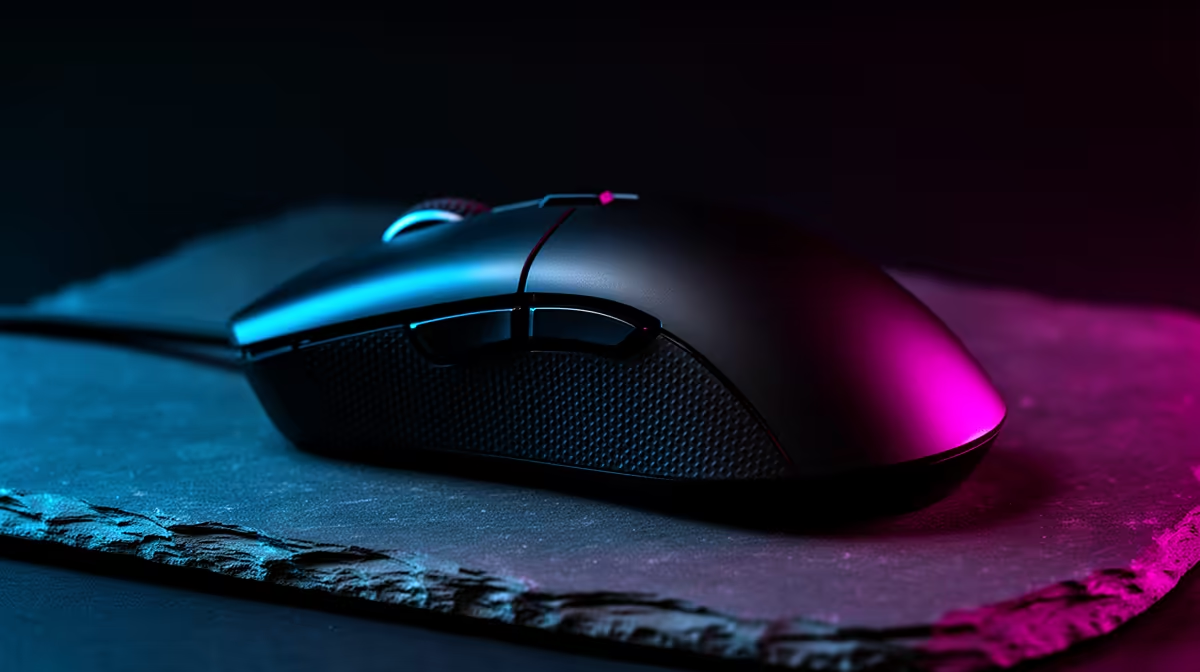
8,000 Hz polling reduces the time between mouse position reports from 1 ms (at 1,000 Hz) to 0.125 ms, meaning the game engine receives 8 times more cursor data per second. On 240 Hz monitors and above, this translates to measurably smoother cursor trajectories during fast sweeps, reduced input blur, and more accurate registration of micro-corrections during slow tracking.
The Physics of High-Rate Polling 📊
At 1,000 Hz, your mouse reports its position once per millisecond. During a fast flick covering 30 cm of mousepad in 80 ms, the game engine receives 80 data points to reconstruct your movement path. At 8,000 Hz that same flick generates 640 data points. The difference is not that the cursor moves differently; it is that the game engine has a far more precise record of exactly where your cursor was at every moment during the flick. This finer path resolution reduces interpolation between mouse samples and produces smoother cursor arcs on high-refresh panels.
At 60 Hz, one frame covers 16.7 ms and even 1,000 Hz provides 16 position samples per frame, which is ample resolution. The 8,000 Hz advantage is specifically for 240 Hz and above, where each frame covers only 4.17 ms, giving 1,000 Hz only 4 samples per frame versus 33 at 8,000 Hz.
Battery Life Trade-Off at 8,000 Hz Wireless 🔋
The cost of 8,000 Hz polling in a wireless mouse is power consumption. The RF chip must transmit 8 times more data per second, and the onboard processor handles 8 times more sensor reads. In practice, wireless mice report battery life reductions of 50 to 70 percent compared to their 1,000 Hz rated figure. A mouse rated at 95 hours at 1,000 Hz may deliver around 30 to 40 hours at 8,000 Hz.
For South African gamers averaging 4 to 6 hours of gaming per day, this still represents 5 to 10 days between charges, which is practical for most use cases. Many players run 4,000 Hz for casual sessions and 8,000 Hz only for ranked play, extending battery life without permanently sacrificing the option.
Real-World Benefit for SA Gamers 🎮
For South African players gaming on 144 Hz monitors (the most common tier locally), the jump from 1,000 Hz to 8,000 Hz produces minimal perceptible benefit. At 144 Hz, each frame is 6.94 ms and 1,000 Hz already provides nearly 7 samples per frame. The 8,000 Hz tier is most relevant for players who have invested in 240 Hz or 360 Hz displays, locally priced from around R3,500 for 240 Hz 1080p to R9,000 for 360 Hz 1440p panels. In that category, the R800 to R1,500 premium for an 8,000 Hz wireless mouse over a 1,000 Hz alternative is a justifiable performance investment.
4,000 Hz Is the Practical Sweet Spot ⚡
If your wireless mouse supports multiple polling rates, 4,000 Hz offers most of the 8,000 Hz benefit at 240 Hz while extending battery life significantly. Reserve 8,000 Hz for tournaments or ranked sessions where every marginal advantage counts.
FAQ
Does 8,000 Hz wireless polling require special drivers?
Yes. The companion software must be installed and the polling rate set manually in device settings. The mouse defaults to 1,000 Hz out of the box for compatibility reasons. Without the software, the mouse runs at its default rate regardless of hardware capability.
Can my PC's USB controller handle 8,000 Hz without issues?
Most modern USB 3.2 controllers handle 8,000 Hz without errors. Connect the dongle directly to a rear USB port on the motherboard rather than a front panel header or USB hub for best results.
Will I notice 8,000 Hz if I play at 400 DPI low sensitivity?
Yes, indirectly. At 400 DPI and low sensitivity, fast sweeps involve large physical movements at high hand speeds. At these velocities the 8,000 Hz advantage in capturing path resolution is most pronounced, because the cursor travels faster and the space between 1,000 Hz samples covers more pixels.
Experience 8,000 Hz wireless gaming. Evetech stocks the latest high-polling wireless mice for South African gamers. Browse the range at Evetech to find a wireless mouse that keeps up with your fastest reflexes.