


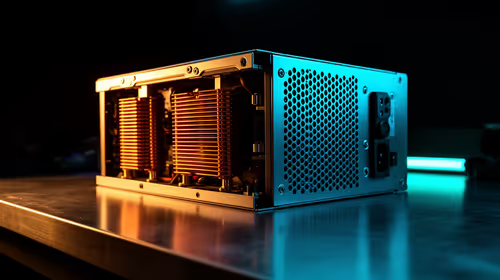
1000W PSU Planning for RTX 5090 Builds in SA
1000W for RTX 5090 needs a full-build check, not a simple yes. Review GPU guidance, CPU draw, transient load, connectors, PSU quality, and upgrade plans before deciding.
Read moreGPU memory needs vary by application, project format and file complexity, so no capacity suits everyone. The RTX A1000 provides an 8GB GDDR6 reference at R12,099, adding 2304 CUDA cores on Ampere and a 128-bit memory interface.

Creative software does not come with one universal memory answer. A simple edit and a dense 3D scene may carry the same project label while requiring very different working sets. The right GPU memory for professional creative software is the capacity that holds regular files with practical headroom and supports the chosen application.
The RTX A1000 provides 8GB GDDR6 with 192GB/sec bandwidth, a practical professional capacity point for CAD, 3D and content projects that fit inside it.
Estimate VRAM from current software guidance, a typical file and the largest credible creative project. RTX A1000 provides an 8GB GDDR6 capacity point for R12,099. Its compute figure is 2304 CUDA cores within Ampere, while the memory connection is 128-bit. Extra capacity is useful only when projects need it.
For 3D work, consider geometry, textures and render assets loaded together. Editors should account for resolution, codecs, effects and frames required by the accelerated stage. CAD users need to test assemblies and visual detail that reflect actual production.
Avoid setting the target from an empty document or an extreme file that will never recur. Use a typical project and a difficult but legitimate project. The gap between them helps define headroom without turning every hypothetical future task into a purchase requirement.
Use the application's diagnostics and operating-system tools while repeating a known action. Pair memory readings with real symptoms such as warnings, failed operations or reduced responsiveness. Allocation behaviour varies, so a number on its own needs interpretation.
If a normal file completes comfortably, 8GB may be reasonable for that workflow. If required projects consistently approach a practical limit, compare higher-capacity cards through Evetech's professional graphics department.
VRAM capacity is not CUDA core count. The A1000 pairs 8GB GDDR6 with 2304 CUDA cores, and its memory runs through a 128-bit interface. Ampere identifies the architecture tying the configuration together.
At R12,099, the PNY A1000 model can be evaluated as one complete option. A render or effect may be compute-limited even when memory remains available, while a large asset set may encounter capacity pressure before compute becomes decisive.
AI-assisted functions can introduce new model and memory requirements. Check where each feature executes and whether the selected GPU is supported. An AI PC comparison is useful when the change affects several components rather than graphics memory alone.
Document the files and settings used to set the capacity target. When software or project scope changes, repeat the same method. That makes future upgrades respond to evidence instead of a remembered rule about how many gigabytes creative work "should" need.
A workstation may keep a 3D application, editor and browser-based review open together. Test the realistic combination if that is normal practice, because concurrent GPU use can change the available headroom compared with a single isolated program.
Then repeat the critical project with unnecessary applications closed. The difference shows whether workflow habits or the core project create the capacity pressure. If concurrency is essential to delivery, include it in the memory target instead of dismissing it as user behaviour.
Document which programs were active so another workstation can reproduce the same demand later.
Include peak project periods in the capacity plan. A workstation that handles ordinary files may face larger campaigns, semester projects or client revisions at predictable times. Choose one real example from that busy period and add it to the test pack.
Archive the file with permission and note which assets can be substituted if confidentiality prevents reuse. The objective is a realistic memory challenge, not exposure of client material.
That memory serves an Ampere processor with 2,304 CUDA, 18 RT and 72 Tensor cores. When a creative application supports those resources, performance can depend on both keeping the active project resident and feeding the relevant processing path. A larger capacity is useful only when the real files require it; the A1000 already defines its own balance of memory, bandwidth, compute and 50W efficiency.
No. Application design, project complexity, file formats, effects and concurrent tasks can produce very different graphics-memory requirements.
It states the card's VRAM capacity and memory type. The 128-bit figure describes the interface, not extra storage space.
Test typical and difficult real files, observe memory behaviour during the slow operation and retain enough headroom for expected growth.
No. Compute, CPU, system RAM, storage or application behaviour may be limiting the task even when more graphics memory is available.
Ready to set a memory target from projects instead of guesswork? Review Evetech's workstation cards after testing the creative files that define your normal capacity and future headroom.
No. Application design, project complexity, file formats, effects and concurrent tasks can produce very different graphics-memory requirements.
It states the card's VRAM capacity and memory type. The 128-bit figure describes the interface, not extra storage space.
Test typical and difficult real files, observe memory behaviour during the slow operation and retain enough headroom for expected growth.
No. Compute, CPU, system RAM, storage or application behaviour may be limiting the task even when more graphics memory is available.
1000W for RTX 5090 needs a full-build check, not a simple yes. Review GPU guidance, CPU draw, transient load, connectors, PSU quality, and upgrade plans before deciding.
Read more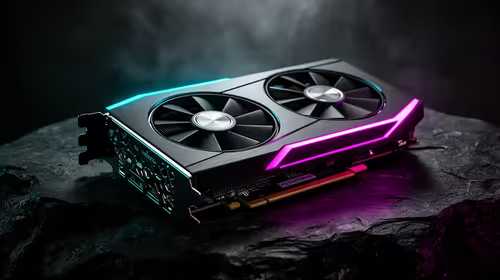
RTX 5080 Super with a 750W PSU is more comfortable than lower wattage if the unit is quality. SA builders should still confirm GPU guidance, CPU draw, connector type, airflow, and upgrade room.
Read more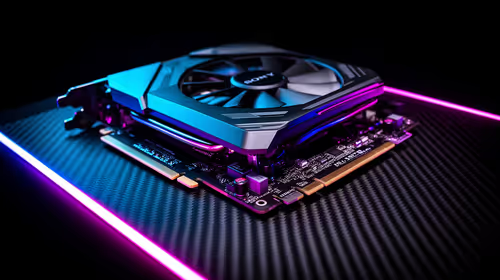
How to fix FPS drops after a RX 9070 XT starts with driver cleanup, chipset updates, thermals, and power checks. For SA gaming PCs, confirm PCIe seating, monitor refresh, frame caps, and per-game graphics settings before replacing parts.
Read more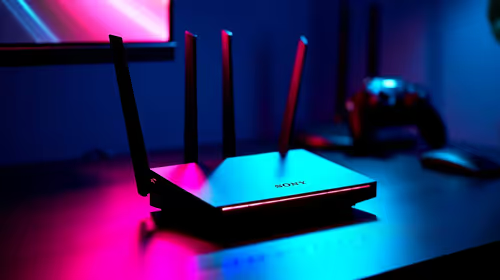
How to fix low FPS Windows 11 Wi-Fi 7 issues starts by checking whether the problem is frame rate or network lag. Test ping, drivers, power settings, Ethernet, and game FPS before adjusting visuals.
Read more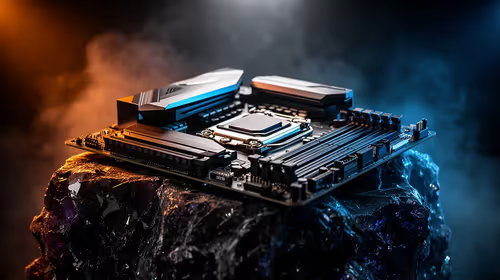
AM5 is smart for SA builders because it supports newer Ryzen CPUs, DDR5 memory, and a longer upgrade path. Compare board cost, cooling, gaming needs, and local part availability before choosing your next PC platform.
Read more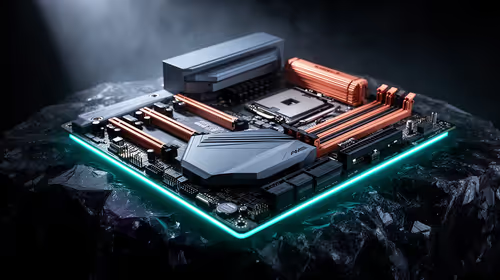
AM5 gives Randburg gaming builders a longer upgrade path. For SA buyers, DDR5 support, newer board features, and future CPU options can justify the platform. Weigh board cost, cooler support, BIOS maturity, and upgrade timing before choosing.
Read more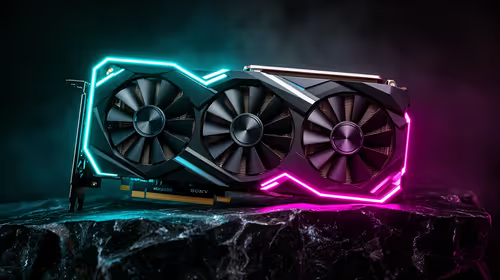
RTX 5090 on a 550W PSU leaves almost no practical room for OC plans. Treat the setup as constrained, with CPU draw, power spikes, cable quality, thermals, and stability checks more important than chasing extra clocks.
FPS drops on a Ryzen 9 9950X3D build often have a fixable cause. Check settings, drivers, thermals, background tasks, network conditions, and bottlenecks before assuming a part must be replaced.

The difference between PCIe 5.0 and PCIe 4.0 for SA gamers is mostly bandwidth headroom. Compare GPU slot needs, NVMe speed, motherboard support, and upgrade timing before paying extra for a newer platform.

Gaming PC stuck pixel checks in South Africa should confirm the monitor fault first. Use colour tests, screenshot comparison, cable swaps, display menu checks, and clear photos before deciding on support.

AMD's current driver now lists a Radeon RX 9050 4GB, while product coverage details a narrowed memory system. SA buyers should weigh the low VRAM ceiling against current local Radeon options.

Samsung Display has demonstrated a 16-inch 2.5K OLED laptop panel running at 300Hz. SA buyers should wait for a named notebook, full panel specifications and a local price before planning an upgrade.

Microsoft says some Windows 11 game crashes after recent updates are linked to RGB-related drivers. Affected SA gamers should confirm the update and driver before using the published registry workaround.
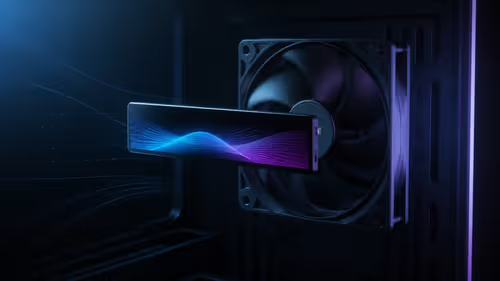
Thermalright's Fan Frame Vision-1 adds a 640x172 status screen to a standard 120mm fan. SA builders should check clearance, USB routing and local support before treating it as an easy upgrade.
1000W for RTX 5090 needs a full-build check, not a simple yes. Review GPU guidance, CPU draw, transient load, connectors, PSU quality, and upgrade plans before deciding.

Wi-Fi 6E vs Wi-Fi 6 matters for 4K video editing when files move across a network. The real-world difference between Wi-Fi 6E and Wi-Fi 6 for video editing in 4K depends on NAS access, cloud uploads, router range, and SA creator workflows.
RTX 5080 Super with a 750W PSU is more comfortable than lower wattage if the unit is quality. SA builders should still confirm GPU guidance, CPU draw, connector type, airflow, and upgrade room.
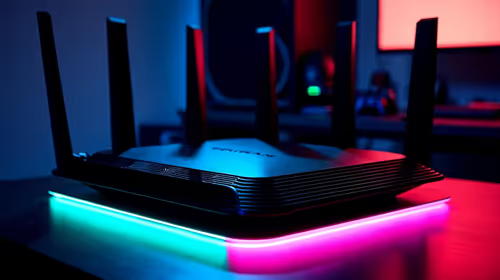
Wi-Fi 6E vs Wi-Fi 6 for Video Editing in 4K comes down to router support, latency, client devices, band support, and home network layout. SA buyers should match the choice to their setup instead of assuming one option always wins.