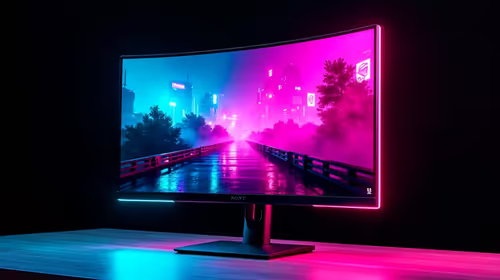
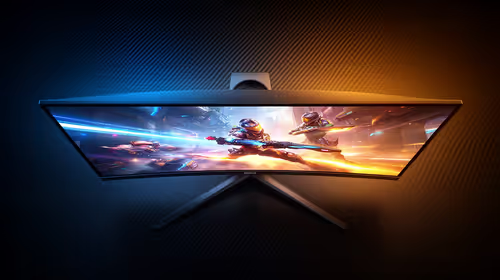
A wide creative screen is most useful when the extra space keeps the artwork central and moves tools out of the way. How South African creators can use DQHD screen space starts with purposeful zones, neutral colour and sensible scaling. Dahua's 49-inch LM49 offers 5120 x 1440 and costs R14,999.
Quick Answer
Place the main canvas or preview in the centre of the R14,999 LM49, use one side for layers and tools, and reserve the other for references, scopes or project files. Its 99% sRGB and Delta-E under 2 accuracy supports sRGB-focused work, while the DQHD width keeps more controls visible.
🎬 Stretch timelines, not attention
Video and audio editors can give the timeline a long lower region while keeping the preview near the centre. More visible duration can reduce horizontal scrolling, but track height and text must remain readable. Hide panels that are open only from habit.
Use Evetech's curved monitor selection to compare the 49-inch format with narrower creative layouts.
🖼️ Keep design work central
Place the artwork in the most direct viewing region and move layers, properties and asset browsers to the sides. The LM49's tilt and swivel stand should align both edges with one consistent seat. Avoid moving far off-axis for subtle colour judgement.
🎨 Build an sRGB workflow
Use a neutral picture mode, stable room light and colour-managed applications. The 99% sRGB specification describes broad coverage of the common digital colour space, while Delta-E under 2 represents a small target-to-display difference.
The Dahua monitor page places those colour features alongside the wide canvas. Preserve gaming or vivid effects in another profile.
🔌 Connect the production desk
The monitor's USB-C feed reaches a 65W ceiling for a compatible creative laptop. RJ-45 adds a wired network route for large approved transfers, and Picture-By-Picture can keep a reference or second computer beside the main source.
Test each function separately and label the working cable. Explore Evetech's gaming monitor range for other connection packages.
Create layouts for editing, review and delivery. During a screen share, send one application or a deliberate region because a full 5120-pixel desktop can be unreadable to participants on smaller screens. Restore the neutral creative layout afterwards.
Archive familiar test material with skin tones, gradients, neutral greys and saturated patches. Reopen it after software or profile changes. The wide screen becomes dependable when colour and workspace behaviour can both be reconstructed.
Adapt the canvas to different creative stages
During selection and ingest, use broad thumbnail and metadata regions so many assets remain visible. During detailed editing, enlarge the central image and collapse panels that are not needed. For delivery, place export settings beside a known reference rather than leaving the timeline stretched across the whole screen.
Save each arrangement with a descriptive name. Switching layouts by production stage reduces visual clutter and keeps the extra width from becoming permanent storage for forgotten windows.
Review output beyond the editing application
Open the export in a second colour-aware viewer and inspect it at ordinary viewing size. Check gradients, neutral areas, skin tones and text edges. If the result differs from the source, trace document and export profiles before changing the monitor picture mode.
For collaborative review, put comments or the call window on one side while preserving a large central preview. Share the application rather than the full ultrawide desktop, and confirm that participants can read labels on a smaller screen.
The LM49's width can also keep version notes and file destinations visible during export. Use that visibility to reduce naming mistakes, not to run unrelated distractions alongside colour-critical work.
Close the project and reopen it once before delivery. Confirm that the saved layout, neutral picture profile and application colour settings return together.
Archive those settings beside the export.
Frequently Asked Questions
Where should the main creative canvas sit?
Keep it near the physical centre, with tools and references assigned to side regions.
Does DQHD help video editing?
Its horizontal width can show more timeline length while leaving room for preview and tool panels.
What do the colour figures mean?
The LM49 couples 99% sRGB coverage with Delta-E under 2 accuracy, a useful foundation for a controlled sRGB workflow.
Can a creative laptop use USB-C?
The monitor connection can feed a compatible laptop as much as 65W.
What does the LM49 cost in South Africa?
The Dahua monitor is R14,999.
Ready to give every tool a wide-screen home without pushing the artwork away from centre stage?
Explore Evetech creator-friendly monitors, save layouts for each production phase, and preserve one neutral colour routine from edit to export.