


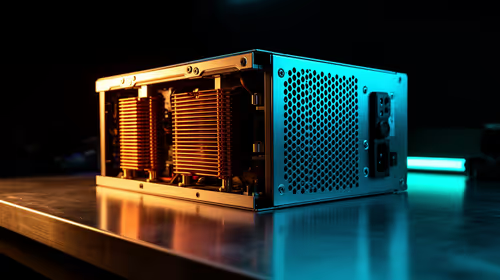
1000W PSU Planning for RTX 5090 Builds in SA
1000W for RTX 5090 needs a full-build check, not a simple yes. Review GPU guidance, CPU draw, transient load, connectors, PSU quality, and upgrade plans before deciding.
Read moreChoose a workstation graphics card by testing CAD, rendering and AI needs against the complete GPU. For R12,099, South African buyers get an A1000 built on Ampere, with 8GB GDDR6 memory connected over 128 bits and 2304 CUDA cores.

CAD, rendering and AI should never be compressed into one "professional performance" score. They can use different execution paths, working data and system components. To choose a workstation graphics card for CAD, rendering and AI, South African buyers need three workload tests and one complete platform check.
For CAD, rendering and AI-capable work, the RTX A1000 combines 2,304 CUDA, 18 RT and 72 Tensor cores with 8GB GDDR6 in a compact 50W card.
Choose a GPU that supports CAD, rendering and AI tools, fits the largest files and clears required accelerated tasks. The A1000 gives South African buyers a R12,099 Ampere candidate. It carries 8GB GDDR6, offers 2304 CUDA cores and connects memory through a 128-bit interface. Evaluate each workload independently.
Confirm the CAD version, GPU guidance and the interaction that needs improvement. Use a representative assembly or model with production visual settings. Observe CPU, system memory and storage as well as the graphics card.
A viewport result does not predict every solver or renderer. Record the exact feature being tested and preserve model correctness. This produces a clear pass condition for the CAD row.
Choose the renderer, device mode, scene and final output. Verify that the intended operation uses CUDA. Time preparation and final compute independently so an upstream delay does not distort the GPU conclusion.
The A1000's 2304 CUDA cores can matter to a supported path, while its 8GB capacity must hold practical scene data. Test both with the same file before comparing alternatives.
Identify the framework, model, precision and where the operation runs. Check the tool's GPU and memory guidance. An architecture name or CUDA count cannot establish model compatibility or whether 8GB is enough.
Evetech's AI PC range lets buyers compare complete platforms. If CPU, system RAM and storage also change the AI experience, a balanced system may be more sensible than a card-only upgrade.
The PNY A1000 costs R12,099. Its Ampere architecture and 2304 CUDA cores sit beside 8GB GDDR6 on a 128-bit interface. Compare it with Evetech's professional GPU department using identical project evidence.
Add physical dimensions, power, connectors and compatibility before purchasing. Select the lowest-cost card that passes all mandatory CAD, render and AI conditions, with realistic headroom for expected file growth.
CAD may favour one support path, rendering another compute balance and AI a different memory target. Put mandatory conditions from all three into one table and highlight contradictions before looking at prices.
When no card within budget clears every row, decide which workload can use another system, remote process or different schedule. Do not silently weaken quality or support requirements to make the preferred model fit.
Record the compromise and its owner. A deliberate exception can be managed, while an undocumented failure becomes a production surprise. Revisit the table when software or project scale changes, especially if local AI models grow.
Use a separate failure code for each row: unsupported feature, insufficient memory, missed completion target, physical mismatch or unresolved information. A single "fail" hides the action needed to improve the shortlist.
Map each code to a response. Memory failures trigger capacity comparisons, support failures trigger another device path, and physical mismatches return to case measurements.
This system keeps the combined CAD-render-AI decision organised without pretending the three workloads share one technical cause.
Its memory runs at 192GB/sec, and its four Mini DisplayPort 1.4a outputs can support up to four 5K displays. PCI Express 4.0 x8 connects the low-profile single-slot board to the workstation. South African buyers can now judge a complete A1000 package at R12,099, then use their own application support, chassis, files and deadlines to decide whether that package fits.
The display layout can include four 5K panels without adding a second graphics board.
Use application support, the largest regular model and the specific viewport or graphics task that must improve.
Renderer version, device path, scene memory, output settings and completion target should be fixed before comparing GPUs.
Confirm framework and model requirements, then run a representative test without assuming that CUDA or Ampere guarantees support.
For R12,099, buyers receive an Ampere GPU with a CUDA total of 2304. The 8GB GDDR6 memory path is 128-bit.
No. Software support, projects, measured results, physical compatibility and the rest of the workstation complete the decision.
Ready to compare CAD, rendering and AI without mixing their requirements? Build your Evetech shortlist from three workload rows, one platform fit check and the exact South African budget available.
Use application support, the largest regular model and the specific viewport or graphics task that must improve.
Renderer version, device path, scene memory, output settings and completion target should be fixed before comparing GPUs.
Confirm framework and model requirements, then run a representative test without assuming that CUDA or Ampere guarantees support.
For R12,099, buyers receive an Ampere GPU with a CUDA total of 2304. The 8GB GDDR6 memory path is 128-bit.
No. Software support, projects, measured results, physical compatibility and the rest of the workstation complete the decision.
1000W for RTX 5090 needs a full-build check, not a simple yes. Review GPU guidance, CPU draw, transient load, connectors, PSU quality, and upgrade plans before deciding.
Read more
RTX 5080 Super with a 750W PSU is more comfortable than lower wattage if the unit is quality. SA builders should still confirm GPU guidance, CPU draw, connector type, airflow, and upgrade room.
Read more
How to fix FPS drops after a RX 9070 XT starts with driver cleanup, chipset updates, thermals, and power checks. For SA gaming PCs, confirm PCIe seating, monitor refresh, frame caps, and per-game graphics settings before replacing parts.
Read more
How to fix low FPS Windows 11 Wi-Fi 7 issues starts by checking whether the problem is frame rate or network lag. Test ping, drivers, power settings, Ethernet, and game FPS before adjusting visuals.
Read more
AM5 is smart for SA builders because it supports newer Ryzen CPUs, DDR5 memory, and a longer upgrade path. Compare board cost, cooling, gaming needs, and local part availability before choosing your next PC platform.
Read more
AM5 gives Randburg gaming builders a longer upgrade path. For SA buyers, DDR5 support, newer board features, and future CPU options can justify the platform. Weigh board cost, cooler support, BIOS maturity, and upgrade timing before choosing.
Read more
RTX 5090 on a 550W PSU leaves almost no practical room for OC plans. Treat the setup as constrained, with CPU draw, power spikes, cable quality, thermals, and stability checks more important than chasing extra clocks.
FPS drops on a Ryzen 9 9950X3D build often have a fixable cause. Check settings, drivers, thermals, background tasks, network conditions, and bottlenecks before assuming a part must be replaced.

The difference between PCIe 5.0 and PCIe 4.0 for SA gamers is mostly bandwidth headroom. Compare GPU slot needs, NVMe speed, motherboard support, and upgrade timing before paying extra for a newer platform.

Gaming PC stuck pixel checks in South Africa should confirm the monitor fault first. Use colour tests, screenshot comparison, cable swaps, display menu checks, and clear photos before deciding on support.

AMD's current driver now lists a Radeon RX 9050 4GB, while product coverage details a narrowed memory system. SA buyers should weigh the low VRAM ceiling against current local Radeon options.

Samsung Display has demonstrated a 16-inch 2.5K OLED laptop panel running at 300Hz. SA buyers should wait for a named notebook, full panel specifications and a local price before planning an upgrade.

Microsoft says some Windows 11 game crashes after recent updates are linked to RGB-related drivers. Affected SA gamers should confirm the update and driver before using the published registry workaround.
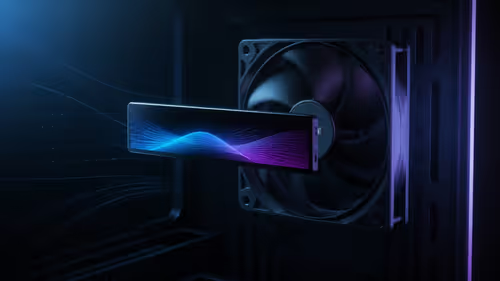
Thermalright's Fan Frame Vision-1 adds a 640x172 status screen to a standard 120mm fan. SA builders should check clearance, USB routing and local support before treating it as an easy upgrade.
1000W for RTX 5090 needs a full-build check, not a simple yes. Review GPU guidance, CPU draw, transient load, connectors, PSU quality, and upgrade plans before deciding.

Wi-Fi 6E vs Wi-Fi 6 matters for 4K video editing when files move across a network. The real-world difference between Wi-Fi 6E and Wi-Fi 6 for video editing in 4K depends on NAS access, cloud uploads, router range, and SA creator workflows.
RTX 5080 Super with a 750W PSU is more comfortable than lower wattage if the unit is quality. SA builders should still confirm GPU guidance, CPU draw, connector type, airflow, and upgrade room.
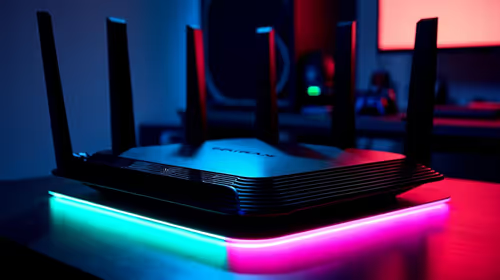
Wi-Fi 6E vs Wi-Fi 6 for Video Editing in 4K comes down to router support, latency, client devices, band support, and home network layout. SA buyers should match the choice to their setup instead of assuming one option always wins.