


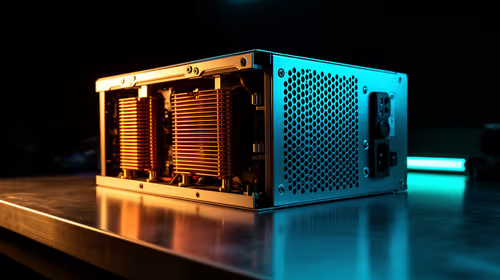
1000W PSU Planning for RTX 5090 Builds in SA
1000W for RTX 5090 needs a full-build check, not a simple yes. Review GPU guidance, CPU draw, transient load, connectors, PSU quality, and upgrade plans before deciding.
Read more32GB LPDDR5X and 1TB NVMe provide a substantial baseline; project size and software determine sufficiency. The R37,999 Prestige adds Core Ultra 9 386H processing, a 90 TOPS AI PC rating and a convertible 2.8K 120Hz OLED touchscreen to that memory and storage pairing.

Memory and storage capacity answer different professional questions: how much active work fits, and how much local data the system can hold. The 32GB RAM and 1TB SSD for AI and creative work decision must use real projects. In the R37,999 MSI Prestige 16 Flip AI+, 32GB LPDDR5X serves memory and 1TB NVMe provides local storage.
Thirty-two gigabytes and 1TB can suit substantial AI and creative workflows, but no universal "enough" result applies across applications and files. Core Ultra 9 386H provides the general processor, while supported AI operations can use 90-TOPS capability. Measure memory peaks, project storage, cache growth and free-space headroom during representative work.
Open the normal application set and largest routine project. Record peak memory during editing, generation, export and multitasking. Add a difficult project that reflects credible growth rather than an imaginary maximum.
LPDDR5X identifies the memory type, while 32GB describes capacity. Neither supplies an application benchmark.
Divide the 1TB NVMe drive among Windows, applications, project files, source media, caches and local AI models where used. Measure actual folder sizes and leave working headroom for temporary files.
Archive policy can matter as much as internal capacity. Compare MSI professional laptops at Evetech after defining local-storage requirements.
The 90-TOPS label describes AI compute capability. A local model may still require supported software, sufficient memory and storage. Monitor all stages instead of crediting a failed capacity test to compute.
Graphics configuration also needs verification for GPU-dependent AI or creative tasks. The processor and memory do not identify it.
Thunderbolt 4 can support a tested external-storage chain. Confirm device, enclosure, cable and workflow, then measure transfer and project behaviour directly. Use Evetech's creator laptop category for broader capacity choices.
External storage affects the carried kit and power plan. Test battery duration and portability with the actual devices; the 32GB/1TB configuration does not supply those results.
Start with an inventory of active projects, reusable assets, application libraries, caches and local models. Assign each group a current size, monthly growth and retention rule. Place archives outside the active total only after their restore path has been tested. This avoids treating the headline 1TB as one undivided creative workspace.
For memory, save peak readings from normal editing, generation and export stages. Average use can hide the short pressure point that causes a project to stutter or close.
Choose a free-space threshold and a memory symptom that will trigger review. The response might be clearing reproducible caches, moving completed source material through a verified archive, or reducing simultaneous applications. Write the action before the limit appears so urgent deadlines do not encourage random deletion.
Recheck the budget when software or project formats change. Capacity planning succeeds when growth remains visible and recovery stays reliable, not when the drive is filled to its last available space.
Move a completed non-confidential project through the planned storage route, then restore it to a clean folder and open it with links, fonts and assets intact. Time the process and confirm the final output. An archive that saves space but cannot rebuild the working project is not a capacity solution; it merely moves risk away from the internal drive.
Larger active projects can take longer to protect and restore. Schedule a backup window using the actual folder size and chosen destination, then verify one restored asset before the deadline arrives. The capacity plan should account for recovery effort as well as free space. A full drive with an untested copy does not provide professional resilience.
It can provide substantial headroom, but application type and project size decide peak use. Monitor the real combined session.
The operating system, applications, caches and other data consume part of it. Check free space after the complete setup.
Capacity and speed are separate. The full task may depend on software, compute, memory, storage access and model size.
No. Verify the exact device, enclosure and cable, then test the project's transfer and working pattern.
Ready to decide capacity from project evidence? Compare Evetech MSI and creator laptops after measuring active memory, local data, cache growth and external-storage needs.
It can provide substantial headroom, but application type and project size decide peak use. Monitor the real combined session.
The operating system, applications, caches and other data consume part of it. Check free space after the complete setup.
Capacity and speed are separate. The full task may depend on software, compute, memory, storage access and model size.
No. Verify the exact device, enclosure and cable, then test the project's transfer and working pattern.
1000W for RTX 5090 needs a full-build check, not a simple yes. Review GPU guidance, CPU draw, transient load, connectors, PSU quality, and upgrade plans before deciding.
Read more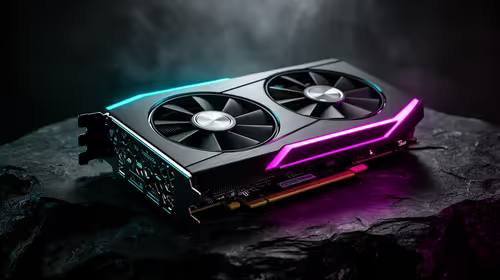
RTX 5080 Super with a 750W PSU is more comfortable than lower wattage if the unit is quality. SA builders should still confirm GPU guidance, CPU draw, connector type, airflow, and upgrade room.
Read more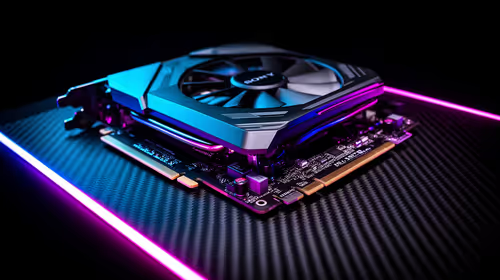
How to fix FPS drops after a RX 9070 XT starts with driver cleanup, chipset updates, thermals, and power checks. For SA gaming PCs, confirm PCIe seating, monitor refresh, frame caps, and per-game graphics settings before replacing parts.
Read more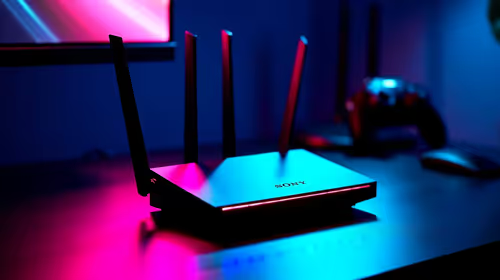
How to fix low FPS Windows 11 Wi-Fi 7 issues starts by checking whether the problem is frame rate or network lag. Test ping, drivers, power settings, Ethernet, and game FPS before adjusting visuals.
Read more
AM5 is smart for SA builders because it supports newer Ryzen CPUs, DDR5 memory, and a longer upgrade path. Compare board cost, cooling, gaming needs, and local part availability before choosing your next PC platform.
Read more
AM5 gives Randburg gaming builders a longer upgrade path. For SA buyers, DDR5 support, newer board features, and future CPU options can justify the platform. Weigh board cost, cooler support, BIOS maturity, and upgrade timing before choosing.
Read more
RTX 5090 on a 550W PSU leaves almost no practical room for OC plans. Treat the setup as constrained, with CPU draw, power spikes, cable quality, thermals, and stability checks more important than chasing extra clocks.
FPS drops on a Ryzen 9 9950X3D build often have a fixable cause. Check settings, drivers, thermals, background tasks, network conditions, and bottlenecks before assuming a part must be replaced.

The difference between PCIe 5.0 and PCIe 4.0 for SA gamers is mostly bandwidth headroom. Compare GPU slot needs, NVMe speed, motherboard support, and upgrade timing before paying extra for a newer platform.

Gaming PC stuck pixel checks in South Africa should confirm the monitor fault first. Use colour tests, screenshot comparison, cable swaps, display menu checks, and clear photos before deciding on support.

AMD's current driver now lists a Radeon RX 9050 4GB, while product coverage details a narrowed memory system. SA buyers should weigh the low VRAM ceiling against current local Radeon options.

Samsung Display has demonstrated a 16-inch 2.5K OLED laptop panel running at 300Hz. SA buyers should wait for a named notebook, full panel specifications and a local price before planning an upgrade.

Microsoft says some Windows 11 game crashes after recent updates are linked to RGB-related drivers. Affected SA gamers should confirm the update and driver before using the published registry workaround.
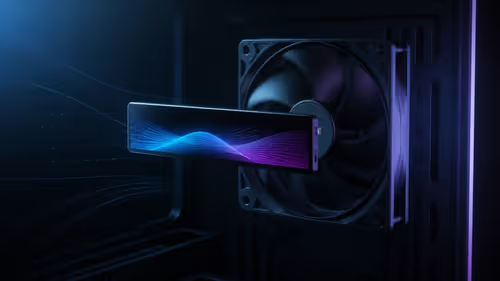
Thermalright's Fan Frame Vision-1 adds a 640x172 status screen to a standard 120mm fan. SA builders should check clearance, USB routing and local support before treating it as an easy upgrade.
1000W for RTX 5090 needs a full-build check, not a simple yes. Review GPU guidance, CPU draw, transient load, connectors, PSU quality, and upgrade plans before deciding.

Wi-Fi 6E vs Wi-Fi 6 matters for 4K video editing when files move across a network. The real-world difference between Wi-Fi 6E and Wi-Fi 6 for video editing in 4K depends on NAS access, cloud uploads, router range, and SA creator workflows.
RTX 5080 Super with a 750W PSU is more comfortable than lower wattage if the unit is quality. SA builders should still confirm GPU guidance, CPU draw, connector type, airflow, and upgrade room.
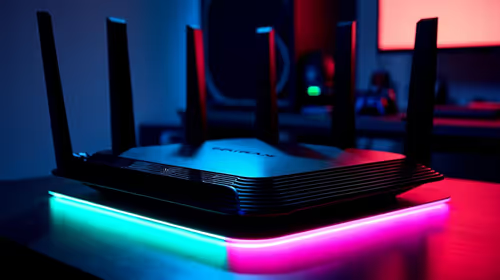
Wi-Fi 6E vs Wi-Fi 6 for Video Editing in 4K comes down to router support, latency, client devices, band support, and home network layout. SA buyers should match the choice to their setup instead of assuming one option always wins.