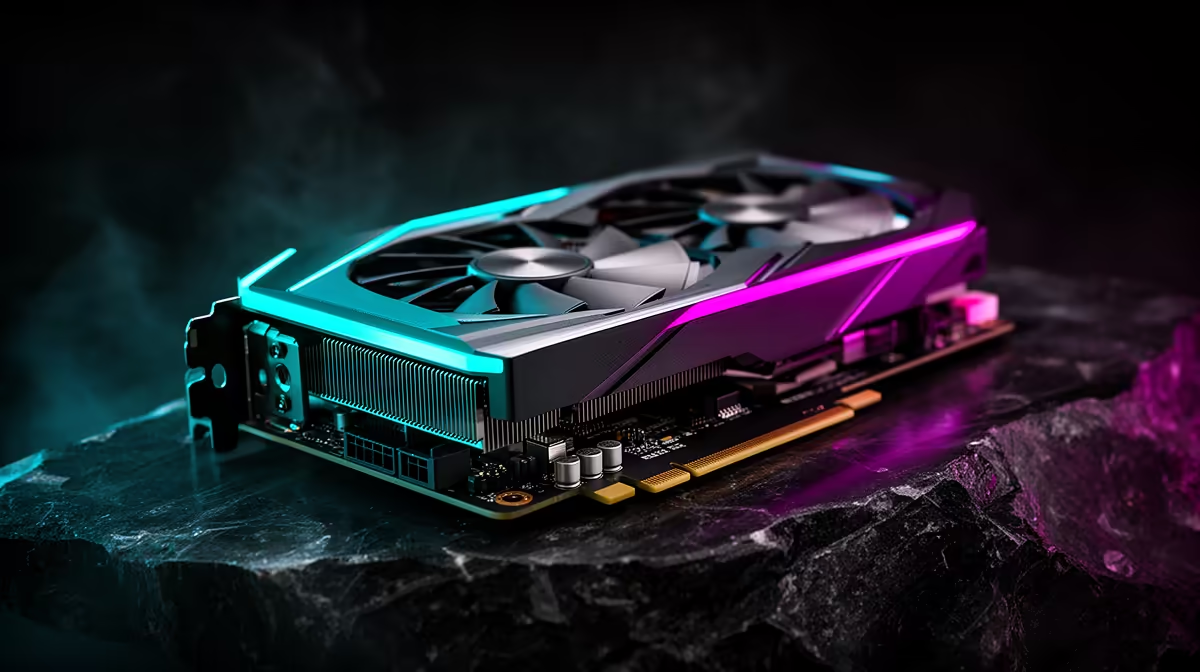
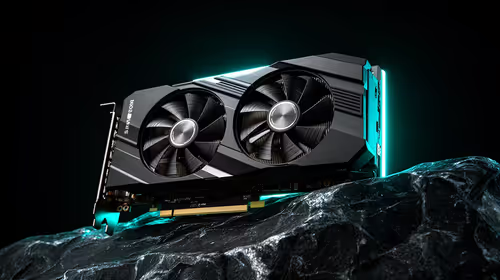
Eight gigabytes of video memory still runs games. It no longer guarantees that every texture slider can stay at maximum. The honest 8GB VRAM in 2026 verdict is neither dead nor future-proof: it remains useful at disciplined 1080p settings, while demanding games, ray tracing and higher resolutions expose its limit sooner.
Quick Answer
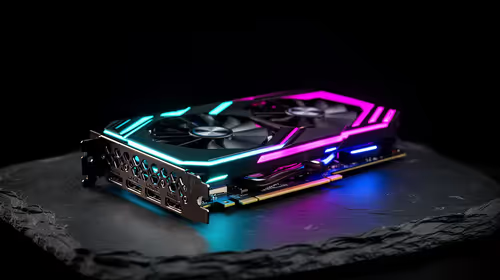
No, 8GB VRAM is not dead. It remains a valid 1080p budget tier when the GPU itself has enough rendering power and the player accepts sensible texture settings. Evetech's July 2026 graphics listings put the Palit RTX 5060 Infinity 2 OC 8GB at R6,999, a real local reference for buyers who would rather protect frame rate and total build balance than chase capacity alone.
🎮 VRAM failure looks different from a slow GPU
Video memory holds textures, geometry, render targets and other data the GPU needs close at hand. When demand exceeds capacity, the game may stream data through slower system memory or storage. Symptoms can include texture pop-in, hard frame-time spikes or settings that refuse to apply.
A GPU can also be too slow while VRAM remains available. Lowering texture quality may barely help when shader load or ray tracing is the limit. Monitor memory use, GPU utilisation and frame times together before blaming the 8GB label.
🖥️ Resolution and settings set the pressure
Higher resolutions need larger render targets, while high-resolution texture packs consume capacity regardless of the monitor. Ray tracing can add further buffers. This is why an 8GB card can feel comfortable in one 1080p title and constrained in another.
Start with textures, ray tracing and resolution scaling. Reducing a texture preset often changes image quality less than dropping resolution or core effects, making it the cleanest adjustment when capacity is the problem.
Evetech's gaming PC deals let buyers judge the whole system rather than one GPU field.
💰 Budget buyers need the complete trade-off
More VRAM does not automatically make a weaker chip faster. Compare benchmarks for the exact card, game and settings. A well-priced 8GB GPU can beat a slower high-capacity alternative even though the latter has more room for textures.
The build also needs enough system RAM, storage and CPU performance. Spending beyond the graphics target can weaken those parts. Evetech's PC best sellers provide complete configurations for a dated SA comparison.
Buy 8GB when the price enables a balanced 1080p machine and today's games meet the target. Choose 12GB or more when high-resolution textures, 1440p, ray tracing or a long ownership period are central.
Frequently Asked Questions
Is 8GB VRAM dead for gaming?
No. It remains workable at 1080p, but demanding games can require texture or ray-tracing compromises.
Which resolutions still suit 8GB?
1080p is the strongest fit. Some games run well at 1440p, but capacity pressure becomes more likely.
Does ray tracing make the limit worse?
It can, because ray-traced effects add memory and rendering demands. The result varies by game.
Should budget buyers still consider 8GB cards?
Yes, when benchmarks meet the target and the saving keeps the complete PC balanced.
How long will 8GB remain viable?
No fixed expiry date exists. Game engines, settings and the owner's tolerance for texture reductions decide it.
Is moving from 8GB to 12GB worth it?
It can be for 1440p or heavier textures, but compare complete card performance and price rather than capacity alone.
Do all 2026 games need more than 8GB?
No. Requirements differ widely, and many titles remain comfortable within 8GB at suitable settings.
Ready to choose the card by the games you will actually run?
Compare Evetech gaming PCs at your target resolution, then treat VRAM as one measured constraint inside the complete graphics result.