Streaming while gaming asks a lot more of a CPU than gaming on its own, since encoding a video feed in the background competes for the same cores that are already busy running the game. That combined load is where a lot of cooling setups start to strain, and it is a fair question whether a mid-size radiator can keep pace. A 240mm liquid cooler is built for exactly this kind of sustained, multi-threaded workload, and for most streaming rigs it holds up well without the cost of stepping up to a bigger unit.
Quick Answer
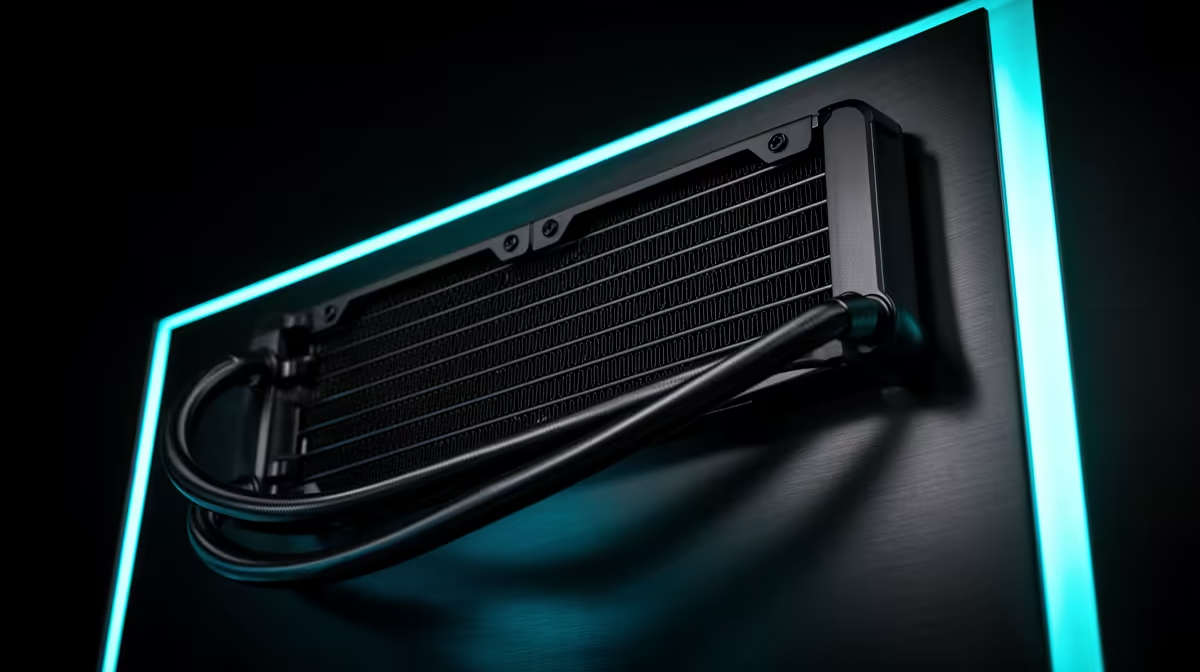
Yes, a 240mm radiator keeps most CPUs cool through simultaneous gaming, streaming and encoding workloads without throttling, provided the chip itself sits within a reasonable power draw for its class. The MasterLiquid 240 Atmos backs this up with two SickleFlow Edge PWM fans pushing sustained airflow across its radiator, priced at R1,399.
🎥 Why Streaming Changes the Thermal Equation
A CPU running a single game generates a fairly predictable heat load, one that most cooling solutions handle without much drama. Add a live encode on top of that, whether through OBS or another capture tool, and the CPU is now processing two demanding workloads at once, often for hours at a stretch rather than the shorter bursts typical of single-player sessions.
This is where sustained cooling performance matters more than peak cooling performance. A cooler that handles brief spikes well but cannot maintain that performance over a multi-hour stream is the wrong choice for this use case, even if it looks capable on a spec sheet.
💧 How the MasterLiquid 240 Atmos Handles Sustained Load
The MasterLiquid 240 Atmos pairs its 240mm radiator with two 120mm SickleFlow Edge PWM fans, which adjust speed automatically to maintain airflow as thermal load increases rather than running at a fixed rate regardless of demand. That responsiveness is particularly relevant for a streaming workload, where CPU load can spike suddenly as a game's scene complexity changes or a new source gets added to the stream.
AMD builders get brackets for AM5 and AM4, while Intel builders are covered from LGA 1851 through 1700 and 1200, so streamers running current-generation hardware from either side get the same sustained cooling performance. The full spec sheet for this cooler confirms it at R1,399, a practical middle ground for anyone building a dedicated streaming and gaming rig without needing enthusiast-tier cooling hardware.
🖥️ When a Bigger Radiator Actually Makes Sense
Some streaming setups do push past what a 240mm cooler comfortably handles, particularly builds running very high-TDP CPUs, aggressive all-core overclocks, or additional encoding hardware that adds further sustained heat output. In those specific cases, moving up to a 360mm radiator provides a genuine thermal benefit rather than just extra headroom that goes unused.
For the large majority of gaming-plus-streaming setups running current mainstream or enthusiast CPUs, though, a 240mm liquid cooler like the MasterLiquid 240 Atmos handles the combined load without throttling. Evetech's range of CPU liquid coolers for SA builds makes it easy to compare radiator sizes if there is any doubt about where a specific setup falls.
Frequently Asked Questions
Does streaming really add that much extra heat load compared to gaming alone?
Yes, encoding a video feed alongside a game adds sustained CPU load on top of the game itself, which is a heavier combined workload than gaming by itself typically produces.
Can a 240mm cooler handle hardware encoding as well as CPU encoding?
Hardware encoding offloads much of the work to a dedicated encoder, reducing CPU load, so a 240mm cooler generally has an easier time with hardware-encoded streams than CPU-encoded ones.
Do PWM fans help specifically with variable streaming loads?
Yes, PWM fans ramp speed up and down automatically as load changes, which suits the fluctuating demands of a stream better than fixed-speed fans.
Is the MasterLiquid 240 Atmos compatible with the latest Intel sockets?
It ships with brackets for LGA 1851, 1700 and 1200 on the Intel side, and AM5 and AM4 on the AMD side, so recent builds from either camp are covered.
At what point should a streamer consider a 360mm radiator instead?
Mainly with very high-TDP CPUs or heavy sustained overclocks, where the extra radiator surface area provides a real, measurable thermal advantage over a 240mm unit.
Anyone finalising a build can check the full CPU coolers category to compare this option against other sizes before deciding.
Ready to see if 240mm covers your gaming and streaming load?
Judge the cooling headroom of Cooler Master's MasterLiquid 240 Atmos AIO at R1,399 from Evetech's cooling range, against your CPU under sustained load.