


1000W PSU Planning for RTX 5090 Builds in SA
1000W for RTX 5090 needs a full-build check, not a simple yes. Review GPU guidance, CPU draw, transient load, connectors, PSU quality, and upgrade plans before deciding.
Read moreNew memory fabrication plants announced for the current shortage take years to reach full output, with lead times stretching into 2028, so added capacity cannot ease 2026 pricing. The supply gap this year has to close through existing production, not future factories.
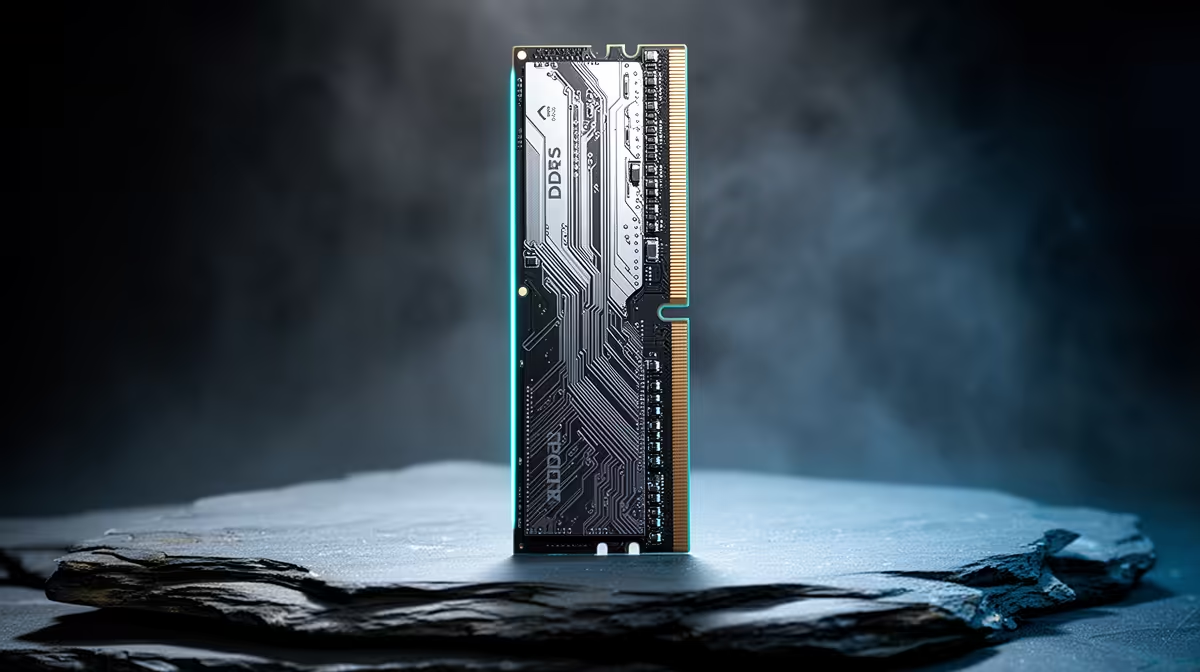
A factory announcement creates future capacity, not chips that can reach shelves this year. New memory fabs and 2026 prices live on different timelines because construction, tooling, qualification and ramp-up take years.
New memory factories announced during a shortage cannot create meaningful 2026 supply. A leading-edge fab takes years to permit, build, equip, qualify and ramp, and early output is smaller than the nameplate target. Existing fabs, product allocation and customer inventories decide near-term DRAM and NAND availability. Treat a 2028 capacity date as a project target rather than a guaranteed moment when consumer RAM prices fall.
Memory production needs cleanrooms, power, water, lithography, deposition, etch, inspection and packaging capacity. Much of that equipment has long lead times and must be installed in a strict sequence.
After tools arrive, the maker qualifies the process and product. Early wafers can have lower yield, meaning fewer good chips per wafer. Customers then validate the parts before high-volume systems use them.
That chain is why a ground-breaking ceremony does not add DIMMs to this quarter.
A maker can improve yield, add tools inside an existing shell or shift wafer starts between products. Each move takes engineering work and can reduce another product's output.
DRAM, NAND and HBM do not roll off one universal line as interchangeable finished chips. They use different process flows, packaging and customer qualification.
Advanced packaging can also bottleneck HBM even when wafer capacity exists. Solving one stage does not guarantee finished supply.
Investors and buyers may react to a capacity plan before the factory ships anything. That is sentiment and future planning, not physical 2026 inventory.
Project dates can move with permits, equipment delivery, yield and demand. Read company updates for actual tool installation and qualification milestones rather than repeating the announcement year.
Volume at target yield matters more than the ceremony date.
Write the capacity your workload needs and the date you need the PC. Compare exact kits, not a category forecast. If current capacity prevents swapping or lost work, a distant fab is weak reason to wait.
If the upgrade is optional, set a dated price trigger and review it each month. Do not assume every new plant pushes local Rand pricing down, because exchange rate, shipping, channel inventory and product mix sit between wafer and shelf.
Check exact capacities in the DDR5 memory range. Use the memory best-seller page as a live control for the kits buyers are considering now.
Several years can pass from planning to useful volume, and the schedule varies by site, equipment and qualification.
Yes through yield work, added tools or allocation changes, with time and trade-offs against other products.
It may change expectations. It does not create near-term physical supply, and local prices have other inputs.
Base your RAM purchase on required capacity, a current exact-kit price and build date, not an announced fab's target year.
Several years can pass from planning to useful volume, and the schedule varies by site, equipment and qualification.
Yes through yield work, added tools or allocation changes, with time and trade-offs against other products.
It may change expectations. It does not create near-term physical supply, and local prices have other inputs.
1000W for RTX 5090 needs a full-build check, not a simple yes. Review GPU guidance, CPU draw, transient load, connectors, PSU quality, and upgrade plans before deciding.
Read more
RTX 5080 Super with a 750W PSU is more comfortable than lower wattage if the unit is quality. SA builders should still confirm GPU guidance, CPU draw, connector type, airflow, and upgrade room.
Read more
How to fix FPS drops after a RX 9070 XT starts with driver cleanup, chipset updates, thermals, and power checks. For SA gaming PCs, confirm PCIe seating, monitor refresh, frame caps, and per-game graphics settings before replacing parts.
Read more
How to fix low FPS Windows 11 Wi-Fi 7 issues starts by checking whether the problem is frame rate or network lag. Test ping, drivers, power settings, Ethernet, and game FPS before adjusting visuals.
Read more
AM5 is smart for SA builders because it supports newer Ryzen CPUs, DDR5 memory, and a longer upgrade path. Compare board cost, cooling, gaming needs, and local part availability before choosing your next PC platform.
Read more
AM5 gives Randburg gaming builders a longer upgrade path. For SA buyers, DDR5 support, newer board features, and future CPU options can justify the platform. Weigh board cost, cooler support, BIOS maturity, and upgrade timing before choosing.
Read more
RTX 5090 on a 550W PSU leaves almost no practical room for OC plans. Treat the setup as constrained, with CPU draw, power spikes, cable quality, thermals, and stability checks more important than chasing extra clocks.

FPS drops on a Ryzen 9 9950X3D build often have a fixable cause. Check settings, drivers, thermals, background tasks, network conditions, and bottlenecks before assuming a part must be replaced.

The difference between PCIe 5.0 and PCIe 4.0 for SA gamers is mostly bandwidth headroom. Compare GPU slot needs, NVMe speed, motherboard support, and upgrade timing before paying extra for a newer platform.

Gaming PC stuck pixel checks in South Africa should confirm the monitor fault first. Use colour tests, screenshot comparison, cable swaps, display menu checks, and clear photos before deciding on support.

AMD's current driver now lists a Radeon RX 9050 4GB, while product coverage details a narrowed memory system. SA buyers should weigh the low VRAM ceiling against current local Radeon options.

Samsung Display has demonstrated a 16-inch 2.5K OLED laptop panel running at 300Hz. SA buyers should wait for a named notebook, full panel specifications and a local price before planning an upgrade.

Microsoft says some Windows 11 game crashes after recent updates are linked to RGB-related drivers. Affected SA gamers should confirm the update and driver before using the published registry workaround.
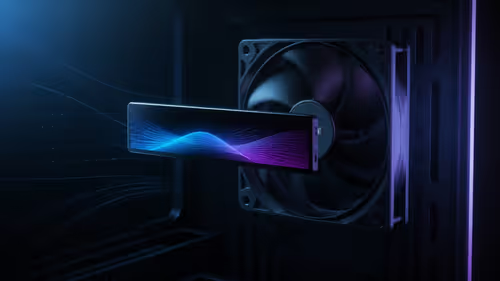
Thermalright's Fan Frame Vision-1 adds a 640x172 status screen to a standard 120mm fan. SA builders should check clearance, USB routing and local support before treating it as an easy upgrade.
1000W for RTX 5090 needs a full-build check, not a simple yes. Review GPU guidance, CPU draw, transient load, connectors, PSU quality, and upgrade plans before deciding.

Wi-Fi 6E vs Wi-Fi 6 matters for 4K video editing when files move across a network. The real-world difference between Wi-Fi 6E and Wi-Fi 6 for video editing in 4K depends on NAS access, cloud uploads, router range, and SA creator workflows.
RTX 5080 Super with a 750W PSU is more comfortable than lower wattage if the unit is quality. SA builders should still confirm GPU guidance, CPU draw, connector type, airflow, and upgrade room.
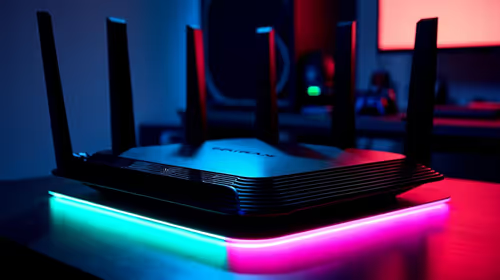
Wi-Fi 6E vs Wi-Fi 6 for Video Editing in 4K comes down to router support, latency, client devices, band support, and home network layout. SA buyers should match the choice to their setup instead of assuming one option always wins.