


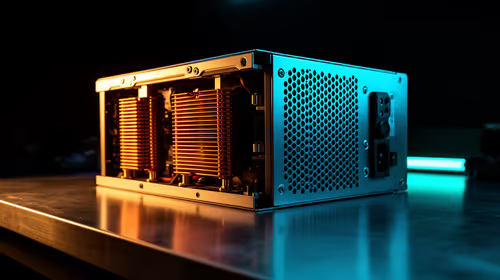
1000W PSU Planning for RTX 5090 Builds in SA
1000W for RTX 5090 needs a full-build check, not a simple yes. Review GPU guidance, CPU draw, transient load, connectors, PSU quality, and upgrade plans before deciding.
Read moreAn OLED laptop screen is worth it in 2026 for buyers who prioritise colour and contrast, since deep blacks and vivid colour clearly beat IPS, though battery life and burn-in risk are real compromises. Evetech stocks OLED laptops across several gaming and creator lines.

An OLED laptop screen is worth it when you care about black level, fast pixel response and rich colour every time you open the lid. It is less convincing for all-day static office work, outdoor use or a battery-first machine. Panel quality and software settings still matter.
Choose OLED for games, film, photo work and design after checking gamut modes, brightness behaviour and burn-in cover. Choose a good IPS laptop when you want stable large-window brightness, familiar text rendering and fewer worries about fixed interface elements.
Compare complete systems among current laptop best sellers and gaming laptop deals. For a desktop alternative, inspect the sizes and specifications in the OLED monitor range. Use all three as different product choices, since a monitor does not replace laptop portability.
Every OLED pixel produces light independently, allowing dark pixels to shut down completely. Night scenes avoid the backlight glow of an LCD, while small HDR highlights can stand out against the surrounding image. Pixel transitions are fast, which keeps motion clean at a suitable refresh rate.
Colour can be wide and vivid. Accuracy is a separate question. Use the laptop's calibrated or sRGB mode for work that must match other devices, rather than leaving an oversaturated profile active.
OLED power changes with image content. A white document lights many pixels, while a dark interface uses less panel power. Resolution and refresh rate add their own cost.
Use independent battery tests that resemble your workload. Dark mode can help in some apps, but it should not become the only reason to choose the screen. A larger battery and efficient processor may outweigh the panel difference between two laptops.
Taskbars, browser controls and editing panels can age pixels unevenly over time. Modern laptops use pixel shifting, dimming and other care routines. Let them operate, use screen sleep and avoid leaving a bright fixed image on the panel for hours.
Read the exact warranty terms for image retention. Do not assume every OLED laptop has the same cover. If your day is eight hours in one fixed application, include that pattern in the decision.
High pixel density can make laptop OLED text look sharp, though subpixel layout and scaling still affect coloured edges. Inspect small dark and light text at your normal distance.
Glossy OLED surfaces can show reflections in a bright classroom or office. Peak HDR brightness does not describe visibility under room light. Test the screen near a window and check its minimum brightness for night use.
No. Image content, brightness, refresh, battery size and the rest of the laptop determine runtime.
Yes, uneven wear is possible. Care features, brightness, usage pattern and warranty shape the practical risk.
It can be, when the exact panel has suitable gamut modes and calibration. Vivid colour alone does not prove accuracy.
Check the exact OLED panel's gamut modes, battery tests and image-retention cover against the static and mobile work you do each day.
No. Image content, brightness, refresh, battery size and the rest of the laptop determine runtime.
Yes, uneven wear is possible. Care features, brightness, usage pattern and warranty shape the practical risk.
It can be, when the exact panel has suitable gamut modes and calibration. Vivid colour alone does not prove accuracy. {{PRODUCTS: { facets: { query: "OLED laptop" }, limit: 12, title: "Compare OLED Laptop Displays", style: "4" } }}
1000W for RTX 5090 needs a full-build check, not a simple yes. Review GPU guidance, CPU draw, transient load, connectors, PSU quality, and upgrade plans before deciding.
Read more
RTX 5080 Super with a 750W PSU is more comfortable than lower wattage if the unit is quality. SA builders should still confirm GPU guidance, CPU draw, connector type, airflow, and upgrade room.
Read more
How to fix FPS drops after a RX 9070 XT starts with driver cleanup, chipset updates, thermals, and power checks. For SA gaming PCs, confirm PCIe seating, monitor refresh, frame caps, and per-game graphics settings before replacing parts.
Read more
How to fix low FPS Windows 11 Wi-Fi 7 issues starts by checking whether the problem is frame rate or network lag. Test ping, drivers, power settings, Ethernet, and game FPS before adjusting visuals.
Read more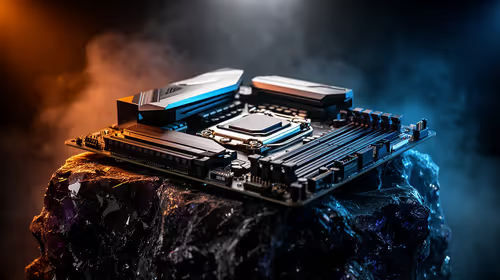
AM5 is smart for SA builders because it supports newer Ryzen CPUs, DDR5 memory, and a longer upgrade path. Compare board cost, cooling, gaming needs, and local part availability before choosing your next PC platform.
Read more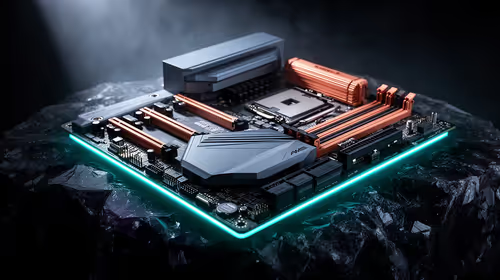
AM5 gives Randburg gaming builders a longer upgrade path. For SA buyers, DDR5 support, newer board features, and future CPU options can justify the platform. Weigh board cost, cooler support, BIOS maturity, and upgrade timing before choosing.
Read more
RTX 5090 on a 550W PSU leaves almost no practical room for OC plans. Treat the setup as constrained, with CPU draw, power spikes, cable quality, thermals, and stability checks more important than chasing extra clocks.

FPS drops on a Ryzen 9 9950X3D build often have a fixable cause. Check settings, drivers, thermals, background tasks, network conditions, and bottlenecks before assuming a part must be replaced.

The difference between PCIe 5.0 and PCIe 4.0 for SA gamers is mostly bandwidth headroom. Compare GPU slot needs, NVMe speed, motherboard support, and upgrade timing before paying extra for a newer platform.

Gaming PC stuck pixel checks in South Africa should confirm the monitor fault first. Use colour tests, screenshot comparison, cable swaps, display menu checks, and clear photos before deciding on support.

AMD's current driver now lists a Radeon RX 9050 4GB, while product coverage details a narrowed memory system. SA buyers should weigh the low VRAM ceiling against current local Radeon options.

Samsung Display has demonstrated a 16-inch 2.5K OLED laptop panel running at 300Hz. SA buyers should wait for a named notebook, full panel specifications and a local price before planning an upgrade.

Microsoft says some Windows 11 game crashes after recent updates are linked to RGB-related drivers. Affected SA gamers should confirm the update and driver before using the published registry workaround.
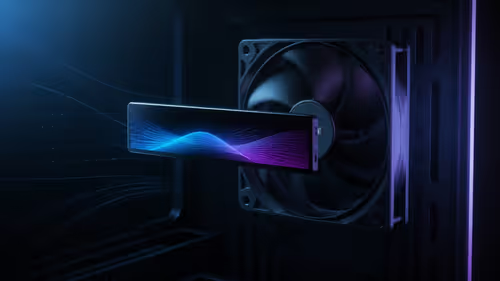
Thermalright's Fan Frame Vision-1 adds a 640x172 status screen to a standard 120mm fan. SA builders should check clearance, USB routing and local support before treating it as an easy upgrade.
1000W for RTX 5090 needs a full-build check, not a simple yes. Review GPU guidance, CPU draw, transient load, connectors, PSU quality, and upgrade plans before deciding.

Wi-Fi 6E vs Wi-Fi 6 matters for 4K video editing when files move across a network. The real-world difference between Wi-Fi 6E and Wi-Fi 6 for video editing in 4K depends on NAS access, cloud uploads, router range, and SA creator workflows.
RTX 5080 Super with a 750W PSU is more comfortable than lower wattage if the unit is quality. SA builders should still confirm GPU guidance, CPU draw, connector type, airflow, and upgrade room.
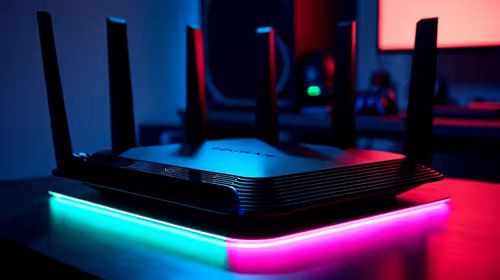
Wi-Fi 6E vs Wi-Fi 6 for Video Editing in 4K comes down to router support, latency, client devices, band support, and home network layout. SA buyers should match the choice to their setup instead of assuming one option always wins.