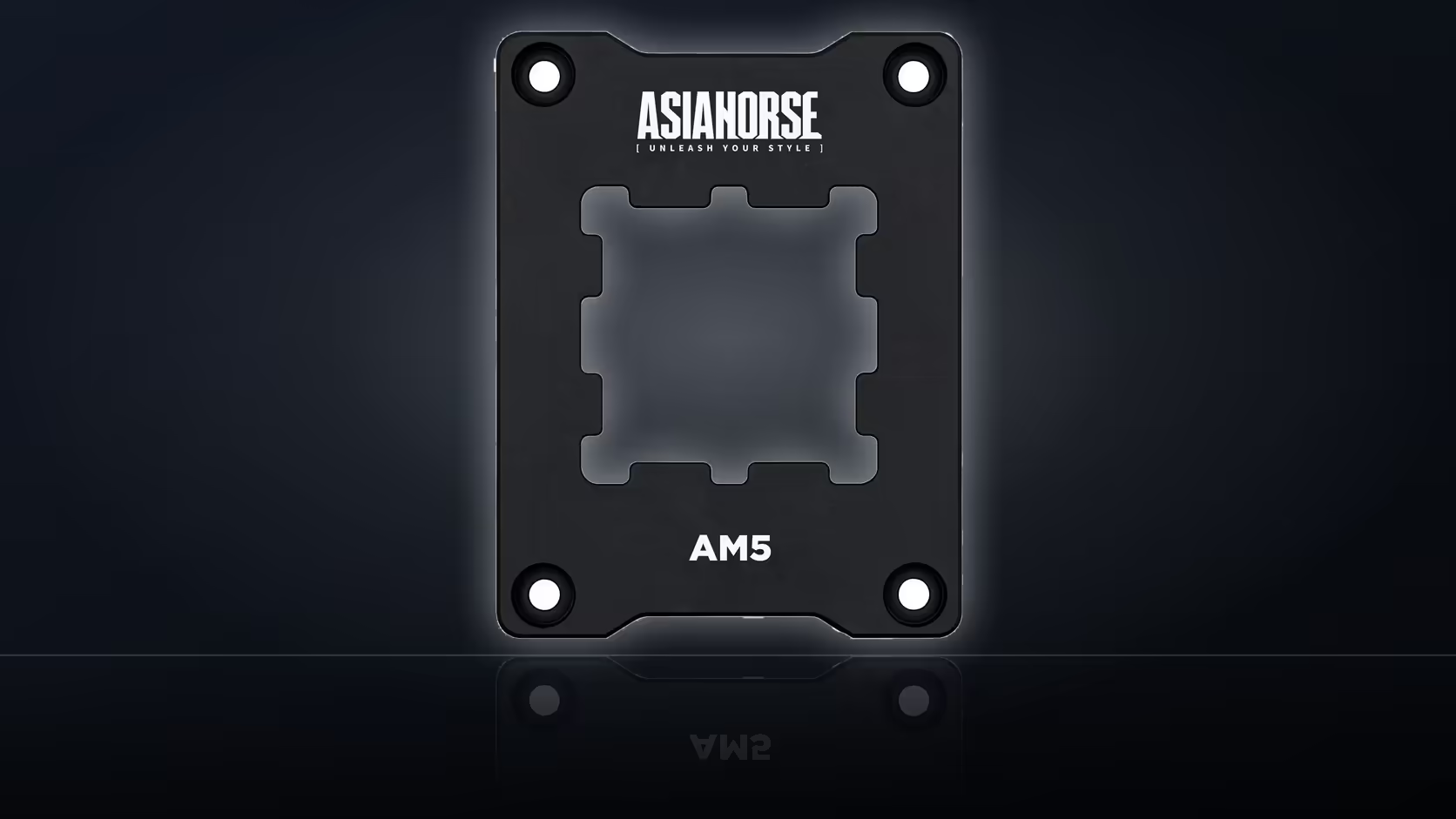
Socket-specific hardware is one of the fastest ways to end up with a part that looks right in a photo and does nothing on the board it was bought for. The Pulsar contact frame from AsiaHorse is built around one socket family only, and checking that against a board's chipset before ordering saves an unnecessary return.
Quick Answer
Pulsar is listed for AM5 boards running the X670, B650, or A620 chipsets and nothing beyond that. It is not compatible with AM4 boards and has no application on Intel sockets either, since each platform uses its own distinct retention hardware around the processor.
🔌 The platforms this part is built for
AsiaHorse names three chipset families on the product listing: X670, B650, and A620. All three sit under AMD's AM5 socket, which means the frame is designed around AM5's specific physical layout - the hole spacing, the retention geometry, and the socket shape that the stock arms clamp against. Nothing about the frame's design extends beyond that platform. It replaces the retention arms that ship with AM5 boards, fastened with four included screws and a hex wrench, and it does that job specifically because AM5's retention layout is what it was engineered to match.
❌ Why AM4 boards are a hard no
AMD's earlier AM4 platform uses a different socket shape and a different retention mechanism entirely - the mounting holes and clamping hardware do not align with AM5's layout. A frame built for one platform's geometry simply will not seat correctly on the other, regardless of how similar the two sockets might look at a glance. Anyone running an older AM4-based Ryzen system looking to address cooler contact should be looking at AM4-specific solutions, not this listing.
⚙️ Why Intel sockets are equally out of scope
Intel's LGA sockets use their own retention design, built around a different clamping mechanism from the start. There is no overlap between how an AM5 board secures a cooler and how an Intel LGA board does it, so a frame engineered for AMD's AM5 layout has no physical application on an Intel system. This is not a case of partial compatibility or a workaround with extra hardware - the two platforms simply do not share the geometry this product depends on.
Frequently Asked Questions
Which platforms are named?
AM5 boards using the X670, B650, or A620 chipsets, which the product listing states explicitly.
Would it fit an AM4 board?
No. AM4 uses different retention hardware, so a frame made for AM5 does not transfer to it.
And an Intel socket?
No. Intel sockets use an entirely different retention mechanism, so this frame has no application there.
How do I identify my socket?
The board specification states it, and AM5 boards are identified by the chipset names listed on this product.
Are all AM5 boards covered?
The listing names those three chipset families, which covers the mainstream AM5 range.
What if my chipset is not listed?
Then it falls outside what the product states, and confirming with the manufacturer would be the sensible step.
Does the processor model matter?
The frame works around the socket rather than the chip, so the board platform is what determines fitment.
Before ordering any socket-specific accessory it is worth confirming the exact chipset on the board itself. Pairing the right cooler from the cpu coolers range, and fresh compound from the thermal solutions shelf, only matters once socket compatibility is settled.
Not sure which socket your board uses?
Check the exact chipset before buying AM5-specific hardware, and browse Evetech's motherboard range if an upgrade is on the cards.