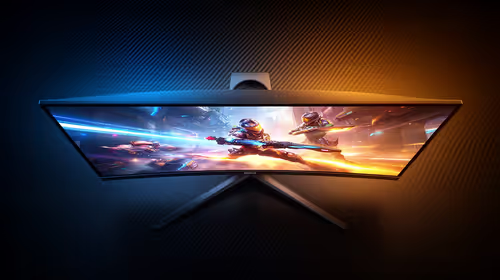
Resolution, motion and black depth pull a monitor decision in different directions. QHD OLED vs 4K IPS is not a simple quality ladder: the first can favour fast frames and deep contrast, while the second carries more pixels. The R10,999 ASUS XG27AQDMG is a speed-led QHD WOLED example with 240Hz refresh.
Quick Answer
Choose QHD OLED when rapid transitions, high refresh and black-level contrast lead the brief; choose 4K IPS when the higher pixel count is more valuable than pushing maximum frame rate. At R10,999, the XG27AQDMG runs 2560x1440 at 240Hz with 0.03ms response and True Black HDR.
🔎 Decide how much detail the task needs
4K contains more pixels than QHD, which can benefit fine imagery and dense desktop work. That extra resolution also increases the rendering workload in games. QHD's 2560x1440 canvas is less demanding and remains detailed at 27 inches.
Scaling, viewing distance and application layout affect how either choice feels. The gaming monitor selection provides useful comparisons across sizes and native resolutions.
⚡ Put motion requirements in context
The XG27AQDMG's 240Hz refresh and 0.03ms WOLED response target frequent updates with quick pixel transitions. A QHD workload can make high frame output more attainable than 4K on the same computer, though game settings still decide the result.
Adaptive sync supports the periods below the ceiling. FreeSync Premium and G-Sync Compatible let the ASUS follow changing frame completion on supported graphics systems.
🌑 Value contrast separately from resolution
WOLED controls light per pixel, producing black areas without an LCD backlight glow. IPS remains an LCD technology with different strengths and behaviour. More pixels do not automatically create deeper blacks, just as OLED contrast does not add 4K detail.
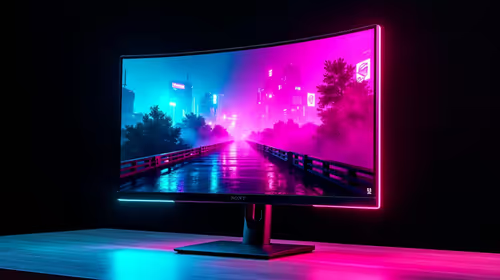
Browse the OLED monitor category to compare contrast-led options. If physical immersion is a priority, Evetech's curved screen range adds shape as another independent variable.
Judge the dominant workload. Competitive play, dark cinematic content and high-detail productivity may rank these features differently, so a balanced shortlist should reflect the hours spent on each.
Compare two complete working days
Use the QHD WOLED for one day of gaming, browsing and ordinary documents, then repeat equivalent tasks on the 4K IPS option. Keep screen size, viewing distance and operating-system scaling as comparable as possible. Record text comfort, dark-scene detail, motion clarity and the graphics settings required for the preferred frame rate. The result will be more useful than judging a store demo that shows different footage on each panel.
QHD reduces the pixel workload relative to 4K, which can make high frame targets more practical on the same graphics system. The XG27AQDMG reinforces that speed direction with 240Hz and a 0.03ms WOLED response. A 4K IPS monitor instead places more pixels on screen and may better suit a user whose work values fine static detail over maximum competitive refresh.
Room and ownership habits complete the choice. WOLED delivers exceptional black depth when ambient light is controlled, while regular content variation and sensible static-element habits support panel care. IPS may look less absolute in dark scenes but remains familiar for long fixed desktop layouts. At R10,999, the ASUS should be chosen because its speed, contrast and QHD workload match the buyer, not because OLED or 4K wins every category automatically.
Frequently Asked Questions
Which option has more pixels, QHD or 4K?
4K has the higher pixel count. QHD on the ASUS is 2560x1440 and places a lighter rendering demand on the graphics system.
Why can QHD be easier to drive at high frame rates?
The graphics card has fewer pixels to render per frame than at 4K. That can leave more performance available for frequent updates.
What contrast benefit does WOLED bring?
Individual pixels can turn off, giving dark scenes strong black depth and local contrast without relying on a shared backlight.
Which features show the ASUS monitor's speed focus?
Its QHD panel combines 240Hz refresh with a stated 0.03ms response and two adaptive-sync standards.
Would 4K IPS make more sense for detail-led work?
It can, especially when pixel count takes priority over maximum game refresh. Screen size and scaling should also be considered.
How should I assess the R10,999 WOLED option?
Measure its complete mix of QHD, speed, OLED contrast, HDR, sync flexibility and panel safeguards against the work you do most.
Ready to rank pixels, motion and contrast instead of forcing one specification to win?
Use Evetech's monitor categories to build a shortlist, then score each screen against your real gaming and desktop workload.