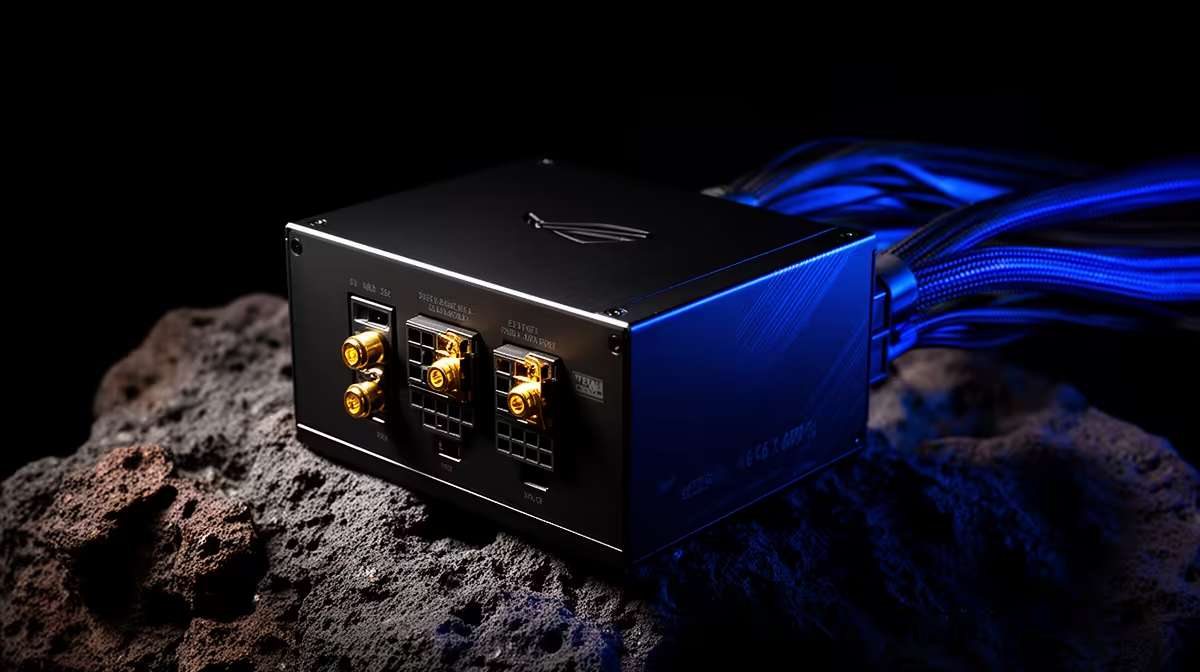
Reusing an old PSU with a new GPU can be safe when the exact unit was high quality, remains within its supported life and has the right capacity and cables. Age alone is not a universal cutoff. Unknown history, missing cables or unstable behaviour makes replacement the sensible path.
Quick Answer
Find the model, purchase date, warranty, rated output and cable set. Check the new GPU maker's system-power and connector guidance. Replace the PSU when you cannot verify those facts, when it has suffered a fault or when adapters would be needed outside supported instructions.
Use the power-supply catalogue and popular PSU models to price a named July 2026 replacement. Do not compare with a bare category minimum.
Model and History Matter
Read the label without opening the PSU enclosure. Check continuous wattage, 12V output, protections and manufacturer. Never open a PSU; internal capacitors can retain dangerous charge.
Consider years of heat, dust, outages and heavy load. A ten-year warranty does not guarantee every unit remains suitable after abuse, and an expired warranty does not prove immediate failure.
Connectors Can End the Reuse Plan
The new card may require a native 12V-2x6 cable or several eight-pin plugs. Use only cables approved for the exact PSU. Modular cables from another model can be electrically different.
Inspect plugs for damage, discolouration, looseness and bent contacts. Seat them fully with room for a gentle cable path.
Test Without Repeating Faults
Return CPU, GPU and memory to stable settings, then run a monitored game and combined load. A shutdown, burning smell, connector heat or crackling requires immediate power-down and proper diagnosis.
Software voltage readings cannot certify a PSU. When condition is uncertain, a known suitable replacement is cheaper than risking the new GPU and downtime.
Warranty and Service Life Are Clues
Find the invoice date and remaining manufacturer cover. Some premium supplies carry long warranties because their platform was designed for extended use. Confirm whether coverage transfers and what documentation a claim needs.
Warranty expiry is not a timer that causes failure. It marks the end of one support promise. Use age beside heat history, fan behaviour, connector condition and the cost of the hardware it will power.
If the PSU fan grinds, starts and stops abnormally or the unit has endured liquid or surge damage, retire it through an appropriate electronics recycling route. Do not attempt an internal repair.
Build a Replacement Comparison
Choose a named current PSU with the wattage, native connectors and case dimensions required. Record its price as of July 2026 and compare that amount with the new GPU and lost-work risk.
Replacing before the graphics card lets you test the PSU on known hardware. Run the old GPU, confirm stability, then install the new card. This staged approach makes troubleshooting easier.
Label and store the new modular cables together. Remove every old modular lead from the case so a similar-looking incompatible cable cannot be reused by mistake.
FAQ
Must every five-year-old PSU be replaced?
No. Exact model, warranty, workload, condition and new-system demand decide.
Can I use the old PSU's modular cables on a new PSU?
Only when the manufacturer explicitly confirms the cable is compatible with both exact models.
Does a successful boot prove the PSU is enough?
No. Sustained and changing loads can reveal problems that idle use misses.
Verify the old PSU's identity, history and approved cables, then replace it before the GPU when any part of that power path remains unknown.