


550W PSU Planning for RTX 5080 Super Builds in SA
550W for RTX 5080 Super needs a full-build check, not a simple yes. Review GPU guidance, CPU draw, transient load, connectors, PSU quality, and upgrade plans before deciding.
Read moreSending a gaming pc component overseas for warranty repair means it crosses SA customs twice, and each leg needs its own paperwork to avoid duty on your own property. Evetech's local warranty support skips this round trip entirely.
Your own component can attract questions when it leaves for repair and returns across the border. A customs repair round trip needs serial records, export proof and the current SARS procedure before shipping.
Sending a component overseas for repair creates an export and a return import, so you need evidence that the item coming back is your property or an authorised replacement under the same repair case. Arrange the customs procedure before dispatch. The courier, repair provider and SARS should confirm the required documents for your exact shipment; a note saying "warranty return" is not enough on its own.
Use the current best-seller catalogue to compare a named domestic replacement or support route. Complete-system owners can identify their configuration through the gaming PC best-seller listings. Check your own invoice and warranty terms before assuming an overseas return is required.
Get a repair authorisation with the provider's name, address, case number and fault description. Photograph the component, serial number, condition and packaging. Keep the purchase invoice and any import record from when the item first entered South Africa.
Ask the courier which outward declaration or temporary-export process applies and what will prove the item's status on return. Record its model, serial and value truthfully. Do not understate the shipment because it is faulty.
A repair centre may replace the whole component rather than return the same board. Ask it to state the original serial, replacement serial, reason for substitution and warranty-case number on the return paperwork. Without that chain, customs may see a different item instead of the outcome of your repair.
If the repair adds a charge, ask how labour, parts and transport must appear on the commercial or pro forma documents. Do not invent a zero value. The clearing agent needs an accurate description to apply the current rules.
Courier cover may protect physical loss or damage while excluding delay, poor packing, customs action or the component's own fault. Read the exclusions and claim limits before dispatch. Use packaging approved for the weight and fragility, then keep photos of the sealed parcel and collection scan.
Track both legs as separate shipments. Save every clearance request, upload receipt, assessment update and return label. If the parcel stalls, those records show which party has it and what information was supplied.
Current SARS guidance and the appointed clearing agent are the authority for the customs treatment. Get written advice before the component leaves, since trying to reconstruct an export record after it returns can be difficult.
Customs needs evidence that the arriving item is linked to the exported property and repair case. A changed serial or poor description can break that link.
Do not assume it does. Confirm who prepares each export, repair and return document, and review them for matching details.
Get a document linking both serial numbers and the warranty authorisation before the replacement ships.
Agree the repair-export procedure before dispatch, record the outgoing serial, and require paperwork that links any returning replacement to the same case.
Customs needs evidence that the arriving item is linked to the exported property and repair case. A changed serial or poor description can break that link.
Do not assume it does. Confirm who prepares each export, repair and return document, and review them for matching details.
Get a document linking both serial numbers and the warranty authorisation before the replacement ships.
550W for RTX 5080 Super needs a full-build check, not a simple yes. Review GPU guidance, CPU draw, transient load, connectors, PSU quality, and upgrade plans before deciding.
Read more
8000Hz polling is overrated for most SA gamers because gains can be tiny next to battery drain and monitor limits. Mbombela players should weigh mouse feel, game support, and system stability before chasing the number.
Read more
Magnetic switches are taking over SA gaming keyboards because actuation can be tuned. For Sandton gamers, rapid trigger, reset control, and profile depth can help, but layout, key feel, and software quality still matter.
Read more
Polokwane oled monitor value questions need cautious SA context because pricing can move with availability, exchange rates, specs, and warranty support. Treat the trend as a planning signal, not a fixed price promise.
Read more
Arc B580 budget builds for Midrand gamers can shift with exchange rates, supply, specs, and model tier. Treat the title as a buying prompt, then compare SA warranty, timing, and build priorities.
Read more
ROG Ally X may beat the LCD Steam Deck for SA gamers who value stronger handheld performance, more memory, and Windows flexibility. Compare battery life, controls, game libraries, and Polokwane support needs before deciding.
Read more
Minisforum's M2 Pro pairs Core Ultra X7, Arc B390 graphics and 32GB onboard memory in 1.8 litres. SA buyers should weigh its fixed memory and $1,439 launch offer against local mini PCs.
Lenovo says Legion Go failures linked to BIOS N3CN42WW are not user error. Affected SA owners should stop retrying the update, preserve proof and open a support case.

Smart monitors can add apps and convenience, but they also add privacy settings and unwanted-software risk. SA buyers should audit the operating system before paying for extras.

A fake 113GB GTA VI ISO reportedly used empty padding around a small malware payload. SA gamers should delete unofficial builds, keep Windows security active and wait for official channels.
ASUS calls the ROG GT-BN98 the first Wi-Fi 8 gaming router. SA buyers should fix coverage and client limits before paying for a future wireless standard.
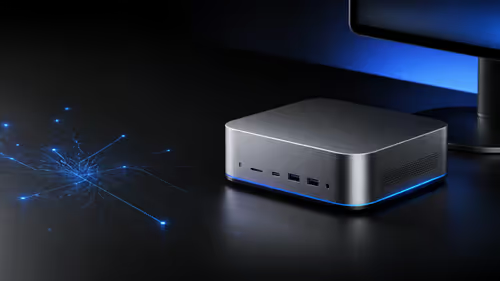
Apple's M6 Mac mini adds faster AI, graphics and networking in the same compact format. SA buyers should wait for a rand listing before comparing value.
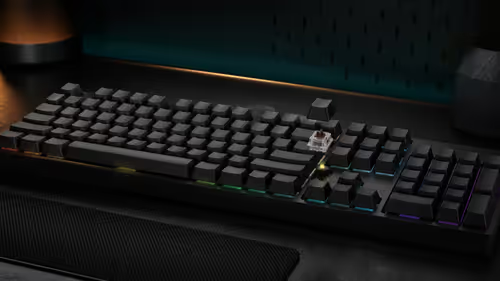
The Vulcan II XP adds hot-swappable switches, sound damping and gaming controls to a full-size wired board. SA buyers should compare feel before features.

Microsoft says Windows on Arm now has over 7,000 verified apps and games. SA buyers should still check each driver, game and work tool before switching.

Xbox Insiders can test disc-to-digital from 31 August 2026. Supported Xbox One and Series X discs gain a digital entitlement, but older discs, regions and title coverage still need exact checks.

ViewSonic's XG2738 pairs QHD QD-OLED with 240Hz and automatic panel care. SA buyers should compare warranty, brightness, ports and burn-in protection against today's R9,999-plus OLED shelf.

NVIDIA's final Windows 10 Game Ready driver is due in October 2026. SA gamers can keep using their GPU, but new game optimisations move on while critical security fixes continue quarterly.

JBL's new Quantum 520, 520X and 120 headsets cover wireless, Xbox-certified and wired use. SA buyers should compare connection, comfort and microphone needs before paying for a new badge.