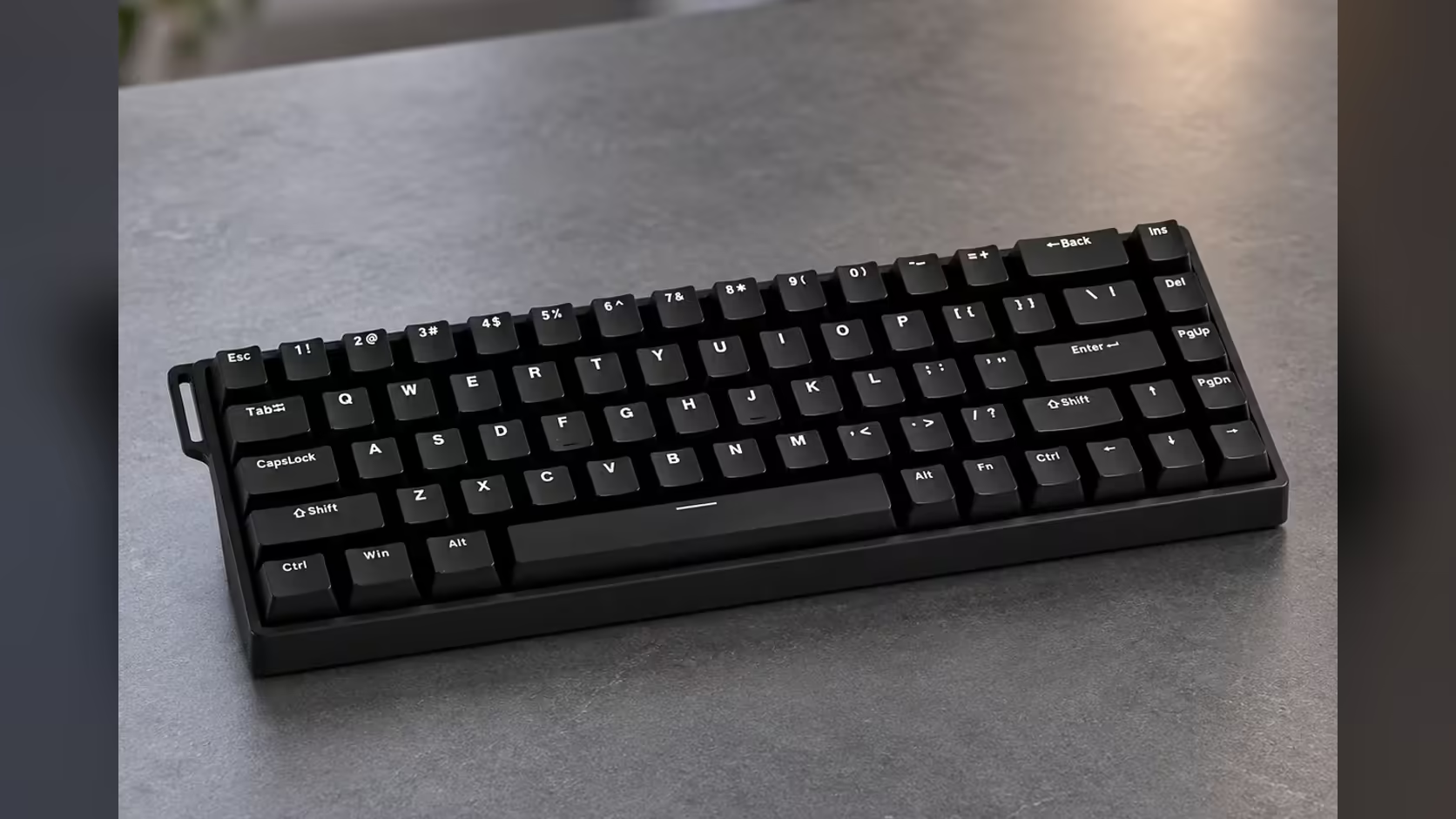
If your mouse keeps bumping into the side of the keyboard mid-flick, the problem is rarely your aim. It is geometry. A full-size board pushes your mouse hand far off to the right, and a 65% keyboard for mouse room pulls it back towards the middle of your body. The AULA WIN68 is built on exactly that idea, and AULA pitches its compact layout on the space it leaves for your mouse.
Quick Answer
A 65% board like the AULA WIN68 HE drops the numpad and function row, so the mouse can sit closer in and travel further before it hits anything. Players on low sensitivity, who swing the mouse across the pad, gain most. Both the WIN68 HE and WIN68 MAX use the same 68-key layout with arrow keys kept. Evetech has the HE at R449 and the MAX at R699.
🖱️ Why low-sensitivity players care
Low in-game sensitivity means big arm movements for small turns on screen. Many shooter players prefer it for steadier aim, but it needs room: a single turn can sweep the mouse a long way to the left. With a full-size board, that sweep runs into the numpad. With a compact one, the space is simply there.
A narrower board also lets the keyboard itself sit angled or pushed further left, so your left hand stays on the movement keys while your right arm has a clear lane.
🧍 Posture and your shoulders
A board that ends before the numpad means your two hands are closer together. That keeps the mouse arm nearer your side rather than reaching outwards, which many people find more relaxed on the shoulder over a long session. It is not a cure for a poor chair or desk height, but it removes one common source of strain.
📏 65% against 75% on a tight desk
A 75% board keeps a function row and usually a few extra keys, so it is a bit wider and taller than a 65% one, but still well short of a full-size board. AULA does not publish measurements for the WIN68, so a precise comparison is not possible from the product pages. For reference, AULA's 75% AG75 measures 319.8 x 143.8 x 42.1mm, and the HERO 75 HE 313 x 139 x 43mm.
If every centimetre counts, the 65% layout is the tighter fit. If you rely on the function row for work shortcuts, a 75% board is a sensible middle ground.
🧵 Keeping the rest of the desk tidy
The WIN68 is a wired board that connects through a detachable USB-C cable, which is also how it keeps its 8000Hz polling. A detachable cable is easier to route neatly than a fixed one: run it behind the monitor stand or along the desk edge, and it can be unplugged when the board goes into a bag.
Compact does not mean stripped back. Both editions keep magnetic switches with Rapid Trigger, per-key south-facing RGB and hot-swap sockets. The WIN68 HE uses Gray Wood switches at 32gf. The WIN68 MAX uses Wing Chun switches at 36gf and adds the competitive modes, including SOCD, DKS and Mod-Tap, which can also help squeeze more actions onto fewer keys.
The WIN68 pair sits in Evetech's gaming keyboards category, and because both are hot-swappable, the keyboard switches range stays open to you later. Each edition comes with a 2 Years Local Warranty through Evetech.
Frequently Asked Questions
Why does keyboard width matter to a low-sensitivity player?
Low sensitivity needs long mouse sweeps. A narrower board leaves more clear space to the side for those movements.
Can a compact board help shoulder comfort?
It keeps your hands closer together, so the mouse arm reaches out less. Many people find that more relaxed over long sessions.
How much wider is a typical 75% board?
It adds a function row and often a few keys, so it is somewhat larger, though still far smaller than a full-size board.
Does compact mean fewer features?
Not here. Both WIN68 editions keep magnetic switches, Rapid Trigger, 8000Hz polling, hot-swap sockets and per-key RGB.
Which edition suits a space-saving setup better?
Both share the same footprint. Choose the HE for a lighter switch or the MAX for its extra competitive modes.
Need more room for your mouse?
Look through Evetech's gaming keyboard range for compact 65% and 75% boards that free up space on a busy desk.