


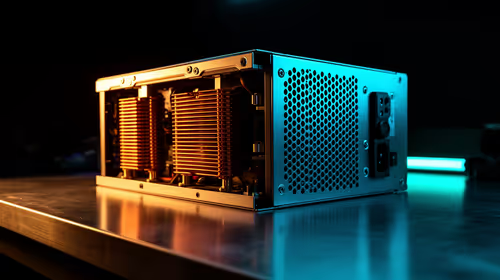
1000W PSU Planning for RTX 5090 Builds in SA
1000W for RTX 5090 needs a full-build check, not a simple yes. Review GPU guidance, CPU draw, transient load, connectors, PSU quality, and upgrade plans before deciding.
Read moreAccessory choice for Solving motion blur issues in fast-paced starts with connector fit. For solving motion blur issues in, confirm cable length, port shape and warranty path before buying.
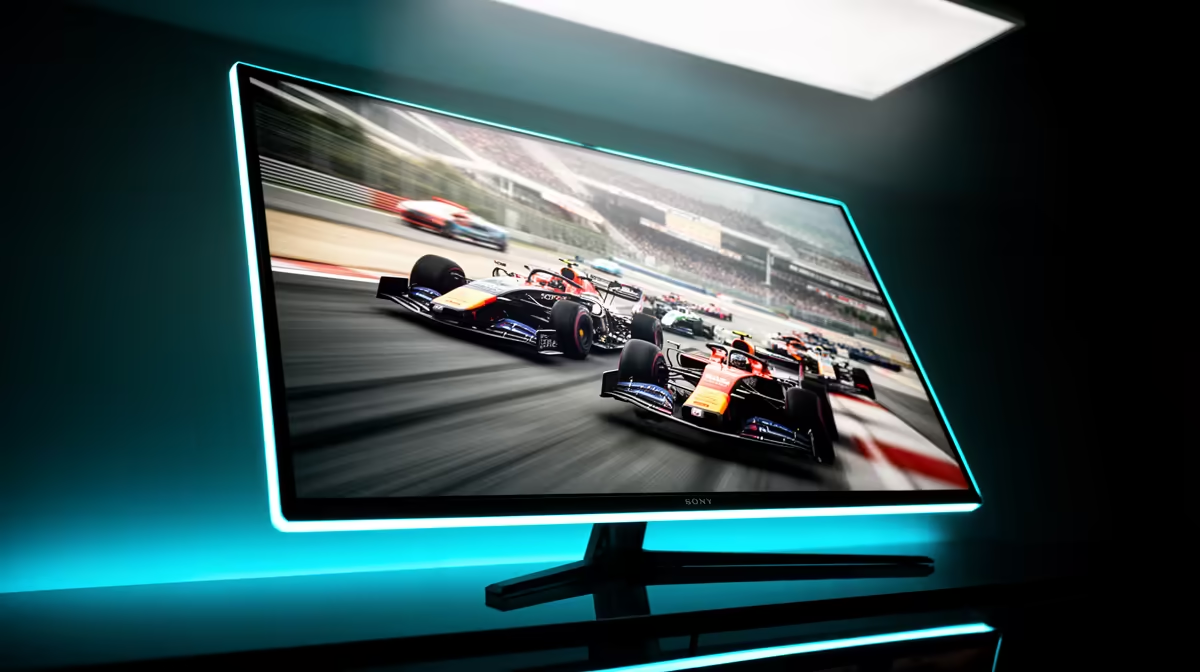
A problem with motion blur issues in fast-paced games with 0.03 is easier to solve when you separate symptoms from assumptions. In bright daytime rooms, GPU mismatch often points back to 0.03 ms response time or a weak match with 1440p or 4K scaling.
For motion blur issues in fast-paced games with 0.03, shortlist around 0.03 ms response time, 1440p or 4K scaling and 240Hz refresh support. Use 1440p or 4K scaling as the tie-breaker for motion blur issues in fast-paced games with 0.03 for shared devices.
Use one normal session as the test case for motion blur issues in fast-paced games with 0.03. During bright daytime rooms, watch how 0.03 ms response time affects timing, handling or comfort, then compare 1440p or 4K scaling against the device you use most. In bright daytime rooms, motion blur issues in fast-paced games with 0.03 should solve one visible problem with the daily setup. The right option makes smoother refresh feel routine rather than fragile.
Small details around motion blur issues in fast-paced games with 0.03 become more important after the unboxing. Cable strain, button placement, app support, desk space and storage can all change how a 27-inch desk setup feels. Test motion blur issues in fast-paced games with 0.03 with the cable or pairing route, not just in copy. If two options look close, choose the one that keeps more readable detail steady with fewer daily workarounds.
The final check for motion blur issues in fast-paced games with 0.03 is whether you can explain the benefit in one real situation. If the answer is bright daytime rooms, connect it directly to 0.03 ms response time, 1440p or 4K scaling or 240Hz refresh support. If the answer for motion blur issues in fast-paced games with 0.03 is only that the product sounds premium, the shortlist needs more work. A good choice for motion blur issues in fast-paced games with 0.03 makes smoother refresh easier without adding GPU mismatch.
blur issues in fast-paced games with 0.03 against one real bright daytime rooms session. If 0.03 ms response time, 1440p or 4K scaling and 240Hz refresh support all fit, the motion blur issues in fast-paced games with 0.03 shortlist is already stronger.
Start with 0.03 ms response time, then check 1440p or 4K scaling on the main device. Most motion blur issues in fast-paced games with 0.03 problems become clearer once basic compatibility is removed.
Replace the product only when 240Hz refresh support or build quality is clearly limiting smoother refresh. If motion blur issues in fast-paced games with 0.03 settings or pairing are the cause, a new model may repeat the same issue.
Yes. Devices and apps can all affect motion blur issues in fast-paced games with 0.03, especially when bright daytime rooms depends on stable support.
Yes. At 0.03ms GtG, pixel transitions complete within a single 4.2ms frame at 240Hz, nearly eliminating smear trails on moving targets.
Backlight strobing (ELMB) reduces sample-and-hold blur that 0.03ms GtG cannot fix. Combining both gives the sharpest motion on fast scenes.
No. WOLED pixels switch via self-emissive OLED chemistry without overdrive voltage, so inverse ghosting artefacts simply do not occur.
Yes. Strobing typically halves effective brightness from 400 nits to around 200 nits, which can reduce visibility in bright SA gaming environments.
Yes. Valorant is GPU-light; an RTX 4060 with a Ryzen 5 7600X easily sustains 240-plus fps at 1080p for full 240Hz panel utilisation.
Some users report headaches from strobing below 240Hz. Start at maximum ELMB brightness and reduce session length to under 2 hours initially.
1000W for RTX 5090 needs a full-build check, not a simple yes. Review GPU guidance, CPU draw, transient load, connectors, PSU quality, and upgrade plans before deciding.
Read more
RTX 5080 Super with a 750W PSU is more comfortable than lower wattage if the unit is quality. SA builders should still confirm GPU guidance, CPU draw, connector type, airflow, and upgrade room.
Read more
How to fix FPS drops after a RX 9070 XT starts with driver cleanup, chipset updates, thermals, and power checks. For SA gaming PCs, confirm PCIe seating, monitor refresh, frame caps, and per-game graphics settings before replacing parts.
Read more
How to fix low FPS Windows 11 Wi-Fi 7 issues starts by checking whether the problem is frame rate or network lag. Test ping, drivers, power settings, Ethernet, and game FPS before adjusting visuals.
Read more
AM5 is smart for SA builders because it supports newer Ryzen CPUs, DDR5 memory, and a longer upgrade path. Compare board cost, cooling, gaming needs, and local part availability before choosing your next PC platform.
Read more
AM5 gives Randburg gaming builders a longer upgrade path. For SA buyers, DDR5 support, newer board features, and future CPU options can justify the platform. Weigh board cost, cooler support, BIOS maturity, and upgrade timing before choosing.
Read more
RTX 5090 on a 550W PSU leaves almost no practical room for OC plans. Treat the setup as constrained, with CPU draw, power spikes, cable quality, thermals, and stability checks more important than chasing extra clocks.
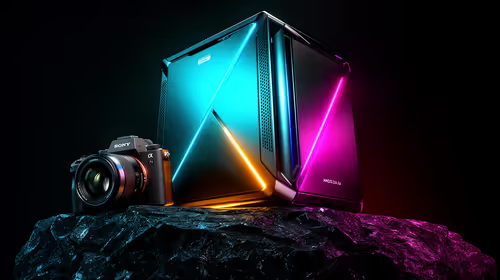
FPS drops on a Ryzen 9 9950X3D build often have a fixable cause. Check settings, drivers, thermals, background tasks, network conditions, and bottlenecks before assuming a part must be replaced.

The difference between PCIe 5.0 and PCIe 4.0 for SA gamers is mostly bandwidth headroom. Compare GPU slot needs, NVMe speed, motherboard support, and upgrade timing before paying extra for a newer platform.

Gaming PC stuck pixel checks in South Africa should confirm the monitor fault first. Use colour tests, screenshot comparison, cable swaps, display menu checks, and clear photos before deciding on support.

AMD's current driver now lists a Radeon RX 9050 4GB, while product coverage details a narrowed memory system. SA buyers should weigh the low VRAM ceiling against current local Radeon options.

Samsung Display has demonstrated a 16-inch 2.5K OLED laptop panel running at 300Hz. SA buyers should wait for a named notebook, full panel specifications and a local price before planning an upgrade.

Microsoft says some Windows 11 game crashes after recent updates are linked to RGB-related drivers. Affected SA gamers should confirm the update and driver before using the published registry workaround.
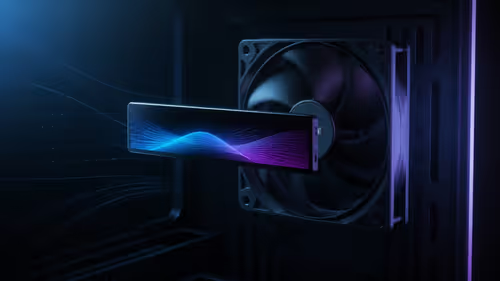
Thermalright's Fan Frame Vision-1 adds a 640x172 status screen to a standard 120mm fan. SA builders should check clearance, USB routing and local support before treating it as an easy upgrade.
1000W for RTX 5090 needs a full-build check, not a simple yes. Review GPU guidance, CPU draw, transient load, connectors, PSU quality, and upgrade plans before deciding.
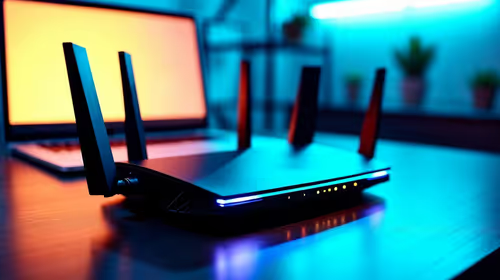
Wi-Fi 6E vs Wi-Fi 6 matters for 4K video editing when files move across a network. The real-world difference between Wi-Fi 6E and Wi-Fi 6 for video editing in 4K depends on NAS access, cloud uploads, router range, and SA creator workflows.
RTX 5080 Super with a 750W PSU is more comfortable than lower wattage if the unit is quality. SA builders should still confirm GPU guidance, CPU draw, connector type, airflow, and upgrade room.
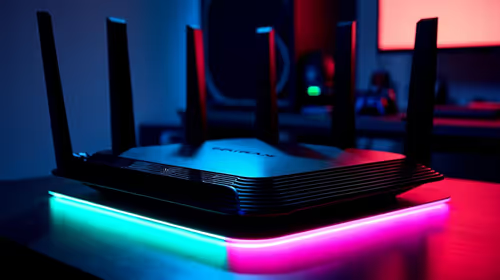
Wi-Fi 6E vs Wi-Fi 6 for Video Editing in 4K comes down to router support, latency, client devices, band support, and home network layout. SA buyers should match the choice to their setup instead of assuming one option always wins.