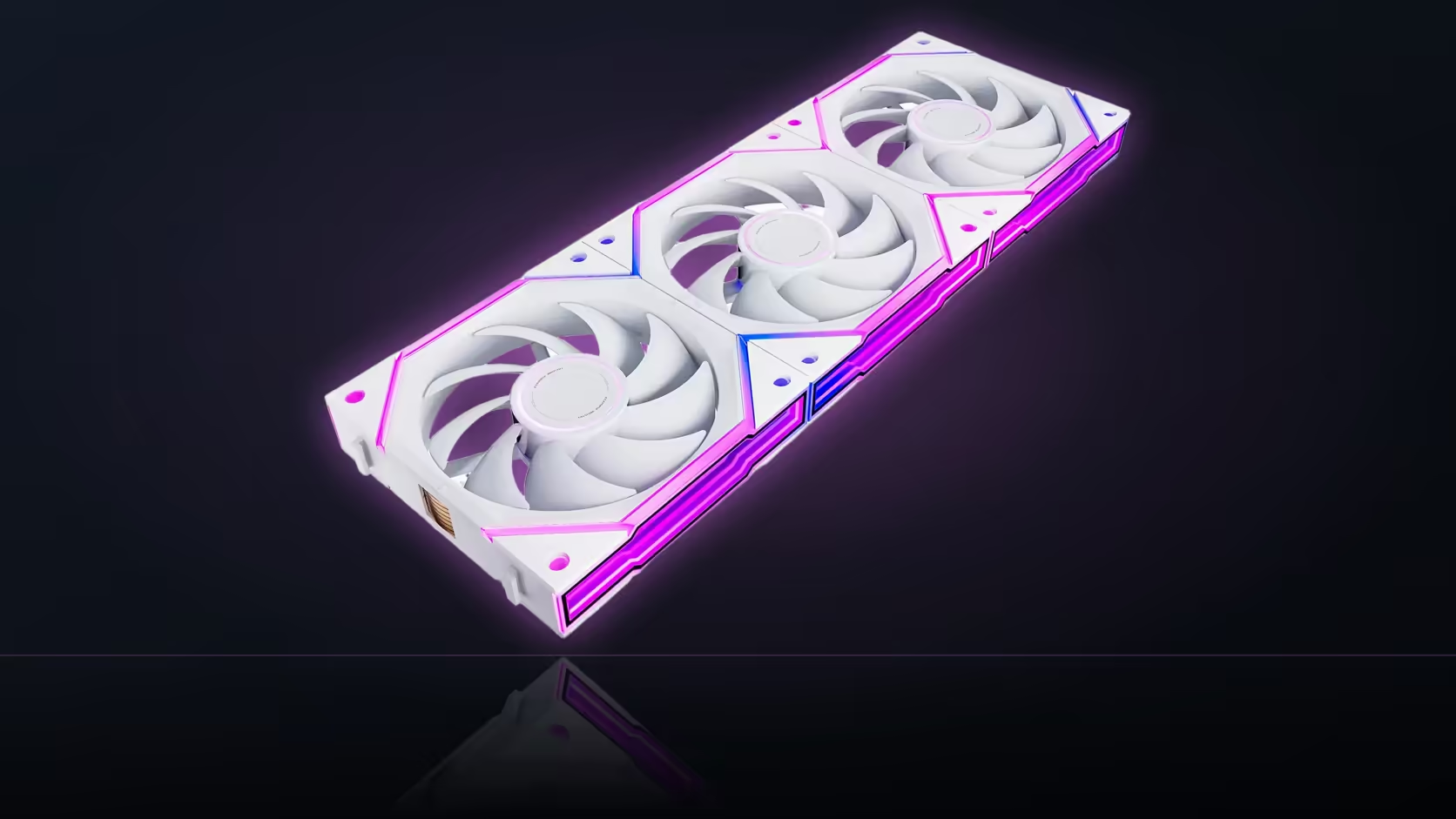
It would be reasonable to assume a fan spinning faster changes how its lighting looks, since so much else about a fan does shift with speed. The Nyota Ultra's ring is the exception to that assumption, and the reason comes down to exactly where its LEDs physically sit.
Quick Answer
The Nyota Ultra's 16 addressable LEDs sit in the frame ring rather than on the moving blades, so the infinity-mirror effect looks essentially the same at 800 RPM as it does at 2000 RPM. Spin speed does not change the lit element itself; what does change is the blur of the blades behind it.
🔦 Where the LEDs are actually mounted
The lighting sits in the stationary frame ring surrounding the fan, not on the blades themselves. Because the ring does not move relative to the frame even as the impeller spins, the lit element it produces stays consistent regardless of how fast the fan is running. That is a deliberate design choice, distinct from lighting mounted directly on rotating blades.
🌀 What actually does change with blade speed
The blur behind the ring shifts as speed increases: at 800 RPM individual blades remain somewhat distinguishable, while at 2000 RPM they blur into a flatter, more continuous surface. That visual change is real and noticeable, but it is a separate effect from the mirror ring itself, which stays unchanged throughout.
⚖️ How blade-mounted lighting would behave differently
A fan with LEDs mounted directly on its blades would produce genuinely speed-dependent effects, since the lit points themselves are physically moving and their apparent pattern shifts with rotation. The Ultra's frame-ring design sidesteps that entirely, which is worth knowing if you are comparing it against a different fan where blade-mounted lighting does behave that way.
🎛️ Linking speed and lighting through software anyway
Some motherboard or case lighting software can drive an effect from temperature readings, and since temperature and fan speed often correlate under load, a build can appear to link the two even though they remain separate systems technically. The ring itself carries 16 addressable LEDs layered by the infinity-mirror construction, and brightness there is governed by the addressable control signal rather than by RPM, so a fan running quietly at idle shows the same lit ring as one spinning at its maximum. Browse the case fan range to compare ring designs across models, and case accessories for the ARGB controllers that manage ring effects.
Frequently Asked Questions
Where exactly are the Ultra's LEDs mounted?
In the stationary frame ring around the fan, which is why the lit element does not shift as the blades spin.
Does the blade blur change what is visible at all?
Yes, faster blades blur into a flatter surface behind the ring, though the ring's own lighting stays unchanged.
Would blade-mounted lighting behave differently to this?
Yes, lighting fixed to moving blades produces effects that genuinely shift with rotation speed, unlike a stationary frame ring.
Does the mirror depth vary with how fast the fan spins?
No, the depth comes from the ring's construction and viewing angle, neither of which relates to fan speed.
Can lighting and fan speed be linked through software?
Some board software can drive lighting from temperature, which correlates with speed, though the two remain separate systems underneath.
Does the ring dim when the fan runs slowly?
No, brightness is set by the addressable lighting control rather than by how fast the fan happens to be spinning.
Ready to see how a frame-mounted ring holds its look at any speed?
Browse Evetech's case fan range for the Nyota Ultra and its ARGB siblings.