


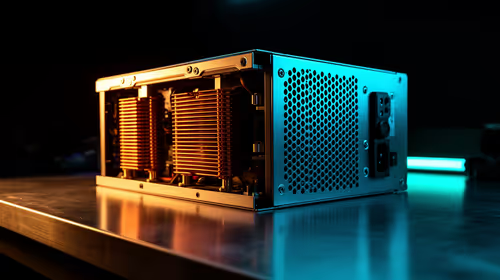
1000W PSU Planning for RTX 5090 Builds in SA
1000W for RTX 5090 needs a full-build check, not a simple yes. Review GPU guidance, CPU draw, transient load, connectors, PSU quality, and upgrade plans before deciding.
Read moreMost overlays report VRAM allocated on a graphics card, meaning memory the game has reserved for caching, not memory it is actively using every frame. A bar sitting near full is not automatically a bottleneck, so read the two numbers correctly.
A VRAM meter near full can be harmless. Many games reserve graphics memory for textures and caches before they need every byte. Trouble starts when the working set exceeds the useful local capacity and assets have to move across a slower path.
Read the metric's name before reacting. Allocation or committed memory describes space requested or reserved by the game. Dedicated GPU memory in use may be closer to the active footprint, though tools and APIs still report it in different ways. Confirm pressure through frame-time spikes, texture pop-in and settings changes.
The GeForce GPU selection lets you compare VRAM capacities within NVIDIA's range. The graphics-card best-seller list adds popular alternatives, but capacity should be judged beside GPU speed, resolution and the games you play.
A game can keep recently used textures in available VRAM so they are ready if you turn back towards an area. Empty memory would bring no benefit. Some engines request a broad budget and manage assets inside it, which makes a monitoring overlay look alarming while play remains smooth.
Windows and the driver also manage budgets. Other applications, browser windows and hardware-accelerated video can consume part of the local memory. Shared GPU memory shown in Task Manager is system RAM available to the graphics path; it is much slower than VRAM on the card.
Watch the frame-time graph as you enter a new area or turn the camera. Repeating spikes paired with asset streaming, muddy textures that sharpen late, or a large improvement after lowering texture quality can point to memory pressure.
A smooth benchmark with a full allocation meter is weak evidence of a problem. Compare the same scene after reducing texture resolution one step. Keep ray tracing, output resolution and background applications unchanged so the test isolates memory demand.
Texture quality often has a large VRAM effect with a smaller performance cost until the card runs short. Ray-tracing data, high-resolution shadows and large frame buffers also consume memory. Upscaling can reduce some render-target demand, though it will not shrink every texture pack.
Restart the game after a major texture change if the engine does not release its cache. A clean run prevents the old allocation from confusing the comparison.
Use the same monitoring tool for both runs. Task Manager, a vendor overlay and a game's own counter can label or sample memory in different ways, so mixing their readings creates a false comparison. Note the peak and the moment when any hitch occurred.
No. It can be a healthy cache. Check performance symptoms and a controlled setting change.
No. It uses system memory across the platform's interconnect and carries much higher latency.
Texture quality is the clearest first test, followed by other memory-heavy options identified in the game's menu.
Match the overlay label to what it measures, repeat one demanding scene and lower texture quality one step before blaming a near-full VRAM bar.
No. It can be a healthy cache. Check performance symptoms and a controlled setting change.
No. It uses system memory across the platform's interconnect and carries much higher latency.
Texture quality is the clearest first test, followed by other memory-heavy options identified in the game's menu. {{PRODUCTS: { facets: { query: "graphics card with 12GB VRAM" }, limit: 12, title: "Compare GPU Memory Options", style: "4" } }}
1000W for RTX 5090 needs a full-build check, not a simple yes. Review GPU guidance, CPU draw, transient load, connectors, PSU quality, and upgrade plans before deciding.
Read more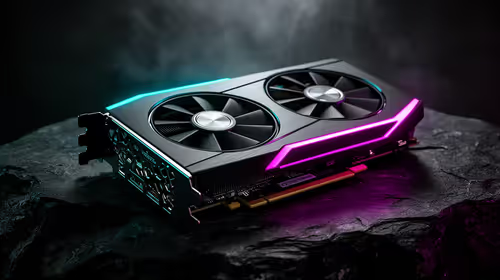
RTX 5080 Super with a 750W PSU is more comfortable than lower wattage if the unit is quality. SA builders should still confirm GPU guidance, CPU draw, connector type, airflow, and upgrade room.
Read more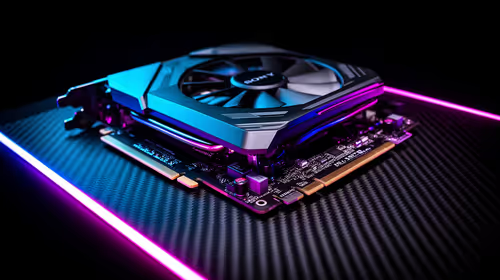
How to fix FPS drops after a RX 9070 XT starts with driver cleanup, chipset updates, thermals, and power checks. For SA gaming PCs, confirm PCIe seating, monitor refresh, frame caps, and per-game graphics settings before replacing parts.
Read more
How to fix low FPS Windows 11 Wi-Fi 7 issues starts by checking whether the problem is frame rate or network lag. Test ping, drivers, power settings, Ethernet, and game FPS before adjusting visuals.
Read more
AM5 is smart for SA builders because it supports newer Ryzen CPUs, DDR5 memory, and a longer upgrade path. Compare board cost, cooling, gaming needs, and local part availability before choosing your next PC platform.
Read more
AM5 gives Randburg gaming builders a longer upgrade path. For SA buyers, DDR5 support, newer board features, and future CPU options can justify the platform. Weigh board cost, cooler support, BIOS maturity, and upgrade timing before choosing.
Read more
A fake 113GB GTA VI ISO reportedly used empty padding around a small malware payload. SA gamers should delete unofficial builds, keep Windows security active and wait for official channels.

Wi-Fi 6E vs Wi-Fi 6 matters for 4K video editing when files move across a network. The real-world difference between Wi-Fi 6E and Wi-Fi 6 for video editing in 4K depends on NAS access, cloud uploads, router range, and SA creator workflows.

The difference between PCIe 5.0 and PCIe 4.0 for SA gamers is mostly bandwidth headroom. Compare GPU slot needs, NVMe speed, motherboard support, and upgrade timing before paying extra for a newer platform.
Gaming PC stuck pixel checks in South Africa should confirm the monitor fault first. Use colour tests, screenshot comparison, cable swaps, display menu checks, and clear photos before deciding on support.

Shokz OpenFit Air 2 earbuds weigh 7.2g each and use a redesigned dual-driver open-ear layout. SA buyers should choose them for comfort and awareness, not maximum isolation.

AMD's current driver now lists a Radeon RX 9050 4GB, while product coverage details a narrowed memory system. SA buyers should weigh the low VRAM ceiling against current local Radeon options.

Samsung Display has demonstrated a 16-inch 2.5K OLED laptop panel running at 300Hz. SA buyers should wait for a named notebook, full panel specifications and a local price before planning an upgrade.

Microsoft says some Windows 11 game crashes after recent updates are linked to RGB-related drivers. Affected SA gamers should confirm the update and driver before using the published registry workaround.
Shokz OpenFit Air 2 earbuds weigh 7.2g each and use a redesigned dual-driver open-ear layout. SA buyers should choose them for comfort and awareness, not maximum isolation.
A fake 113GB GTA VI ISO reportedly used empty padding around a small malware payload. SA gamers should delete unofficial builds, keep Windows security active and wait for official channels.

The ROG Flux Charger Dock combines 260W total output, 140W laptop charging and HDMI 2.1. SA buyers should check laptop USB-C limits, display needs and local warranty first.

ASRock's Rock 360 Digital AIO adds a 1.05-inch CPU temperature display, 360mm radiator and simplified wiring. SA builders should check case fit, socket support and local warranty.