Quick Answer
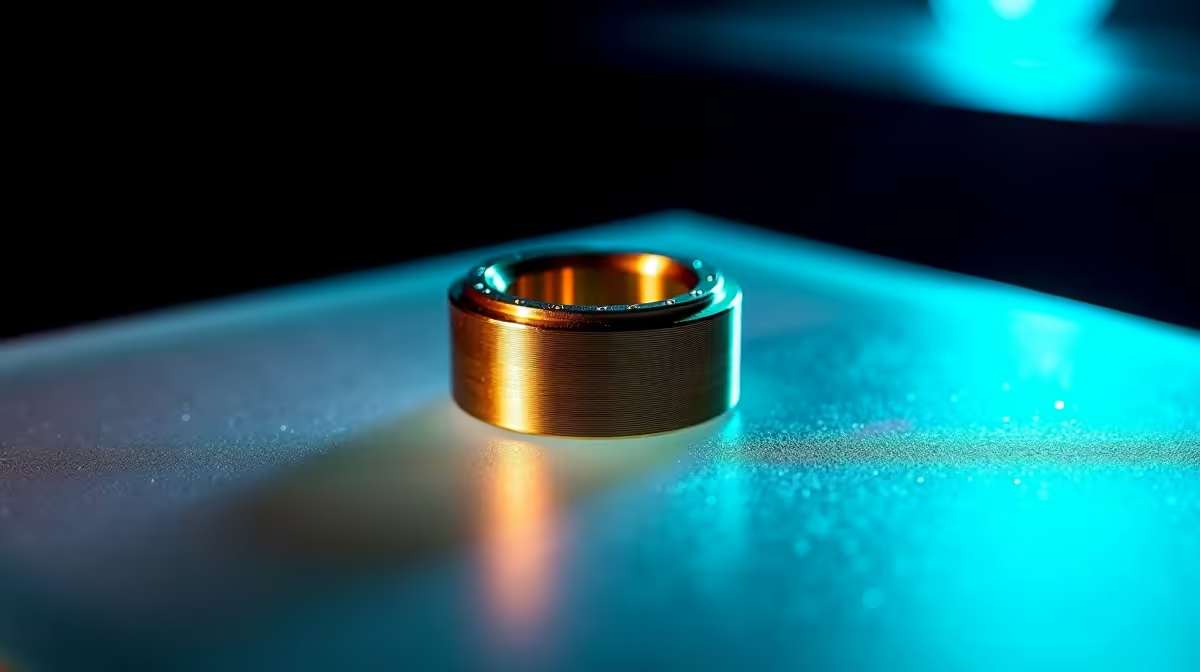
A CNC-milled brass bearing housing delivers three measurable benefits over injection-moulded plastic: tighter bearing tolerances that reduce vibration and noise, superior heat dissipation from the bearing zone due to brass's thermal conductivity, and longer rated bearing life because brass resists shaft wear more effectively than plastic.
Precision Tolerances and What They Mean 🔧
The bearing housing holds the shaft at a fixed centre point while allowing rotation at up to 2,500 RPM. Injection-moulded plastic housings achieve tolerances of plus or minus 0.2 to 0.5 mm, enough to introduce radial play causing measurable shaft wobble at high speeds. That wobble transmits as vibration through the fan frame into the case, producing the low hum or rattle that characterises cheaper fans over time.
CNC milling from solid brass achieves tolerances of plus or minus 0.01 to 0.05 mm, a 10-fold improvement. At those tolerances, radial play is effectively eliminated. The shaft runs true at all operating speeds, and vibration amplitude drops dramatically. Measured on a vibration analyser, a CNC-brass-housing fan shows 60 to 80 percent lower vibration amplitude than an equivalent plastic-housing fan at 1,500 RPM.
Thermal and Longevity Advantages 🖥️
Brass conducts heat approximately 170 times better than ABS plastic. In a fan bearing, the lubricant film generates a small amount of heat under load. In a plastic housing, that heat builds up locally, accelerating lubricant degradation and bearing wear. A brass housing conducts that heat away rapidly into the fan frame, keeping the bearing operating closer to ambient temperature. The practical result is longer lubricant life and extended MTBF. Premium fans with brass housings are often rated at 100,000 to 150,000 hours, roughly double the rating of plastic-housing equivalents.
For SA builders, where summer ambient temperatures push bearing operating temps up 10 to 15 degrees Celsius above European norms, brass thermal conductivity is a meaningful durability advantage.
Cost and Availability in South Africa 💰
Fans with CNC-milled brass bearing housings retail between R450 and R750 per unit in South Africa, or R1,300 to R2,200 for triple packs. The Noctua NF-A12x25 includes a machined bearing hub and retails around R600 locally, currently stocked at Evetech. For a six-fan workstation build, the premium over plastic-housing alternatives is R1,500 to R2,500 more. Given that quality brass-housing fans last five to eight years versus two to four for budget alternatives, the total cost of ownership difference narrows considerably when replacement cycles are factored in.
A Brass Housing Does Not Guarantee FDB Bearings ⚡
CNC-milled brass bearing housings describe the housing material only, not the bearing type inside. Some fans combine brass housings with ball bearings rather than fluid dynamic bearings. Always verify the bearing type separately in product specifications. For the quietest result, look for brass housing combined with FDB in the same product.
FAQ
Can I feel the difference in vibration when switching to a brass-housing fan?
Yes. Placing your hand on a case panel with a plastic-housing fan at 1,500 RPM and then with a CNC-brass-housing fan at the same speed reveals a noticeable difference. The vibration transmitted to the panel is measurably lower with the brass-housing unit.
Do brass housings add significant weight to the fan?
A CNC-brass bearing hub adds 8 to 15 grams over a plastic hub. For a 120mm fan weighing 130 to 180 grams total, this is a 5 to 10 percent weight increase, not enough to affect mounting or balance.
Are CNC-milled brass housings compatible with all standard fan mounts?
Yes. CNC-milled fans use standard 120mm mounting hole patterns and standard 4-pin PWM or 3-pin headers. No special mounting hardware is required.
Upgrading to precision bearing fans for your SA build or workstation?
Browse CNC-milled and premium 120mm case fans at Evetech, stocked locally.