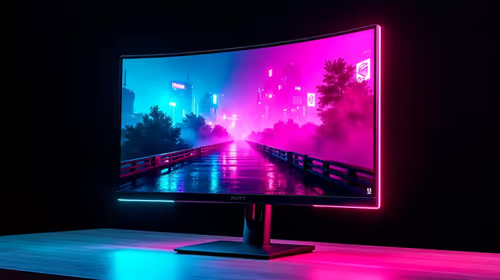
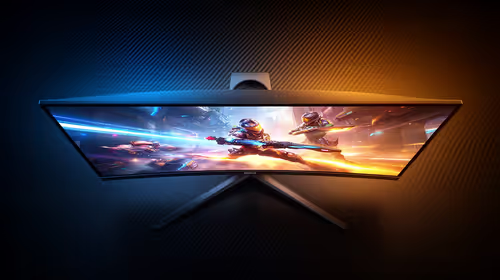
Response time is about the physical change on the panel, not every delay between a click and its result. A 0.03ms OLED response time describes extremely quick pixel transitions. On the R10,999 ASUS XG27AQDMG, that figure works beside QHD 240Hz and adaptive sync to support clear fast motion.
Quick Answer
The 0.03ms figure describes how quickly the WOLED pixels can transition between states; it is not the monitor's complete input lag. At R10,999, the XG27AQDMG pairs that response with 240Hz refresh, so pixels can settle quickly while the screen receives frequent update opportunities.
⚡ Focus on pixel behaviour
As an object moves, the old pixel state must change into the new one. A slow transition can leave a trail or smear, while a rapid transition helps the next image appear distinct.
Compare response specifications through Evetech's gaming monitor range, but keep panel type and test method in context.
⏱️ Separate response from total delay
Input delay includes the controller or mouse, game processing, frame rendering, presentation and display stages. The 0.03ms number concerns one display-stage transition and cannot represent that entire chain.
This distinction prevents a monitor figure from becoming a promise about the whole computer. A slow frame render remains slow even if the pixel changes rapidly.
🔁 Pair quick pixels with frequent frames
The XG27AQDMG can refresh at 240Hz, offering a new scan every 4.17ms. High frame output gives those scans fresh information, while 0.03ms response helps transitions complete cleanly.
The appropriate FreeSync Premium or G-Sync Compatible route lets supported graphics coordinate changing frame completion with display refresh. Browse the OLED monitor category when response and black depth are both important.
🎮 Decide whether the benefit is visible
Fast competitive motion and high-contrast moving edges expose response behaviour clearly. Slow content may show little practical difference.
If a curved layout is more important than a flat speed-focused screen, compare Evetech's curved monitor selection as a separate ergonomic choice.
Place 0.03ms inside the timing chain
Pixel response describes how quickly a pixel changes between states under the stated test method. It is not the total delay from a mouse click to a visible game reaction. The computer must receive the input, the game must process and render a frame, the connection must carry it and the display must present it. A fast pixel transition helps the final image change cleanly; it cannot erase delays earlier in the chain.
Refresh rate is separate. At 240Hz, the screen has a refresh opportunity about every 4.17 milliseconds. The 0.03ms WOLED response helps transitions keep pace with that rapid cycle, reducing visible smearing around moving edges. Frame rate remains another independent input: a game delivering 120 unique frames does not become a 240fps workload because the panel refreshes faster.
Test the meaning through motion rather than arithmetic alone. Use native QHD, the intended refresh and one repeatable pan. Disable any game-rendered motion-blur effect for the comparison, then inspect edge clarity and stopping behaviour. The R10,999 XG27AQDMG also carries adaptive sync and True Black HDR, so price should be judged across the complete screen. Buyers should not pay a premium while assuming 0.03ms is a universal input-lag figure or a shortcut to higher frame output.
Frequently Asked Questions
What physical behaviour does response time measure?
It measures the panel's transition from one pixel state to another, which affects how cleanly moving details change.
Is 0.03ms the monitor's total input delay?
No. Total delay includes input devices, game processing, rendering and presentation in addition to panel response.
How is response time different from frame rate?
Response belongs to the display pixels. Frame rate describes how many new images the computer renders each second.
Why pair a fast response with 240Hz?
Frequent refreshes benefit from pixels that settle quickly, especially when the source delivers a high rate of fresh frames.
Does every game need extremely fast transitions?
No. The advantage is easiest to see in rapid motion; slower genres may prioritise contrast, size or detail.
What is the full price context for this 0.03ms panel?
R10,999 also buys QHD WOLED, 240Hz, adaptive sync, True Black HDR and panel protection features.
Ready to place 0.03ms in the correct link of the response chain?
Explore Evetech's fast gaming displays, then compare pixel response with refresh, source frames and the input path instead of treating one number as total latency.