Quick Answer
DisplayHDR 400 is the entry-level HDR certification from VESA, requiring a minimum peak brightness of 400 nits and 8-bit colour. On a curved gaming monitor it means you get some highlight pop and a wider colour gamut than a non-HDR panel, but do not expect the black-level performance of OLED or mini-LED HDR screens.
What the DisplayHDR 400 Standard Actually Certifies 🖥️
VESA's DisplayHDR 400 spec mandates 400 nits peak brightness, a minimum 95% sRGB colour coverage, and 8-bit panel depth. That last point matters: truly wide colour requires 10-bit output, and most DisplayHDR 400 displays use 6-bit plus FRC dithering to fake it. Contrast ratios on VA-curved panels certified at this tier typically sit between 2,500:1 and 3,000:1, which is noticeably better than IPS at the same spec. In practice, highlights in games like Cyberpunk 2077 or Horizon Zero Dawn look brighter than on non-HDR screens, but the overall HDR experience is modest. Think of DisplayHDR 400 as an honest baseline rather than a premium feature.
How Curvature Interacts With HDR Brightness 🌟
A 1500R or 1800R curve wraps the image around your field of view, which means edge brightness fall-off from wide-angle glow is less visible than on a flat screen. That small advantage actually helps DisplayHDR 400 panels punch slightly above their spec: the perceived uniformity across a 27-inch to 34-inch curved surface tends to be better than on a flat panel with the same nit rating. VA panels, which dominate the curved monitor segment, also deliver deeper blacks than IPS, so the contrast gap that HDR relies on is partially recovered through native panel contrast rather than local dimming. Expect measured peak brightness of around 380 to 420 nits in a real-world HDR scene rather than the marketed ceiling.
Should You Enable HDR Mode for Gaming? 🎮
On Windows 11, enabling HDR in display settings adds an Auto HDR layer that upscales SDR games to a wider luminance range. With a DisplayHDR 400 certified curved monitor this can improve sky gradients and explosion lighting, particularly in titles that do not natively support HDR. The trade-off is occasional washed-out desktop colours if Windows HDR calibration is not set correctly. Samsung's HDR10 support on its Odyssey curved range and similar panels typically costs between R5,500 and R9,000 for a 27-inch to 32-inch unit. For competitive FPS gaming at 144Hz or higher, many South African players turn HDR off entirely to avoid the brightness processing latency, enabling it only for single-player story games.
HDR Calibration Tip for SA Rooms ⚡
Set your Windows HDR brightness slider to around 70 out of 100 in a normally-lit South African home office. Going too high washes out SDR desktop work, while going too low makes HDR game scenes look identical to SDR. A quick calibration pass in Windows Settings under Display, then HDR, takes under two minutes and makes a real difference.
FAQ
Is DisplayHDR 400 enough for a good HDR gaming experience?
It delivers a noticeable improvement over non-HDR panels in bright scenes, but falls short of the performance you get from DisplayHDR 600 or OLED-based HDR. For competitive multiplayer gaming it is adequate; for cinematic single-player games, consider stepping up to a higher-tier certified display.
Does DisplayHDR 400 support 10-bit colour?
Most DisplayHDR 400 panels use 8-bit panels with FRC dithering to approximate 10-bit output. True 10-bit support typically starts at DisplayHDR 600 and above, so check the full spec sheet before purchasing.
Will my RTX 4060 or RX 7600 GPU handle HDR on a curved monitor?
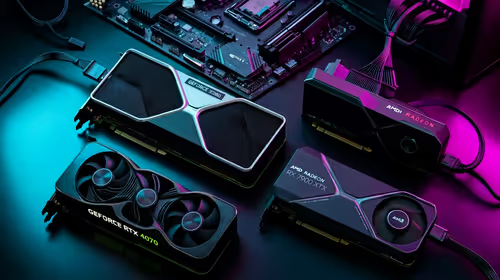
Yes. Both cards output HDR10 signals over DisplayPort 1.4 and HDMI 2.1, which is all a DisplayHDR 400 curved monitor needs. The GPU performance cost of enabling HDR itself is negligible; the frame-rate hit comes from the higher-quality HDR game assets, not the signal path.
Ready to upgrade your gaming monitor?
Browse Evetech's curved gaming monitor range for DisplayHDR 400 and higher certified panels, from 27-inch VA to 34-inch ultrawide options, all stocked locally.