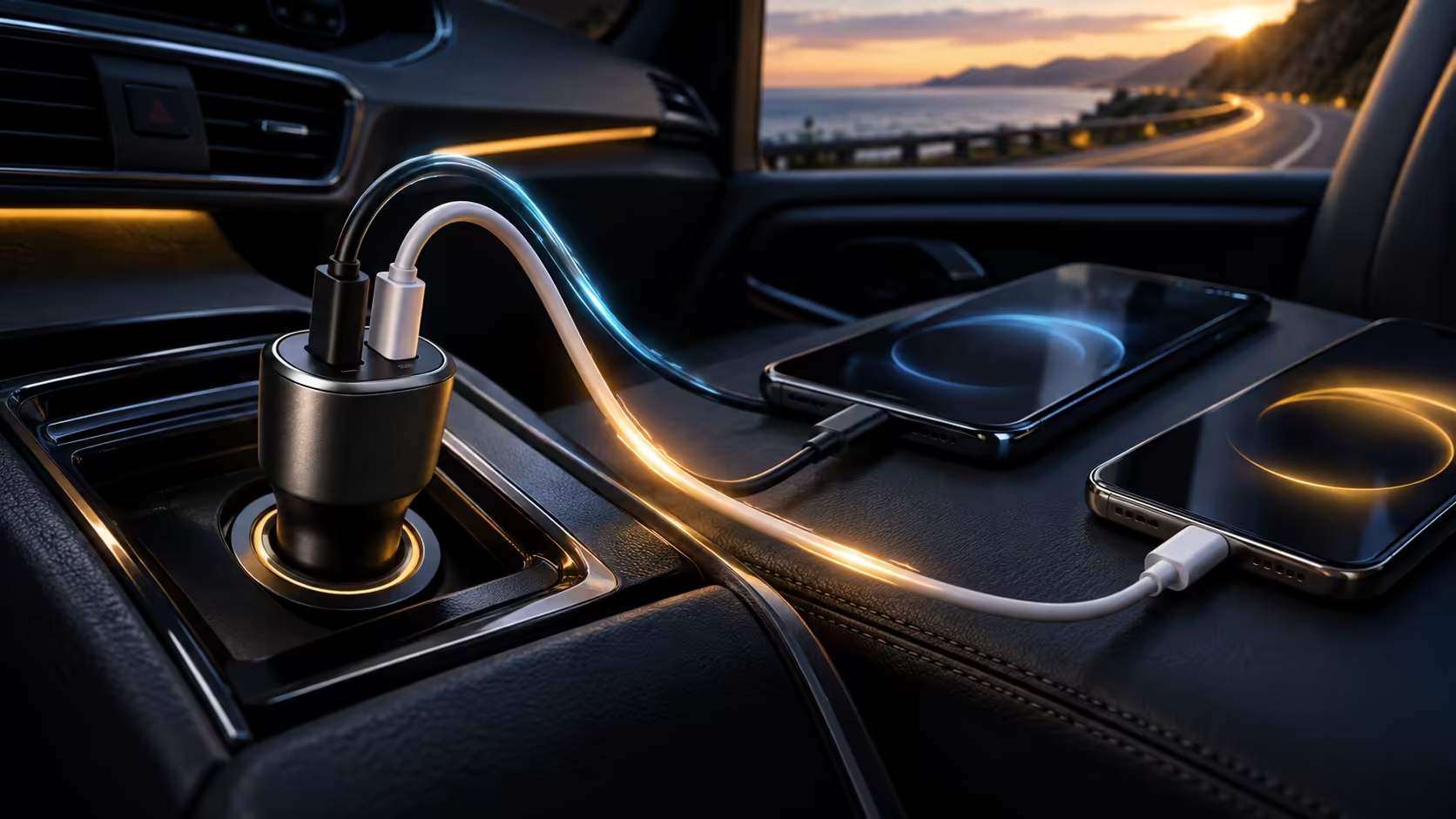
A car charger that lists PPS is doing something a plain PD port cannot: adjusting its output voltage in tiny increments while the phone is plugged in, instead of jumping between a handful of fixed levels. That difference is why two chargers can both claim 30W and still behave differently once a real phone is on the other end. Here is what the letters mean and why the negotiation matters more than the number on the box.
Quick Answer
PPS stands for Programmable Power Supply, a USB Power Delivery mode that lets a phone and charger renegotiate voltage in 20mV steps and current in 50mA steps for as long as the phone is plugged in, rather than locking to a fixed rung like 5V, 9V or 15V. The payoff is less energy lost to heat inside the phone's own charging circuit, not a higher top speed. Anker's 30W two-port car charger carries PPS on its USB-C output and sells for R349.
🔌 Fixed rungs versus a sliding scale
Standard USB Power Delivery works off a short menu. A device picks the closest match from a set list, usually 5V, 9V, 15V or 20V, and the charger holds that exact voltage until the device asks for something else.
PPS throws that menu out. Instead of a handful of stops, the charger can land anywhere across a continuous range and adjust again a moment later, in steps as fine as 20mV for voltage and 50mA for current. The phone re-requests a value as its battery state shifts through a charge, so the supply is a moving target rather than a single number picked once at plug-in.
🔋 Why the small steps matter to the battery
Every phone converts whatever voltage arrives at its port down to what the battery cell actually needs, and that conversion step is where wasted energy becomes heat. The bigger the gap between what arrives and what the battery wants, the more of that gap turns into warmth inside the phone rather than charge.
A fixed PD rung such as 9V can sit well away from what the battery actually wants at that exact moment, and the phone's own circuit has to absorb the whole gap between the two. A charger that can land within 20mV of the ideal figure closes almost all of that gap before the phone has to do any converting itself. That is the entire PPS argument: a cooler-running phone through the busiest part of a charge, at the same wattage a fixed-rung charger would supply, not a faster one.
📱 What has to support it before it switches on
PPS only runs when both ends agree to it. The charger has to offer it, which the car charger range does on its USB-C port, and the phone has to request it during the handshake.
A phone without PPS in its own charging stack is not shut out. It simply settles on the nearest fixed PD rung and charges normally, just without the fine-grained voltage matching. The same applies if the cable between them is damaged enough to disrupt the data pins PPS relies on for its constant back-and-forth; charging continues, but on the coarser standard.
Apple's USB-C accessories line up with standard PD on every current iPhone, and PPS availability from there depends on the model and region rather than the charger alone.
Frequently Asked Questions
Does PPS make a phone charge faster than standard PD at the same wattage?
Not directly. The wattage ceiling stays the same either way; PPS changes how precisely the voltage is matched, which shows up as lower heat rather than a shorter time to full.
Do I need a special cable for PPS to work?
No. Any properly rated USB-C cable carries PPS traffic on its data pins. A cheap or damaged cable can disrupt the negotiation, but that is a cable-quality issue rather than a missing feature.
What happens if my phone does not support PPS?
It charges on standard, fixed-voltage PD instead. Nothing fails; the charger and phone simply agree on the nearest of the usual rungs.
Is PPS the same thing as Qualcomm Quick Charge?
No. They are separate fast-charging schemes from different bodies, though both aim at similar goals. A charger built around USB PD PPS does not follow Quick Charge's own negotiation rules.
Ready to add PPS charging to your car?
Have a look at the car charger range and pick a cable rated to match it.