The short version surprises most people who hear "AI agents" and reach for their wallets: running Antigravity does not need a local GPU at all. Google's agentic development platform runs its model inference on the cloud backend, so the heavy lifting happens on Google's servers, not your machine. What your PC actually needs is a stable internet connection and enough headroom to run a modern editor smoothly.
Quick Answer
No dedicated GPU is required to run Antigravity's AI agents. It is a cloud-backed agentic IDE, so inference for Gemini 3 Pro, Claude Sonnet 4.5, and the other models happens server-side. A current laptop or desktop with 16GB of RAM, a recent multi-core CPU, and a reliable broadband line is enough to use it comfortably.
What the cloud backend means for your hardware
Antigravity sends your prompts and code context to Google's cloud, where the language models do the reasoning and generation, then streams the results back into the editor. Your machine is running an editor and a browser-automation layer, not a multi-billion-parameter model. That flips the usual AI hardware logic on its head: bandwidth and latency matter far more than raw compute or VRAM.
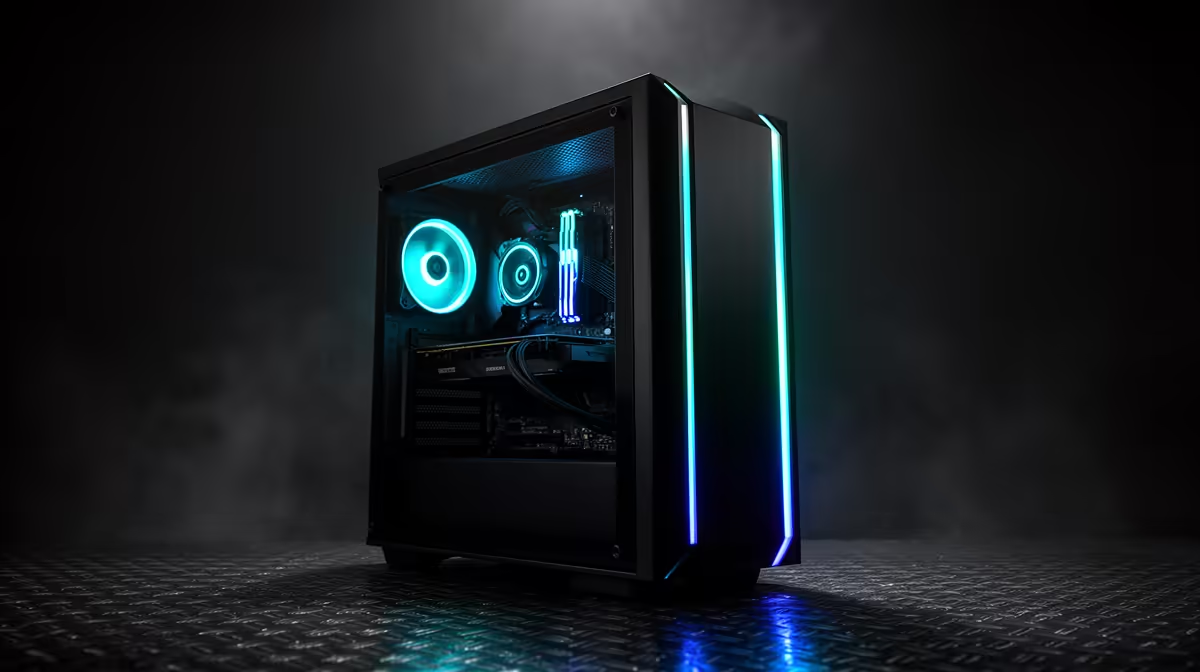
Officially the platform supports Windows 10 and later, recent Ubuntu and Debian releases, and macOS on Apple Silicon, with Chrome installed for its browser-automation features. None of those requirements mention a graphics card, because the agents never touch yours. If you want a capable everyday workstation rather than a dedicated AI rig, the AI PCs range at Evetech covers machines that handle this kind of cloud-connected workflow without overspending on a GPU you would not use.
What actually matters: RAM, CPU, and your line
Treat Antigravity like any demanding modern editor. A recent multi-core processor keeps the interface responsive, and 16GB of RAM gives you room for the editor, a browser, and the project you are building at the same time. 8GB will technically run but feels tight once you have a few tabs and a dev server open.
The variable that decides your real-world experience is your internet connection. Because every agent action is a round trip to the cloud, a steady SA fibre line keeps responses snappy, while a congested or high-latency connection makes the agents feel sluggish even on a fast PC. Wired ethernet beats marginal Wi-Fi for consistency. If you are building a setup that leans on cloud tools generally, the PC best sellers at Evetech show the well-balanced machines people are actually buying for work like this.
Frequently Asked Questions
Do I need an NVIDIA or AMD graphics card to run Antigravity?
No. The AI inference runs on Google's cloud, so no dedicated GPU is needed. Integrated graphics on a modern CPU are perfectly adequate for the editor itself.
How much RAM should my machine have?
16GB is the comfortable target. It leaves room for the editor, a browser for the automation features, and your running project at once. 8GB works but is constrained.
Does my internet speed affect how well the agents work?
Yes, more than any other factor. Every agent action goes to the cloud and back, so a stable, low-latency line gives the snappiest experience. A reliable wired connection is ideal.
Can I run Antigravity on a laptop?
Absolutely. A current laptop with a recent CPU, 16GB of RAM, and good Wi-Fi or ethernet handles it well, since the demanding work is offloaded to the cloud.
You do not need a GPU monster to run cloud-backed AI tools like Antigravity, just a well-balanced machine and a solid line. See the AI PCs range at Evetech to pick a workstation sized for cloud-connected development rather than over-specced on graphics.