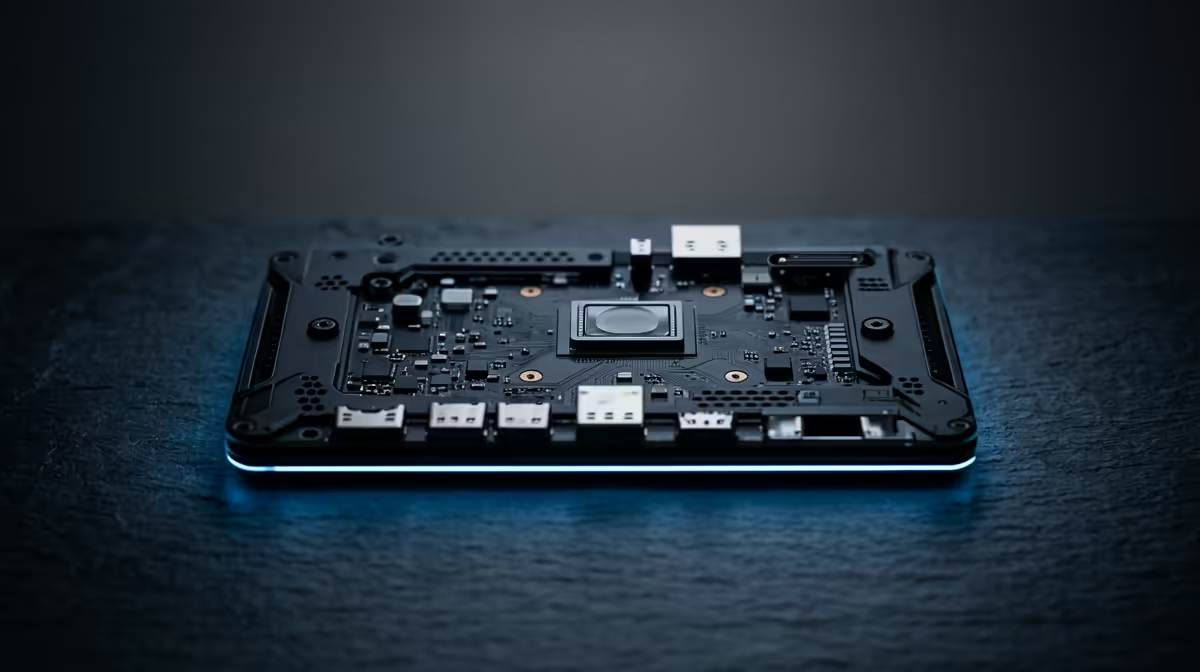
A whole computer that fits in your palm sounds like marketing, until you hold a Raspberry Pi and realise the entire system really is on one small board. A single-board computer, or SBC, packs the processor, memory, storage connections, and ports onto a single piece of circuit board, with no separate motherboard to plug things into. That is the whole idea, and it changes what a computer can be.
Quick Answer
A single-board computer puts the CPU, RAM, storage interfaces, and input-output all on one compact circuit board. The Raspberry Pi 5, built around the BCM2712 chip, is the best-known example. Unlike a desktop PC, there is no separate motherboard, so the complete system fits in a space smaller than your hand.
Everything on One Board
In a desktop PC, the motherboard is a large board you slot other parts into: a CPU here, RAM sticks there, a graphics card, storage drives, and power connectors. An SBC collapses all of that onto one fixed board. The processor, memory, and storage controllers are soldered in place, and the ports stick out of the edges ready to use.
That integration is the defining trait. You do not assemble an SBC the way you build a tower. You take it out of the box, add power and storage, and it boots. The trade-off is that you generally cannot upgrade the CPU or RAM later, because they are part of the board itself.
The Raspberry Pi 5 as the Reference Example
The Raspberry Pi 5 is the SBC most people meet first. At its heart sits the BCM2712, a system-on-chip that combines the processor cores and graphics onto a single die. Around it the board carries RAM, a slot for a microSD card or fast storage, USB ports, video output, networking, and a row of GPIO pins for connecting electronics directly.
Those GPIO pins are a big part of why SBCs are popular. They let the board talk to sensors, motors, lights, and other hardware, which is something a normal desktop cannot do without extra adapters. That makes an SBC a bridge between software and the physical world.
SBC Versus a Desktop PC
The clearest contrast is size and purpose. A desktop is large, upgradeable, and powerful, built to run demanding software and be reconfigured over its life. An SBC is small, fixed, power-sipping, and built to do a focused job reliably and cheaply.
A desktop draws a lot of power and is meant to sit on or under a desk. An SBC draws so little that you can leave it running around the clock as a small server without noticing it on your power bill. You give up raw performance and upgradeability, and in return you get a tiny, efficient, affordable computer you can tuck almost anywhere.
What People Actually Use Them For
SBCs run an enormous range of small projects. Common uses include a home media server, a network ad-blocker, a retro-game console, a file or backup server, a smart-home hub, and countless electronics and learning projects that tap those GPIO pins. They are also a popular, low-cost way for students and beginners to learn Linux and programming on real hardware.
If you want something equally compact but with full desktop software and more power, a small-form-factor PC steps up from where an SBC leaves off. Evetech's compact mini PC selection covers small machines that run Windows or Linux for everyday computing, and the best-selling compact PCs show which options buyers gravitate toward for home-lab and desktop duties. For pure tinkering and low-power always-on projects, though, the SBC remains the cleaner fit.
Frequently Asked Questions
What does SBC stand for?
SBC stands for single-board computer. It describes a complete computer built on one circuit board, with the processor, memory, storage interfaces, and ports all integrated rather than spread across separate components.
Is a Raspberry Pi a single-board computer?
Yes. The Raspberry Pi is the most popular example of a single-board computer. The Pi 5 builds the whole system around the BCM2712 chip on one compact board with built-in ports and GPIO pins.
Can you upgrade an SBC's RAM or CPU?
Generally no. On most SBCs the processor and memory are soldered to the board, so you choose your specification at purchase. To get more power you buy a higher model rather than upgrading the one you have.
What is the difference between an SBC and a mini PC?
An SBC is a bare, highly integrated board built for low-power and electronics projects, often running Linux. A mini PC is a small but complete computer, usually more powerful, designed to run full desktop operating systems like Windows for everyday use.
Are single-board computers good for beginners?
Very. Their low cost, small size, and large support community make them an excellent way to learn Linux, programming, and electronics on real hardware without the expense or complexity of a full desktop build.
Curious where a tiny computer fits in your setup? Explore the compact mini PC range at Evetech to see how small-form machines compare with single-board computers for your next project.