Docker has become the default way to run self-hosted apps on a home server, and the reason is simple: it packages an app and everything it depends on into one tidy container that runs the same on any machine. No more chasing missing libraries or clashing versions. You write a short config file, run one command, and a full stack of services comes up.
Quick Answer
Docker packages an application together with its dependencies into a portable container, so it runs identically anywhere without polluting your host system. For self-hosting, a single Docker Compose file can launch a multi-service stack, such as Nextcloud, Jellyfin, and Vaultwarden, in minutes, and tear it down just as cleanly.
What A Container Actually Is
A container bundles an app's code along with the exact runtime, libraries, and settings it needs. It runs as an isolated process on your machine but shares the host's kernel, which makes it far lighter than a full virtual machine. Because everything the app needs travels inside the container, "it works on my machine" stops being a problem: the container is the machine, as far as the app is concerned.
That isolation is the appeal for self-hosting. Each app lives in its own container with its own dependencies, so two apps that want conflicting versions of the same library coexist happily. Remove a container and it leaves almost nothing behind on the host.
Containers Versus Virtual Machines
A virtual machine emulates a whole computer, including its own operating system, which is heavy on memory and slow to start. A container skips that, sharing the host kernel and starting in seconds. On a modest home server you might comfortably run a dozen containers where only two or three virtual machines would fit. For self-hosting a handful of services, containers are the practical choice on lightweight hardware.
Docker Compose: The Self-Hoster's Tool
The real power for home labs is Docker Compose. Instead of launching containers one by one, you describe your whole stack in a single text file: which apps to run, their settings, storage locations, and how they connect. One command reads that file and brings everything up together. Want to move your setup to a new mini-PC? Copy the file and your data, run the command, and you are back online.
This is how people run Nextcloud for files, Jellyfin for media, and a password manager like Vaultwarden side by side without manual wrangling. Each is a few lines in the file, and updating an app is as simple as pulling a new image and restarting.
Hardware For A Docker Home Server
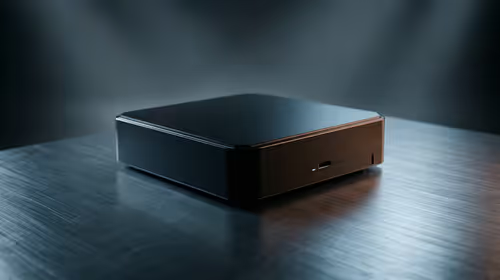
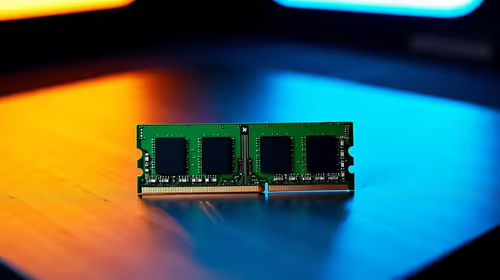
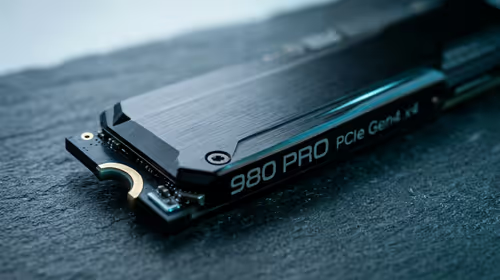
Docker rewards quiet, low-power machines that can stay on all day. A compact mini-PC built around a modern processor, equipped with 16 GB of RAM and a fast SSD, is the natural always-on host for a Docker stack. If you are planning a home server, the mini-PC range Evetech stocks covers compact, efficient boxes that suit running containers around the clock far better than a noisy full tower.
When comparing small machines for this kind of permanent duty, browsing the best-selling PCs at Evetech gives you a quick read on current pricing and popular configurations at this tier.
container data on a separate folder or drive, mapped into the container as a volume. That way you can update, rebuild, or move containers freely without ever putting your files at risk.
Frequently Asked Questions
Is Docker hard to learn for self-hosting?
The basics are approachable. Once you understand containers, images, and a Compose file, most self-hosted apps ship with a ready-made config you can adapt for your setup. No programming background is required to get a home stack running.
Docker or a virtual machine for a home server?
For running several lightweight apps, Docker is usually the better fit because containers start fast and use little memory. Virtual machines make sense when you need a full separate operating system rather than just an isolated app.
What hardware do I need to run Docker?
A quiet, efficient mini-PC with a modern processor and 16 GB of RAM handles a typical self-hosted stack with ease. Containers carry little overhead, so a compact machine runs several of them at once without any need for a full tower.
What is Docker Compose used for?
It defines a multi-container stack in a single file so you can launch, update, and move all your services with one command. It is the standard way self-hosters manage apps like media servers and file sync together.
Will containers slow down my server?
The overhead is small because containers share the host kernel rather than emulating hardware. A modest mini-PC can run many containers at once with little measurable performance cost.
Planning a quiet, always-on home server for your Docker stack? Browse the mini-PC range at Evetech and pick a low-power box built to run containers all day.