Want both Windows and Linux on the same machine without running one inside the other? Dual-booting is how you do it. It installs two operating systems on separate partitions of a single PC and shows you a menu at startup to choose which one loads. Neither system is emulated or virtualised, so each runs at full native speed, which makes dual-booting the most efficient way to keep one foot in each world.
Quick Answer
Dual-booting puts two operating systems on separate disk partitions and uses a boot menu, usually GRUB, to pick one at startup. Each OS runs natively at full speed because only one is active at a time. Install Windows first, then Linux, and let GRUB handle the menu.
How Dual-Booting Works
The core idea is separation. You split your storage into partitions, and each operating system gets its own. Windows typically formats its space as NTFS while Linux uses ext4, so the two never tread on each other. You can also create a shared partition for files you want both systems to read.
When the PC powers on, a bootloader runs before any operating system. With Linux installed alongside Windows, that bootloader is usually GRUB, which presents a menu listing each OS. You pick one, GRUB hands control to that system's own boot files, and it loads as if it were the only thing on the machine. Because nothing is being translated or emulated, the active OS uses the full hardware directly.
Why Native Speed Matters
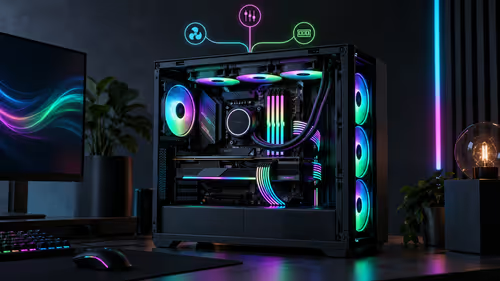
This is the key advantage over a virtual machine. In a VM, one OS runs inside the other and shares resources, so it never gets full performance. With dual-booting, the OS you choose at startup owns the entire machine: all the cores, all the RAM, and the full GPU. For gaming, video work, or anything demanding, that difference is significant. The same logic is why Linux-based handhelds boot straight into a gaming OS, and you can see that approach in the handheld gaming consoles at Evetech. A capable desktop handles both systems comfortably too, and you can compare current options in the PC best sellers at Evetech.
Setting It Up Safely
Order matters. Install Windows first, because its bootloader does not cooperate well with other systems. Then install Linux, which detects Windows and adds it to the GRUB menu automatically, giving you a clean choice at every startup.
A few rules keep it stable. Back up your important data before you start, since partitioning carries risk. Make sure both systems install in the same firmware mode, either UEFI or legacy BIOS, rather than mixing them. On a modern UEFI system there is already a small EFI System Partition; mount it correctly and do not reformat it, so the existing Windows boot entries survive. Get those basics right and the result is a single PC that boots cleanly into either world.
Frequently Asked Questions
Does dual-booting slow down my PC?
No. Only one operating system is active at a time, and it runs natively with full access to your hardware. Unlike a virtual machine, there is no performance penalty from sharing resources between two systems.
Should I install Windows or Linux first?
Install Windows first, then Linux. Windows tends to overwrite other bootloaders, whereas Linux installs GRUB and automatically detects the existing Windows installation, adding it to the boot menu for you.
Can both systems read the same files?
Yes, if you set up a shared partition both can access, or by reading the Windows partition from Linux. Keeping a common data partition is a tidy way to share documents and media between the two systems.
Is dual-booting risky for my existing data?
Partitioning a drive always carries some risk, so back up anything important before you begin. Done carefully, with both systems in the same firmware mode and the EFI partition left intact, dual-booting is reliable and reversible.
How is dual-booting different from a virtual machine?
A virtual machine runs one OS inside another, sharing hardware and losing performance. Dual-booting keeps the systems fully separate on disk and lets the chosen one use the whole PC natively, which is why it is faster for demanding tasks.
Planning to run Windows and Linux on one machine? Browse the PC best sellers at Evetech for a system with the storage and power to handle a clean dual-boot setup.