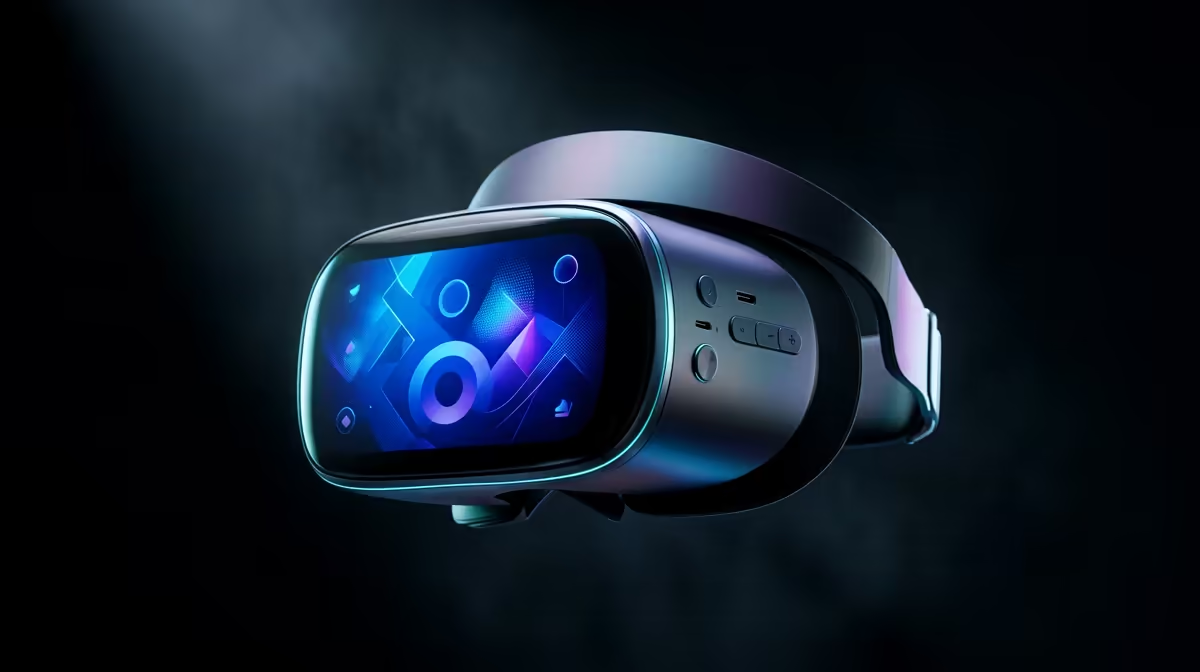
Your eyes only see sharp detail in a tiny central region; everything in your peripheral vision is a low-resolution blur your brain quietly fills in. Foveated rendering is the clever trick that exploits exactly this, drawing the centre of your VR view in crisp detail while letting the edges run softer, and the GPU saves a huge amount of work nobody actually notices.
Quick Answer
Foveated rendering renders the centre of your gaze at full resolution and the periphery at lower detail, cutting GPU load substantially. Fixed versions always sharpen the screen centre; eye-tracked versions follow your pupils so the sharp zone moves with your gaze, hiding the quality drop almost completely.
Why VR Is So Demanding
A VR headset must produce a separate full-resolution frame for each eye, refreshed dozens of times per second without a single miss. That is a brutal load, far heavier than driving a single flat monitor. Pushing every pixel at full detail across both displays is what makes high-resolution VR so hardware-hungry, and it is exactly the waste foveated rendering targets.
Evetech stocks a broad selection of AR eyewear and VR headsets that illustrate how gaze-aware rendering is already being built into current consumer devices.
Fixed vs Eye-Tracked Foveation
There are two flavours, and the difference is where the sharp zone lives.
Fixed foveated rendering keeps the high-detail region locked to the centre of each display. It assumes you mostly look forward, which is often true in VR, so it saves GPU power without needing any extra hardware. The trade-off is that if you glance to the side with your eyes rather than turning your head, you can sometimes notice softer edges.
Eye-tracked foveated rendering adds cameras inside the headset that watch your pupils. The sharp zone follows wherever you actually look, so the low-detail periphery is always genuinely outside your focus. This hides the quality drop almost perfectly and unlocks bigger performance savings, because the renderer can be more aggressive at the edges knowing your gaze is tracked.
What This Means for Performance
By rendering fewer pixels at full detail, the GPU frees up headroom that can go toward higher overall resolution, a more stable frame rate, or richer scene detail. In practice, foveated rendering is what makes very high-resolution VR feasible on hardware that could not otherwise sustain it. It does not lower the image quality you perceive; it removes the rendering effort spent on detail your eyes were never going to resolve anyway.
The catch is that eye-tracked foveation depends on accurate, low-latency tracking. If the tracking lags behind a fast eye movement, the sharp zone arrives a fraction late, so good implementations prioritise tracking speed. Once you have chosen a headset, browsing the top-selling accessories surfaces the cables, mounts, and comfort upgrades that turn a capable device into a comfortable long-session one.
Frequently Asked Questions
Does foveated rendering reduce image quality?
Not in any way you notice. It only lowers detail in your peripheral vision, where your eyes cannot resolve fine detail anyway, so the part of the image you are actually looking at stays sharp.
What is the difference between fixed and eye-tracked foveated rendering?
Fixed foveation always sharpens the centre of the display and assumes you look forward. Eye-tracked foveation uses cameras to follow your pupils, so the sharp zone moves with your gaze, hiding the quality drop and allowing larger performance gains.
Does foveated rendering need special hardware?
Fixed foveated rendering needs no extra hardware and works on the GPU alone. Eye-tracked foveated rendering requires a headset with built-in eye-tracking cameras, which is why it appears mainly on higher-end headsets.
How much performance does foveated rendering save?
The exact saving depends on the headset and how aggressively the periphery is reduced, but it is significant enough to make high-resolution VR practical on hardware that otherwise could not keep up. Eye-tracked versions save more because the renderer can trust where you are looking.
Curious about the next wave of VR and AR eyewear? Browse the AR glasses and VR gear at Evetech to see where gaze-aware rendering is heading.