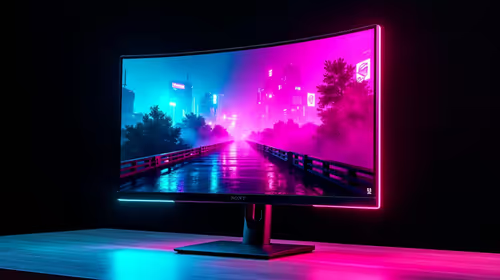
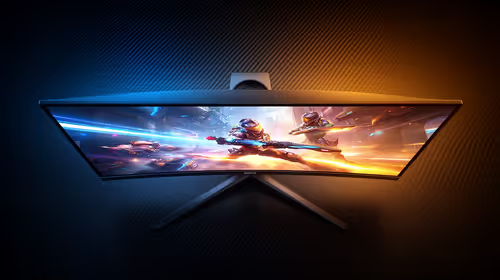
A 500Hz ceiling deserves a checklist that reaches beyond one large number. Buyers assessing a 27-inch QHD 500Hz gaming monitor should verify response, adaptive sync, inputs, HDR, colour, frame delivery and desk fit. The ASUS XG27AQDPG assembles those features at R23,899.
Quick Answer
Look for native QHD at the advertised high refresh, fast pixel response, support for the installed GPU's adaptive-sync path, and inputs that expose the intended mode. Also assess panel technology, HDR class, colour coverage, screen size and price. The XG27AQDPG offers 500Hz QD-OLED, 0.03ms GTG, both major sync routes, HDMI 2.1, DisplayPort 1.4, DisplayHDR 500 True Black and 99% DCI-P3.
📐 Confirm size and native resolution
A 27-inch QHD panel provides 2560x1440 detail in a compact competitive format. Measure the desk, centre the screen and check that the whole image remains easy to scan. Native resolution should be selected before refresh tests begin.
Evetech's gaming monitor collection helps compare size, resolution and speed without separating them into unrelated purchases.
⚡ Pair refresh with response
At 500Hz, the display can start a new refresh every 2ms. The panel also needs to change pixels quickly enough to support clear transitions. ASUS lists 0.03ms GTG for the XG27AQDPG, which describes a pixel-transition measurement rather than total system latency.
Test a rapid pan, moving target and fine text scroll. The result still depends on game frame output, settings and the complete signal path.
🔄 Cover the installed graphics platform
NVIDIA buyers should look for the G-SYNC Compatible path; AMD owners can use FreeSync Premium Pro. Dual support matters when a monitor may outlive the current graphics card. Adaptive refresh does not add frames, so benchmark the intended games at QHD.
🔌 Inspect both ends of the cable
The monitor includes HDMI 2.1 and DisplayPort 1.4. Verify that the GPU offers the matching output, use a suitable cable and confirm 2560x1440 at the chosen refresh in the operating system. Read the active mode in software after connecting instead of relying on connector shape.
The curved gaming monitor category provides a comparison when desk immersion and screen shape are also priorities.
🌈 Add picture quality to the scorecard
QD-OLED supplies self-emissive contrast, while DisplayHDR 500 True Black identifies the HDR performance class. The 99% DCI-P3 figure describes wide gamut coverage. Test dark detail, highlights, natural colour and gradients in the intended room.
Browse Evetech's OLED monitor range to compare these picture qualities across individual products.
💵 Test whether the R23,899 package fits
Allocate budget to the PC needed for the games, a suitable connection and the monitor. A display capable of 500Hz does not remove processor or graphics limits. The premium is strongest when competitive speed, QHD detail and QD-OLED picture quality will all be used.
✅ Score the shortlist in the intended room
Give each candidate a score for desk fit, text comfort, reflections, competitive motion, QHD frame demand, sync support, HDR, colour, inputs and price. Weight competitive motion heavily only when the buyer plays high-frame titles often. Weight text and colour more when the screen also serves work.
For the XG27AQDPG, verify 500Hz at native QHD, repeat a moving-target exercise and inspect near-black texture with the room lights on. Connect the actual GPU platform and confirm its G-SYNC Compatible or FreeSync Premium Pro route. Then switch to HDR content and judge highlights plus natural colour.
Write the limitation beside every score. A monitor may achieve excellent motion while requiring a PC upgrade, or strong colour while needing better reflection control. This prevents a single perfect number from hiding the cost or behaviour that will shape daily ownership.
Add the score totals only after every candidate has been tested through the same source and room. Consistent conditions matter more than an extra checklist column, and the final choice should name both the winning capability and the compromise accepted.
Frequently Asked Questions
Why check response time as well as refresh rate?
Refresh controls update opportunities, while response describes pixel transitions. Both contribute to motion presentation.
Which response time does this ASUS offer?
It lists 0.03ms GTG.
What connectivity should a buyer inspect?
Check the source output, cable and the monitor's HDMI 2.1 or DisplayPort 1.4 input.
Does the panel cover an HDR colour space?
It covers 99% DCI-P3 and carries DisplayHDR 500 True Black.
Why does adaptive-sync support belong on the checklist?
It coordinates display timing when game frame delivery changes.
What budget does this feature set require?
The XG27AQDPG is R23,899.
Ready to turn a premium refresh number into a complete buying checklist?
Compare Evetech's 27-inch gaming monitors across response, sync, inputs, HDR and the PC that will drive them.