


1000W PSU Planning for RTX 5090 Builds in SA
1000W for RTX 5090 needs a full-build check, not a simple yes. Review GPU guidance, CPU draw, transient load, connectors, PSU quality, and upgrade plans before deciding.
Read moreLook for exact build dimensions, achievable speed, firmware, levelling and extrusion features in a 320mm printer. At R7,799, the Neptune 4 Plus provides 320 x 320 x 385mm, Klipper, auto levelling, direct drive and a 300C nozzle.

Knowing what to look for in a 320 x 320mm FDM 3D printer begins with the third build axis, then moves through setup, firmware and extrusion. Bed size alone cannot describe printable height, exterior footprint or the process needed to finish a part.
Look for a real 320 x 320 x 385mm volume, Klipper calibration tools, a 300C direct drive, suitable plate faces, network control and stable dual-Z motion; the Neptune 4 Plus supplies all of them.
For R7,799, the Neptune 4 Plus provides a 320 x 320 x 385mm volume, Klipper firmware, automatic bed levelling, direct drive extrusion and a 300C nozzle. Verify external dimensions, material requirements and tested quality at the speeds your projects need.
Width and depth are both 320mm, while height reaches 385mm. Fit the sliced part inside each boundary after orientation, supports and any required margin are considered.
Build volume describes the printable envelope rather than the machine's outside dimensions. Measure the actual printer and allow room for its movement, spool, cables, plate access and servicing before assigning bench space.
Compare capacities in Evetech's large 3D printer range using prepared project files rather than category labels.
The Neptune 4 Plus uses Klipper and supports up to 500mm/s. Treat that number as a capability ceiling, then test representative geometry and material in steps to find an acceptable working rate.
Confirm the controls and connectivity available on the exact printer. Klipper's name should not be used to assume network functions or remote-operation features.
Automatic bed levelling assists preparation across the broad bed. The exact probe, mesh and user process should be checked, followed by a first-layer pattern that reaches relevant regions.
Direct drive supplies the filament path, while the nozzle can reach 300C. Neither fact defines a universal material list. Match each spool to the entire printer system.
Compare 3D printing filament through Evetech after establishing the project's thermal and handling needs.
Score volume fit, bench fit, tested speed, levelling workflow, extrusion, material route and maintenance access. The Neptune operates below 65dB and connects through Wi-Fi, Ethernet or USB; material-specific safety and external room fit remain separate checks.
Browse Evetech's FDM 3D printers with this same matrix so R7,799 is compared against equivalent requirements.
The right 320mm model is the one whose printable envelope and working process fit repeated projects. A large bed is useful only when the buyer can prepare, feed and supervise the intended job.
Before purchase, perform a paper exercise with three real projects: the widest part, the tallest part and the material with the strictest process. Slice each model, note its required bed region and list every unresolved need. This exposes whether the buyer is paying for usable capacity or simply a large headline.
Plan the operator route as well. Bed access, filament loading, profile selection, monitoring, removal and maintenance all require physical room and responsibility. If several people will use the printer, a repeatable handover can matter as much as maximum speed.
Keep a separate unresolved list for exterior footprint and material-specific environmental requirements. Noise is under 65dB, control runs through Klipper on a 1.5GHz quad-core board, and the plate already supplies dedicated PLA and textured PEI faces. Resolve the remaining room and safety needs before assigning the machine to a workflow.
Its dual motors and lead screws steady the Z axis, while a double Y profile uses two rows of POM wheels. Operation remains below 65dB. Wi-Fi, Ethernet and USB support local or remote job transfer, and the plate offers dedicated PLA and textured PEI surfaces.
The 1.5GHz quad-core controller and 8GB storage provide enough local processing and file space for repeated work. Hand-tensioning knobs simplify X/Y belt adjustments, and silent stepper drivers keep motion below 65dB. These practical ownership details deserve checklist space alongside headline speed and volume.
The machine's connected workflow should also match the workshop's network policy.
The third Neptune 4 Plus axis is 385mm, creating a 320 x 320 x 385mm printable envelope.
The printer supports motion up to 500mm/s, with a usable rate established through job-specific testing.
Klipper firmware runs on the Neptune 4 Plus and forms part of its high-speed platform.
Automatic levelling helps prepare the build area, followed by surface work and a printed first-layer check.
This example uses direct drive and a 300C-capable nozzle; material support still needs whole-system confirmation.
No. Measure the exterior machine and operational clearances separately from its internal printable dimensions.
Building a 320mm printer shortlist around actual projects? Compare Evetech FDM printers with all three axes, bench space, material path and tested speed recorded separately.
The third Neptune 4 Plus axis is 385mm, creating a 320 x 320 x 385mm printable envelope.
The printer supports motion up to 500mm/s, with a usable rate established through job-specific testing.
Klipper firmware runs on the Neptune 4 Plus and forms part of its high-speed platform.
Automatic levelling helps prepare the build area, followed by surface work and a printed first-layer check.
This example uses direct drive and a 300C-capable nozzle; material support still needs whole-system confirmation.
No. Measure the exterior machine and operational clearances separately from its internal printable dimensions.
1000W for RTX 5090 needs a full-build check, not a simple yes. Review GPU guidance, CPU draw, transient load, connectors, PSU quality, and upgrade plans before deciding.
Read more
RTX 5080 Super with a 750W PSU is more comfortable than lower wattage if the unit is quality. SA builders should still confirm GPU guidance, CPU draw, connector type, airflow, and upgrade room.
Read more
How to fix FPS drops after a RX 9070 XT starts with driver cleanup, chipset updates, thermals, and power checks. For SA gaming PCs, confirm PCIe seating, monitor refresh, frame caps, and per-game graphics settings before replacing parts.
Read more
How to fix low FPS Windows 11 Wi-Fi 7 issues starts by checking whether the problem is frame rate or network lag. Test ping, drivers, power settings, Ethernet, and game FPS before adjusting visuals.
Read more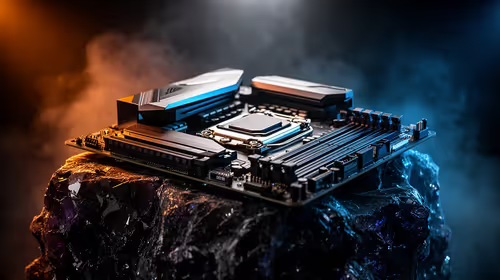
AM5 is smart for SA builders because it supports newer Ryzen CPUs, DDR5 memory, and a longer upgrade path. Compare board cost, cooling, gaming needs, and local part availability before choosing your next PC platform.
Read more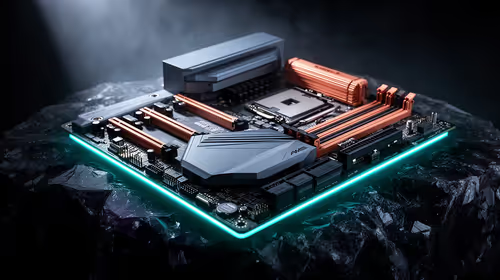
AM5 gives Randburg gaming builders a longer upgrade path. For SA buyers, DDR5 support, newer board features, and future CPU options can justify the platform. Weigh board cost, cooler support, BIOS maturity, and upgrade timing before choosing.
Read more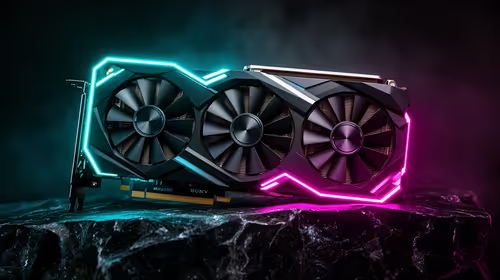
RTX 5090 on a 550W PSU leaves almost no practical room for OC plans. Treat the setup as constrained, with CPU draw, power spikes, cable quality, thermals, and stability checks more important than chasing extra clocks.
FPS drops on a Ryzen 9 9950X3D build often have a fixable cause. Check settings, drivers, thermals, background tasks, network conditions, and bottlenecks before assuming a part must be replaced.

The difference between PCIe 5.0 and PCIe 4.0 for SA gamers is mostly bandwidth headroom. Compare GPU slot needs, NVMe speed, motherboard support, and upgrade timing before paying extra for a newer platform.
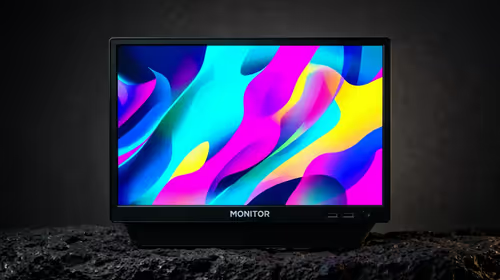
Gaming PC stuck pixel checks in South Africa should confirm the monitor fault first. Use colour tests, screenshot comparison, cable swaps, display menu checks, and clear photos before deciding on support.

AMD's current driver now lists a Radeon RX 9050 4GB, while product coverage details a narrowed memory system. SA buyers should weigh the low VRAM ceiling against current local Radeon options.

Samsung Display has demonstrated a 16-inch 2.5K OLED laptop panel running at 300Hz. SA buyers should wait for a named notebook, full panel specifications and a local price before planning an upgrade.

Microsoft says some Windows 11 game crashes after recent updates are linked to RGB-related drivers. Affected SA gamers should confirm the update and driver before using the published registry workaround.
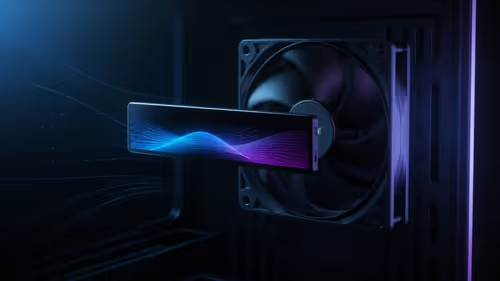
Thermalright's Fan Frame Vision-1 adds a 640x172 status screen to a standard 120mm fan. SA builders should check clearance, USB routing and local support before treating it as an easy upgrade.
1000W for RTX 5090 needs a full-build check, not a simple yes. Review GPU guidance, CPU draw, transient load, connectors, PSU quality, and upgrade plans before deciding.
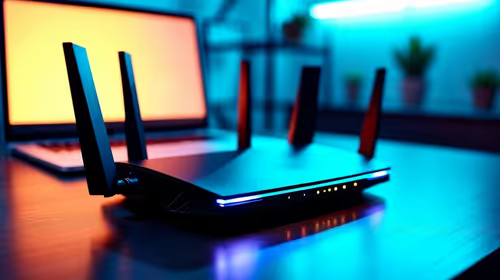
Wi-Fi 6E vs Wi-Fi 6 matters for 4K video editing when files move across a network. The real-world difference between Wi-Fi 6E and Wi-Fi 6 for video editing in 4K depends on NAS access, cloud uploads, router range, and SA creator workflows.
RTX 5080 Super with a 750W PSU is more comfortable than lower wattage if the unit is quality. SA builders should still confirm GPU guidance, CPU draw, connector type, airflow, and upgrade room.
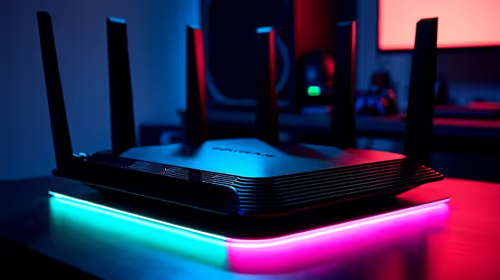
Wi-Fi 6E vs Wi-Fi 6 for Video Editing in 4K comes down to router support, latency, client devices, band support, and home network layout. SA buyers should match the choice to their setup instead of assuming one option always wins.