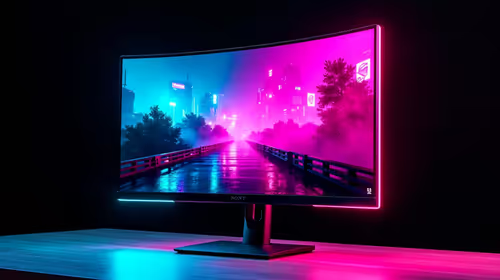
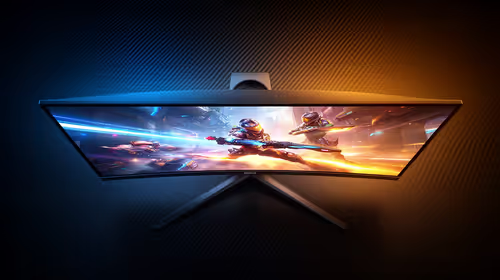
A strong 34-inch 240Hz UWQHD monitor balances rendering demand, pixel response, adaptive sync, panel contrast and desk comfort. Any one impressive number can be undermined when the rest of the package does not fit.
Quick Answer
Look for native 3440 x 1440 at the required refresh, clean motion across several frame rates, working adaptive sync, a curve suited to the viewing distance and picture modes that handle SDR and HDR properly. Confirm the PC can drive UWQHD, check real 21:9 game support and include total rand cost.
Start with resolution and size
At 34 inches, 3440 x 1440 provides a wide desktop with QHD-class vertical detail. It renders about 4.95 million pixels per frame, so the GPU requirement sits above conventional 2560 x 1440.
The gaming monitor range helps compare screen formats. Judge text size and desk depth from the normal seat rather than relying on diagonal measurement alone.
Examine refresh and transitions together
At 240Hz, refresh intervals arrive every 4.17ms. Pixels must change quickly enough to preserve those updates. Test overdrive in bright and dark movement, watching for ordinary trails and inverse halos.
The AW3426DWM lists 1ms GTG and AMD FreeSync Premium. Variable refresh supports changing output below the 240Hz ceiling, but it cannot repair CPU or storage stutter.
Match curvature to the user
The Alienware's 1500R curve directs its edges towards one central viewer. Measure distance, align the chair and ensure the stand leaves mouse room. The curved monitor selection offers radius context.
Users who share the screen from side seats should inspect viewing behaviour before choosing a tight curve.
Set picture expectations
The R8,999 AW3426DWM uses VA and includes DisplayHDR 400, Dolby Vision and 95% DCI-P3. VA contrast suits dark material, while dark-transition motion should be tested. DisplayHDR 400 is an entry HDR tier; accurate tone mapping matters more than a vivid preset.
The OLED monitor category represents a different self-emissive approach. Do not treat the panel names as interchangeable.
Check smaller ownership details
USB-C 15W charging is useful for a light device, not for powering a gaming laptop. Confirm warranty, dead-pixel policy, ergonomic range and mounting compatibility. Verify exact source connections without assuming an unspecified port.
Finally, add any GPU or arm upgrade to the monitor price. The best screen is the one the PC and desk can use immediately.
Inspect the on-screen controls
The menu should make regular changes such as brightness, input choice, adaptive sync and overdrive accessible without confusion. Check whether useful profiles can be saved and whether a reset restores predictable behaviour. Complicated controls become a real cost when the screen switches between work, competitive games and HDR media every day.
Look for a clear active-signal page showing resolution and refresh. That information shortens troubleshooting when 240Hz or HDR disappears after an update.
Run a dark-room and daylight trial
Use the monitor at the brightest and darkest times of its normal day. Reflections, VA contrast, coating and required brightness can change the impression substantially. A picture that looks excellent at night may need desk repositioning near a sunny window.
Check a dark game for shadow trails and a white document for uniformity. Adjust room light before resorting to extreme black equalisation or luminance, because those controls can harm image quality elsewhere.
Confirm game-format support
List the ten titles played most often and mark whether gameplay, menus and cut-scenes support 21:9. Correctly preserved side bars are preferable to stretching. For competitive games, confirm that the wider view complies with the title's rules.
This software check can be as important as panel speed. A broad screen earns more value when the actual library uses its pixels correctly.
Protect the upgrade path
Choose a monitor that remains useful at lower current frame rates through FreeSync Premium, then leaves headroom for a later PC improvement. Avoid funding a complete rebuild solely to hit one benchmark. A balanced display can outlast several graphics generations when its resolution, ergonomics and picture quality remain suitable.
Frequently Asked Questions
Is 240Hz useful when games run lower?
Yes. It provides headroom, while adaptive refresh can handle variable output beneath the maximum.
Why test dark VA motion?
Dark shade transitions can behave differently from bright ones and reveal trailing missed by simple specifications.
What does DisplayHDR 400 indicate?
It is a VESA entry-level HDR performance tier.
Is 15W USB-C laptop power?
No. It is modest charging suited to much smaller power needs.
Want a 34-inch specification list to become a reliable buying test?
Check UWQHD performance, motion across the refresh range, central desk fit and total rand cost before comparing cosmetic extras.