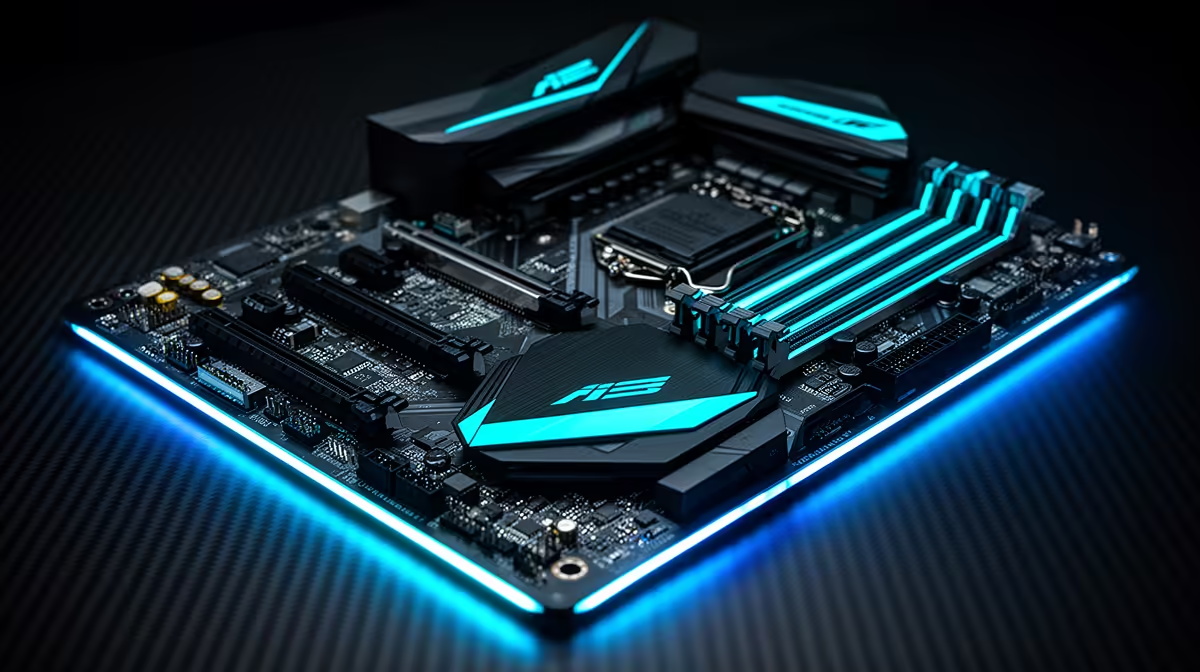
Spec sheets for Intel boards all start to blur together after the fifth one, which is exactly how buyers end up overpaying for features they will never touch. Knowing what to check on a b860m motherboard before checkout saves both money and regret.
Quick Answer
A solid B860M board should cover PCIe 5.0 graphics support, multiple M.2 slots, at least 2.5Gb Ethernet and enough USB bandwidth for modern peripherals, all without an inflated price. The ASUS B860M MAX Gaming AX checks each of these boxes at R4,499.
Chipset generation and CPU support
Start with which Intel CPU generation the board supports, since the B860 chipset pairs with the LGA 1851 socket used by recent Intel Core processors. Confirm BIOS support for your exact CPU model, and look for BIOS FlashBack style features that let you update firmware without needing a CPU installed first, useful if you are buying board and processor separately.
Why chipset tier matters
Higher chipset tiers generally unlock more overclocking headroom and PCIe lanes, while lower tiers trim features to hit a price point. B860 sits as a capable mid-tier option that keeps PCIe 5.0 without the premium of the flagship chipset, and browsing the current Intel B860 motherboard lineup shows how consistently that generation carries PCIe 5.0 support across different board brands.
Storage and expansion on the board
Count the M.2 slots and check whether they run at PCIe 4.0 or 5.0 speeds, since some boards mix generations across slots. The ASUS B860M MAX Gaming AX offers triple PCIe 5.0 M.2 slots, which is a genuinely strong allocation for a board at this price point.
Networking and USB bandwidth
Gigabit Ethernet used to be the default, but 2.5Gb is now a meaningful upgrade for anyone moving large files or streaming. On the USB side, look for at least one fast USB-C port capable of 20Gbps, ideally with DisplayPort output if you plan to run a monitor directly from the motherboard's graphics output. Both boxes are ticked here alongside 2.5Gb LAN.
Build quality and power delivery features
Tool-free features like ASUS Q-Design speed up building and troubleshooting, while protections such as 5X Protection III guard against power and static damage over the board's lifespan. RGB support through Aura Sync is a nice-to-have rather than a deciding factor, but it costs nothing extra when it is already built in. None of these features change frame rates directly, but they do reduce the odds of a frustrating build day or an early failure, which is worth factoring into your final decision. Browse the broader Intel motherboard range to compare these features side by side before you buy.
Frequently Asked Questions
What socket does a B860M motherboard use?
The B860 chipset uses the Intel LGA 1851 socket, matching recent Intel Core desktop processors.
How many M.2 slots should a good B860M board have?
Two is common, but three, as on the B860M MAX Gaming AX, gives more flexibility for separating your OS, game library and general storage.
Is 2.5Gb Ethernet worth prioritising when buying?
Yes, if you regularly move large files or stream, since it offers a meaningful step up from Gigabit at very little extra cost on boards that include it standard.
Does BIOS FlashBack matter for a new build?
It matters most if you are pairing the board with a newer CPU than the board originally shipped supporting, since it lets you update firmware without a working CPU installed.
Is RGB lighting a genuine buying factor?
Not really. Aura Sync and similar features are a bonus rather than something that should influence your final decision.
Should I prioritise price or feature count when comparing B860M boards?
Prioritise the features you will actually use, such as storage and networking, over a longer spec sheet padded with extras that will sit idle in a typical gaming build.
Ready to shortlist the right Intel B860M board?
The ASUS B860M MAX Gaming AX for R4,499 waits within the Intel B860 motherboard selection, ready to cover the checklist most gamers use when buying a B860M board.