VA rating becomes a bottleneck on a UPS the moment your gear draws more usable watts than the unit can supply, at which point it trips instead of protecting you. Spotting that ceiling before you buy or upgrade keeps the UPS doing its job.
Quick Answer
VA rating becomes a bottleneck when your load exceeds the unit's usable watts, since a 1500VA unit only delivers around 900W. A Ryzen 7 plus RTX 4070 rig at 450W is fine there, but add a second GPU or big monitors and it can overshoot. Size to leave a 30-40% margin (a R3,000-R4,500 1500VA unit suits most single-GPU PCs) to avoid hitting the ceiling.
When VA Caps Your Setup
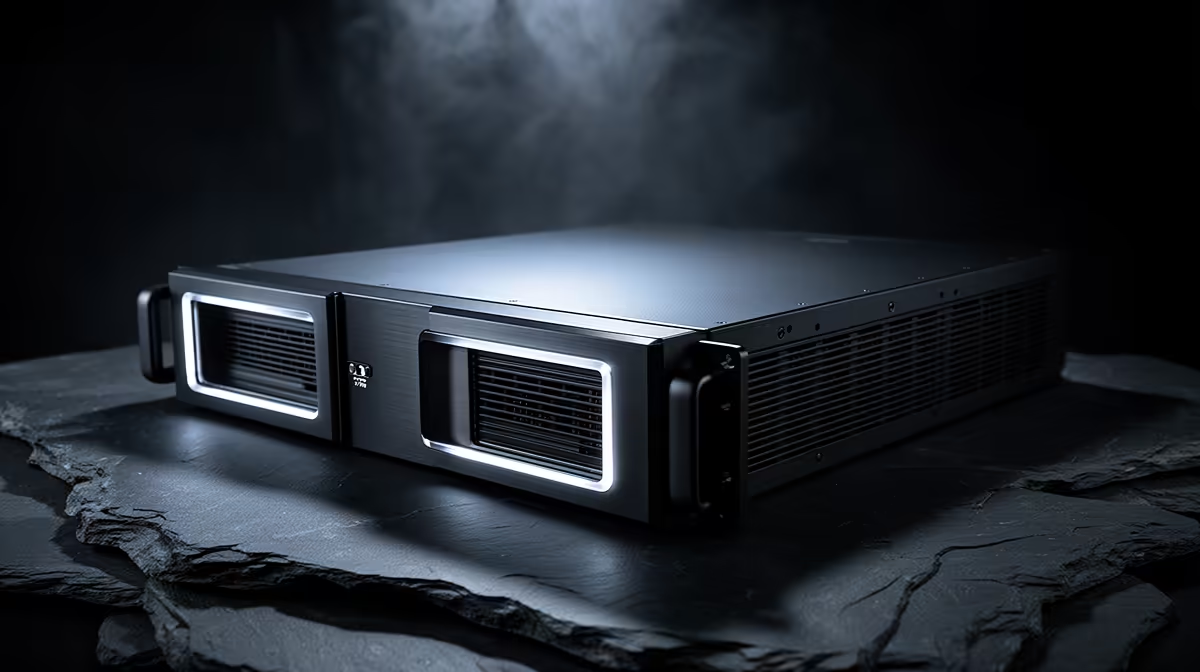
VA converts to usable watts through a power factor, so a 1500VA unit supplies roughly 900W. Your rig draws real watts: a single-GPU gaming PC at 400-450W, plus a monitor and router, sits safely under that. The bottleneck appears when load creeps up, a stronger GPU, a second monitor, or a dual-PC stream, and total draw approaches or passes the watt limit. At that point the UPS may overload and cut out, the opposite of protection, so the VA rating becomes the constraint rather than runtime.
Reading The Warning Signs
The load readout is your early warning. If it sits above 75-80%, you are close to the VA bottleneck and any added device risks an overload trip. A GPU upgrade from an RTX 4060 to a 4080 can lift draw by 100-150W, quietly eating the margin. The fix is to step up VA, so the same gear sits at a comfortable 60-70% load, rather than running a unit on the edge where a load spike during a render or a demanding scene can trip it.
Sizing Past The Bottleneck In SA
For a single-GPU PC, a 1500VA/900W pure-sine unit at R3,000-R4,500 leaves healthy margin. If your draw climbs toward 600W or beyond, move to a 2200VA unit rated near 1320W (R5,000-R6,000) so the VA ceiling stops being the limit. Always read the usable watt figure, not just the VA badge, and recheck the load readout after any upgrade so the unit never becomes the weak link in your power chain.
FAQ
When does VA rating limit a UPS?
When your gear's real draw approaches the unit's usable watts, around 900W on a 1500VA unit. Above that the UPS can overload and trip, so leave a comfortable margin when sizing.
Does a GPU upgrade affect UPS sizing?
Yes. A stronger GPU can add 100-150W of draw, eating your margin. Recheck the load readout after upgrading and step up VA if the unit now runs near its watt ceiling.
How much margin should I leave?
Aim to keep load around 60-70% of usable watts. That leaves headroom for load spikes during renders or demanding scenes and preserves runtime for a clean shutdown.
Read your rig's real watt draw against the UPS usable-watt rating, keep load near 60-70%, and step up VA before an upgrade pushes you past the ceiling.