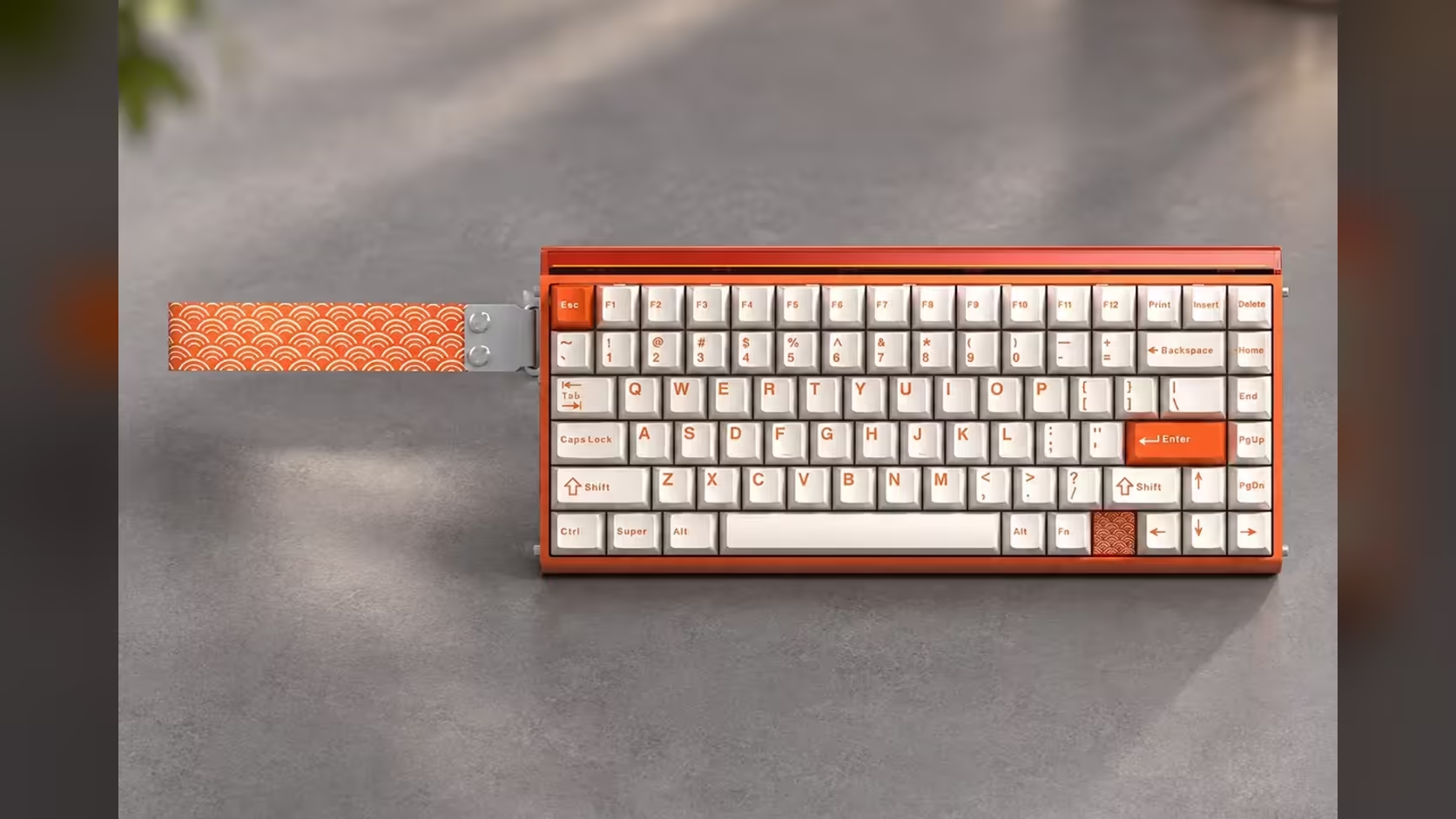
SOCD has gone from an obscure fighting-game term to a hot topic in shooters, and the rules around it keep shifting. Some titles and tournaments allow it, some ban it, and some change their minds between seasons. If you own or are shopping for a keyboard that lists it, you need two things: to know whether your board has it, and to know how to turn it off. Here is where SOCD on AULA keyboards lives, and how to handle it responsibly.
Quick Answer
The AULA WIN68 MAX, HERO 75 HE, AG75 and F87 Pro V2 list SOCD, and on each one it is a setting you control in AULA's software, so it can be switched off. SOCD decides what happens when two opposite keys, such as A and D, are held at once. Game publishers set and revise their own rules on it, so check the current policy for your game before a match. Evetech charges R699 for the WIN68 MAX, R899 each for the HERO 75 HE and F87 Pro V2, and R2,399 to R2,799 for the AG75.
↔️ What SOCD does, in plain terms
SOCD stands for Simultaneous Opposing Cardinal Directions. Hold A and D together on a normal keyboard and the game receives both, which usually cancels out to standing still. A keyboard with SOCD handling applies a rule instead, most commonly "last input wins": if you are holding A and press D, the board sends D alone until you let it go.
In a shooter, that can make strafing changes cleaner, because you never pass through a moment of cancelled movement. It is also exactly why some publishers treat it as an unfair automation, and why others do not mind it.
🗂️ Which AULA boards list it
- WIN68 MAX: SOCD sits alongside DKS, Mod-Tap, Toggle and Rapid Switch, all set in AULA's web driver.
- HERO 75 HE: listed with END, Toggle, Mod-Tap, DKS, Multi-Point Trigger and Rapid Trigger, configured in the AULA HUB web driver.
- AG75 Pro and AG75 Ultra: one entry in the fullest mode list AULA offers, which also covers Rapid Switch, Toggle, END, Mod-Tap, Multi-Point Trigger and DKS, all in AULA's web HUB.
- F87 Pro V2: SOCD with Mod-Tap and Toggle, on a mechanical tri-mode board.
The WIN68 HE and the HERO 84 HE do not list SOCD. The WIN68 HE's headline mode is Rapid Trigger, and the HERO 84 HE's page names Mod-Tap and Dynamic Keystrokes in its driver.
🔒 Making sure it is off for a game that bans it
AULA's product pages confirm these modes are set in software rather than fixed in the hardware, so they are yours to switch on or off. AULA does not publish a step-by-step menu path, so the routine below is general rather than a screen-by-screen guide:
- Connect the keyboard and open the driver it uses (AULA's web driver or HUB for the magnetic boards).
- Look through the advanced key or key mode settings for SOCD on the keys you use for movement.
- Remove or disable any SOCD assignment, then save to the board.
- Test it. Open a key tester in your browser, hold A, then press D. With SOCD off, both keys should show as held.
Many players keep one profile with SOCD for games that allow it and a clean profile without it, then switch profiles depending on what they are playing.
Do the rules stay fixed?
No. Whether a game or event permits SOCD is decided by its publisher or organiser, and those decisions have changed over time. The only reliable source is the current rules page or announcement from the game or tournament itself. Check it before a ranked session or an event, not after.
Rapid Trigger is a separate feature: it resets a single key as soon as it starts to rise, and every AULA magnetic board has it. A rule about SOCD may or may not say anything about Rapid Trigger, so read the wording carefully.
The magnetic boards on this list carry a 2 Years Local Warranty at Evetech; the F87 Pro V2 carries one year. Compare them in the gaming keyboards category, and browse keyboard switches if you want to change the feel of a hot-swap board.
Frequently Asked Questions
What happens when A and D are held together with SOCD on?
The board applies a rule, usually "last input wins", so only the most recent direction is sent.
Where is SOCD on the HERO 75 HE?
In the AULA HUB web driver, alongside its other advanced key modes.
Do the WIN68 HE and HERO 84 HE list SOCD?
No. Neither lists it among its key modes.
How do I make sure SOCD is off?
Remove the SOCD assignment in the driver, save it to the board, and confirm in a key tester that opposite keys both register.
Are Rapid Trigger and SOCD the same?
No. Rapid Trigger resets one key as it rises; SOCD resolves two opposite keys held at once.
Do game rules on SOCD stay the same?
No. Publishers and organisers set and revise them, so check the current rules before you play.
Want full control over your key modes?
Explore the magnetic and mechanical keyboards at Evetech and choose a board whose advanced settings you can switch on or off.