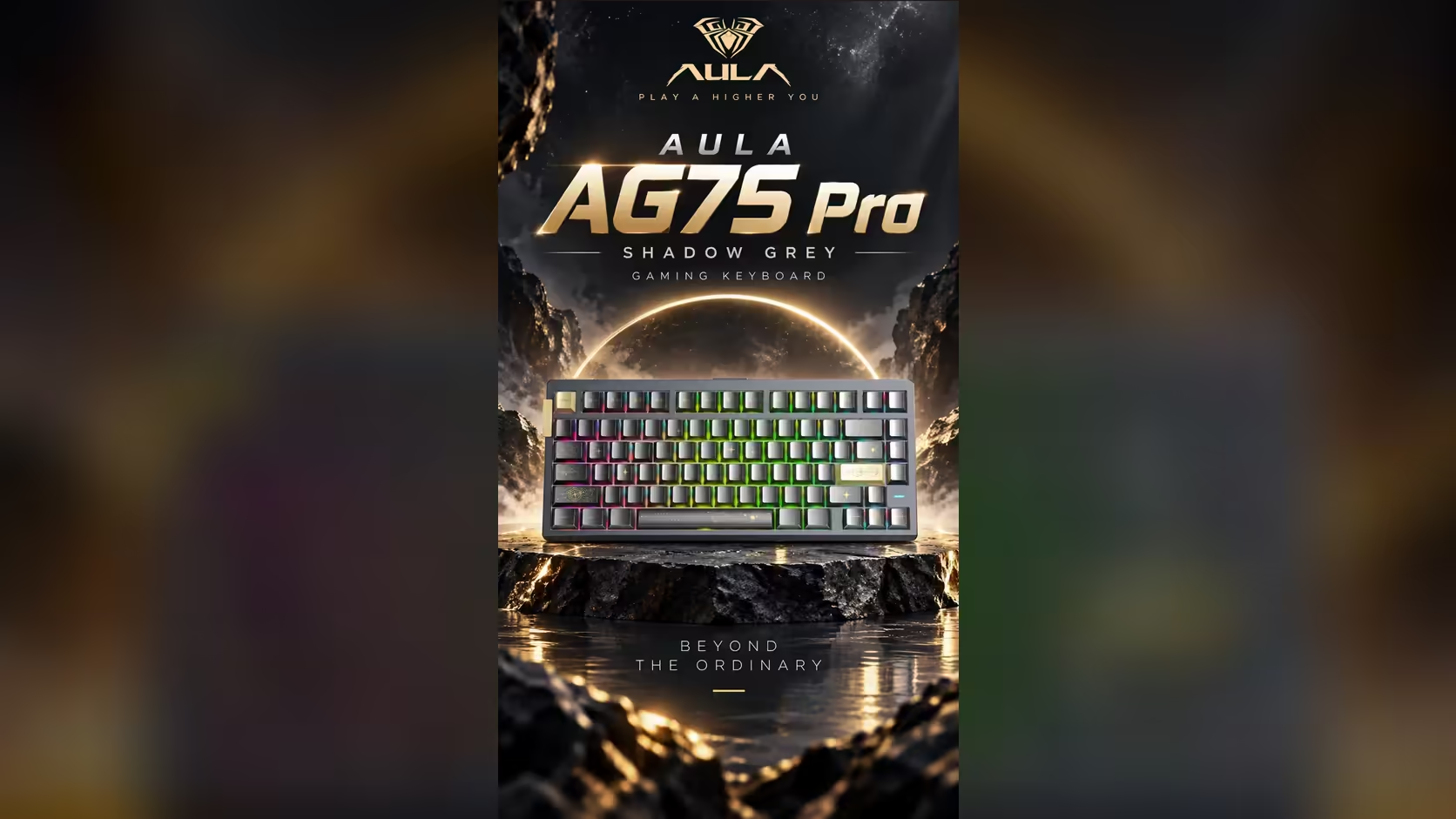
Inside almost every keyboard there is a small chip doing all the thinking: reading keys, running lighting, talking to the computer. The AG75 carries three. AULA calls it a triple-MCU direct connection and says the split cuts processing delay. The phrase sounds like marketing, but the idea behind a triple-MCU keyboard is straightforward, and it explains how the AG75 can read its keys as fast as it does.
Quick Answer
The AULA AG75 divides its internal work between three microcontrollers (MCUs) instead of one, which AULA says reduces processing delay. That arrangement supports 256kHz full-key scanning, up to 2304kHz when reading a single key, and 8000Hz polling over the USB-C cable. The AG75 Pro and AG75 Ultra both use the same design. Evetech carries the Ultra at R2,399 and the Pro at R2,399 in Shadow Grey or R2,799 in Armor Silver.
🧠 What an MCU does in a keyboard
MCU stands for microcontroller unit, a small, self-contained computer on a chip. In a keyboard it has three broad jobs:
- Scanning: checking every key's sensor, over and over, to see what has changed.
- Deciding: working out whether a change counts as a press or a release, applying settings such as actuation depth and Rapid Trigger.
- Reporting: sending the result to the PC on schedule.
On a magnetic board, scanning is heavier work than on an ordinary one. Each Hall Effect sensor reports a position rather than a simple on or off, and the controller has to compare that position with your chosen actuation point and watch for the tiny upward movements that Rapid Trigger reacts to.
🔀 Why three instead of one
One chip handling everything has to take turns. While it is busy reporting or processing, it is not reading keys, and vice versa. Splitting the load across three controllers lets those jobs overlap, so scanning does not have to pause while other work happens.
AULA does not publish exactly how the three divide their tasks, so the best way to think of it is capacity. More processing headroom is what allows the rates AULA quotes for the AG75:
- A 256kHz sweep of the whole board, so every key is checked 256,000 times each second.
- Up to 2304kHz when a single key is read.
- 8000 reports per second to the computer, one every 0.125ms.
🎯 Does it change anything you do?
There is nothing to configure. The MCUs work in the background from the moment the board is plugged in; your settings live in AULA's browser-based web HUB, where you tune actuation, Rapid Trigger, SOCD, DKS and the rest.
Where the design earns its keep is in those features. Rapid Trigger on the AG75 works at 0.001mm precision with a true zero dead zone, which means the controllers must notice extremely small movements quickly and act on them. Dense, fast scanning is what makes that practical. The same applies to DKS and Multi-Point Trigger, which assign actions at different depths and need accurate, frequent position readings.
The triple-MCU arrangement is shared by every AG75, whether the Frostcore-equipped Pro in Shadow Grey or Armor Silver, or the Eight Treasures Ultra in Battle Shine Orange. Pick your edition on switch and colour; the electronics are the same.
Evetech carries the AG75 range under gaming keyboards, where it has a 2 Years Local Warranty, and it is worth comparing against the buyer favourites in keyboard best sellers. Evetech's product pages list the price.
Frequently Asked Questions
What does MCU mean on the AG75?
Microcontroller unit, a small processor that reads the keys and talks to the PC. The AG75 uses three.
Why not use a single chip?
One chip has to take turns between tasks. Three can share the work, which AULA says reduces processing delay.
How fast does the AG75 scan?
256kHz across the full board, with a single key readable at up to 2304kHz.
Do I need to set anything up for the MCUs?
No. They run automatically; your own settings go in AULA's web HUB.
Is Rapid Trigger any better for it?
Fast, frequent readings are what let 0.001mm Rapid Trigger respond to tiny movements, so the design supports it.
Is the design the same on Pro and Ultra?
Yes. Every AG75 uses the triple-MCU arrangement.
Want a keyboard with processing headroom to spare?
Explore Evetech's gaming keyboard range and compare the AG75 Pro and Ultra with other high-speed boards.