


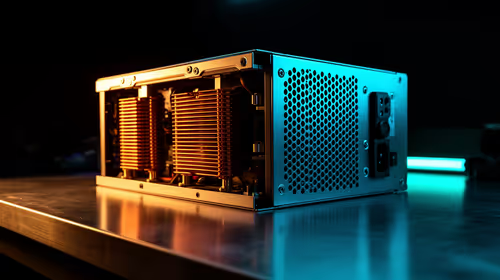
1000W PSU Planning for RTX 5090 Builds in SA
1000W for RTX 5090 needs a full-build check, not a simple yes. Review GPU guidance, CPU draw, transient load, connectors, PSU quality, and upgrade plans before deciding.
Read moreSurge claims for a damaged power supply get rejected in SA mainly over fine print excluding surge damage, missing proof of surge protection, or gaps proving the surge caused it. Reading the policy's surge clause before an incident prevents most rejections.

A surge claim can be declined when the event is excluded, the item falls outside the insured section, conditions were not met, ownership is unclear, or technical evidence does not link the damage to the claimed incident.
Reasons vary by policy and claim. Read the current wording, ask the insurer what proof it needs, and request any decline with the exact clause in writing.
Ask whether electrical surge, lightning and accidental electrical damage are included. Check excess, item limits and whether a custom gaming PC must be specified.
Read any conditions about surge protection, maintenance or electrical compliance. Do not assume a condition from another insurer applies to yours.
Keep the written answer and policy schedule in secure storage away from the PC.
Keep invoices, component list, serials and dated photos. After damage, record what you observed without guessing the cause.
Contact the insurer before repair where required. Keep damaged parts until it gives disposal or salvage instructions.
Use the assessor or technician route the insurer accepts. A replacement quote proves value, not cause.
Ask for the decision, evidence gap and policy clause in writing. Provide factual missing records through the claim channel.
Use the insurer's internal complaint process when needed. Follow the current external dispute route named in the policy after internal steps.
If replacement power is part of an approved quote, compare Corsair PSU models with best-selling power supplies only after the damaged system has been assessed.
Record the time the PC was last working, the electrical event you observed, any utility notice and the first sign of damage.
Separate fact from assumption. Write "PC shut down when supply returned" rather than declaring a surge unless the technical evidence establishes it.
Keep claim calls, reference numbers and inspection dates in the same timeline. A clear sequence helps the assessor understand what changed.
Do not discard the PSU, surge device or damaged cables before written authorisation. Do not repeatedly power the machine.
Ask which technician or assessor the insurer accepts and what the report must cover. A generic repair note may not answer causation.
Keep replacement quotes matched to the lost configuration. An oversized upgrade quote can distract from the insured loss.
Save the electrician's fixed-installation records and point-of-use product invoices. Note when a surge strip status changes or a device is replaced.
These records cannot guarantee approval, but they can show what equipment existed and how it was maintained.
Review the policy after major PC or electrical upgrades. Item values and conditions may need updating.
No. Approval depends on the policy, event, conditions and evidence.
Follow the insurer's instructions. Unapproved work can alter evidence under some claim processes.
Ask for the reason and policy clause. The insurer's complaint route should also be available.
Confirm the surge clause before an incident, keep ownership and protection records, and require any claim decision to cite the current policy wording.
No. Approval depends on the policy, event, conditions and evidence.
Follow the insurer's instructions. Unapproved work can alter evidence under some claim processes.
Ask for the reason and policy clause. The insurer's complaint route should also be available. {{PRODUCTS: { facets: { query: "power supply" }, limit: 12, title: "Power Supplies", style: "4" } }}
1000W for RTX 5090 needs a full-build check, not a simple yes. Review GPU guidance, CPU draw, transient load, connectors, PSU quality, and upgrade plans before deciding.
Read more
RTX 5080 Super with a 750W PSU is more comfortable than lower wattage if the unit is quality. SA builders should still confirm GPU guidance, CPU draw, connector type, airflow, and upgrade room.
Read more
How to fix FPS drops after a RX 9070 XT starts with driver cleanup, chipset updates, thermals, and power checks. For SA gaming PCs, confirm PCIe seating, monitor refresh, frame caps, and per-game graphics settings before replacing parts.
Read more
How to fix low FPS Windows 11 Wi-Fi 7 issues starts by checking whether the problem is frame rate or network lag. Test ping, drivers, power settings, Ethernet, and game FPS before adjusting visuals.
Read more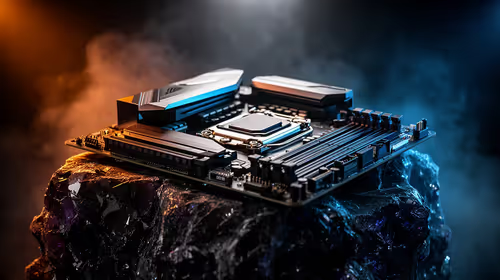
AM5 is smart for SA builders because it supports newer Ryzen CPUs, DDR5 memory, and a longer upgrade path. Compare board cost, cooling, gaming needs, and local part availability before choosing your next PC platform.
Read more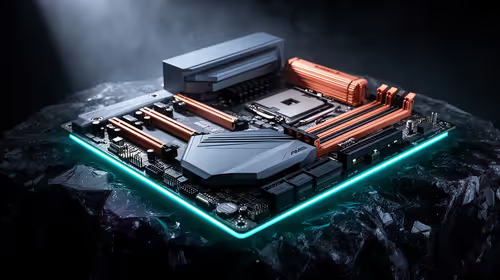
AM5 gives Randburg gaming builders a longer upgrade path. For SA buyers, DDR5 support, newer board features, and future CPU options can justify the platform. Weigh board cost, cooler support, BIOS maturity, and upgrade timing before choosing.
Read more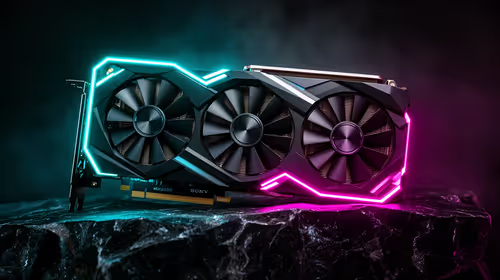
RTX 5090 on a 550W PSU leaves almost no practical room for OC plans. Treat the setup as constrained, with CPU draw, power spikes, cable quality, thermals, and stability checks more important than chasing extra clocks.
FPS drops on a Ryzen 9 9950X3D build often have a fixable cause. Check settings, drivers, thermals, background tasks, network conditions, and bottlenecks before assuming a part must be replaced.

The difference between PCIe 5.0 and PCIe 4.0 for SA gamers is mostly bandwidth headroom. Compare GPU slot needs, NVMe speed, motherboard support, and upgrade timing before paying extra for a newer platform.

Gaming PC stuck pixel checks in South Africa should confirm the monitor fault first. Use colour tests, screenshot comparison, cable swaps, display menu checks, and clear photos before deciding on support.

AMD's current driver now lists a Radeon RX 9050 4GB, while product coverage details a narrowed memory system. SA buyers should weigh the low VRAM ceiling against current local Radeon options.

Samsung Display has demonstrated a 16-inch 2.5K OLED laptop panel running at 300Hz. SA buyers should wait for a named notebook, full panel specifications and a local price before planning an upgrade.

Microsoft says some Windows 11 game crashes after recent updates are linked to RGB-related drivers. Affected SA gamers should confirm the update and driver before using the published registry workaround.

Thermalright's Fan Frame Vision-1 adds a 640x172 status screen to a standard 120mm fan. SA builders should check clearance, USB routing and local support before treating it as an easy upgrade.
1000W for RTX 5090 needs a full-build check, not a simple yes. Review GPU guidance, CPU draw, transient load, connectors, PSU quality, and upgrade plans before deciding.

Wi-Fi 6E vs Wi-Fi 6 matters for 4K video editing when files move across a network. The real-world difference between Wi-Fi 6E and Wi-Fi 6 for video editing in 4K depends on NAS access, cloud uploads, router range, and SA creator workflows.
RTX 5080 Super with a 750W PSU is more comfortable than lower wattage if the unit is quality. SA builders should still confirm GPU guidance, CPU draw, connector type, airflow, and upgrade room.
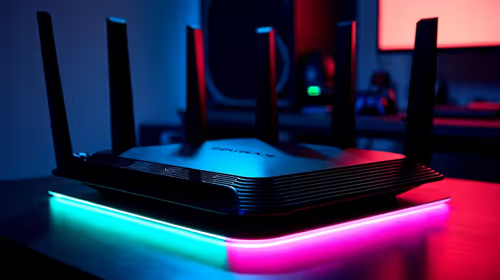
Wi-Fi 6E vs Wi-Fi 6 for Video Editing in 4K comes down to router support, latency, client devices, band support, and home network layout. SA buyers should match the choice to their setup instead of assuming one option always wins.