Competitive players will argue this one for hours, but the honest answer has stayed the same for years even as wireless standards keep improving. A b650e motherboard that includes both options as standard at least means you are not locked into a compromise either way.
Quick Answer
Wired Ethernet still edges out Wi-Fi 6E for the lowest, most consistent ping in competitive gaming. Both options come built into the R3,499 ASUS B650E MAX Gaming WiFi, so switching between wired and wireless costs nothing extra and does not require any additional hardware purchase.
🔌 Why Wired Ethernet Keeps Winning
A physical cable removes the variables that any wireless signal introduces, from interference off neighbouring networks to the small overhead of the wireless protocol itself. For split-second competitive matchups, that consistency matters more than a marginal difference in theoretical bandwidth.
When the Difference Is Most Noticeable
In fast-paced multiplayer titles where reaction timing decides rounds, even small, occasional latency spikes from a wireless connection can be the difference between winning and losing an exchange, which is why serious competitive players default to a cable whenever one is available.
📶 Why Wi-Fi 6E Still Has a Real Place
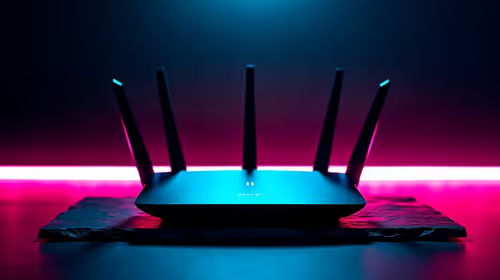
Tri-band Wi-Fi 6E, standard on the B650E MAX Gaming WiFi, includes access to the less congested 6GHz band, which meaningfully reduces the interference issues that plagued older Wi-Fi standards in busy households. For casual and single-player gaming, the difference against wired Ethernet is rarely noticeable.
A Sensible Default for Most Households
If running a cable to your desk is inconvenient, Wi-Fi 6E on this board is a strong fallback rather than a compromise, particularly compared to older dual-band Wi-Fi standards still found on cheaper boards.
For the full specification list, see ASUS's B650E MAX Gaming WiFi. Builders comparing networking options across similar boards can browse Evetech's B650 selection, and those open to other AMD chipset generations should check the wider AMD motherboard section for further comparison.
Frequently Asked Questions
Is the latency difference between wired and Wi-Fi 6E large in practice?
It is usually small in absolute terms, but competitive players often still prefer wired for its consistency rather than raw speed alone.
Do I need special equipment to use the board's Wi-Fi 6E?
Your router also needs to support Wi-Fi 6E and its 6GHz band for you to get the full benefit, otherwise the connection falls back to an older band.
Should casual gamers bother running an Ethernet cable at all?
Not necessarily, since Wi-Fi 6E on this board is capable enough for casual and single-player gaming without a noticeable downside.
Can I switch from Wi-Fi to Ethernet without losing any settings?
Yes, both connections are available on the board at the same time, so switching between them does not require reconfiguring your network setup.
Does using an Ethernet cable free up the Wi-Fi 6E radio for other devices?
It does not disable the radio, but a wired PC connection means other devices in the house have less competition for airtime on the 6GHz and 5GHz bands.
Is a cheap Ethernet cable good enough, or do I need a specific type?
A standard Cat6 cable is generally sufficient for gaming purposes, since the board's wired networking does not require anything more exotic to perform reliably.
Ready to settle the wireless-versus-wired debate?
The ASUS B650E MAX Gaming WiFi waits in the AMD B650E motherboard range, built to offer both Wi-Fi 6E and wired Ethernet so either choice is covered.