Sorting NVMe storage on a X870 board comes down to a few decisions that matter and several that do not. Here is what a Johannesburg builder should actually weigh before buying.
Quick Answer
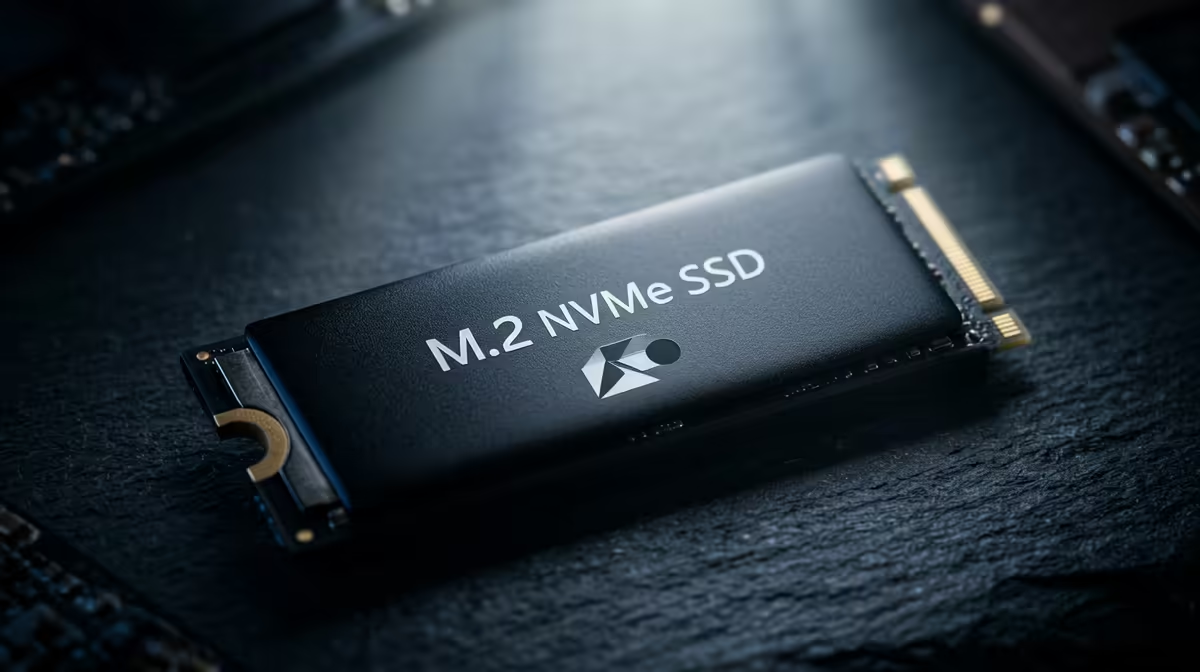
For a X870 2TB Gen 4 NVMe, a model with an onboard DRAM cache gives the steadiest sustained-write and random performance, which keeps large game installs and editing scratch files smooth. A DRAM drive holds full speed where a cheaper DRAM-less drive slows under load. Treat DRAM as the feature that separates a good primary drive from a budget one.
What the DRAM cache actually does
The onboard DRAM stores the drive's mapping table so the controller finds data without round-trips to slower flash. That keeps random 4K performance and sustained writes steady, which you feel when installing large games or running an editing scratch disk. DRAM-less drives lean on system memory and slow under load, so for a main drive the DRAM model earns its small premium.
Pairing it with your X870 board
Use the CPU-direct primary M.2 slot for your fastest drive so it gets full lanes, and mount it under the supplied heatsink. Johannesburg climates run warm, so confirm one case fan pulls air across the M.2 area. For most SA gamers a single 2TB Gen 4 drive is the right call: it is simpler, cooler and easier to back up than juggling several smaller drives. Update the board to the latest stable BIOS for the best NVMe compatibility before you install Windows.
SA pricing and what to actually buy
At local retail a solid 1TB Gen 4 TLC drive sits around R1,100-R1,600, a 2TB around R2,000-R3,000, and a 2TB Gen 5 with heatsink in the R3,500-R5,000 band. For a gaming-first X870 build, a 2TB Gen 4 TLC drive with DRAM is the value sweet spot; Gen 5 is worth it mainly if you move very large files often. Buy the capacity you need now plus headroom, because adding a second drive later is cheap and easy on this platform.
FAQ
Do I need a Gen 5 NVMe for gaming on a X870 board?
Not really. Game load times are nearly identical between a fast Gen 4 and a Gen 5 drive because games rarely saturate the bus. Gen 5 (around 7,000MB/s) only pays off for very large file transfers or editing scratch work.
How big should the drive be?
For a gaming-first build, 2TB is the comfortable size today, leaving room for a few large titles plus Windows and software. A 2TB Gen 4 TLC drive runs about R2,000-R3,000 at SA retail.
Will heat damage the drive in SA's climate?
Only if it runs uncooled. Mount the NVMe under the board's bundled heatsink and keep one case fan moving air across it; that holds the controller under 65C and stops thermal throttling even in a hot Johannesburg room.
drive to the slot: put your fastest NVMe in the CPU-direct primary M.2 socket under the supplied heatsink, then confirm one case fan moves air across it. That single step at build time prevents thermal throttling in a warm Johannesburg room.