Quick Answer
If a AM5 system becomes unstable after EXPO, start with safe BIOS defaults, boot the RAM at JEDEC speed, then reapply a conservative memory profile. For a 240Hz display issue, treat the board, RAM profile, BIOS version, and CPU memory controller as one stability chain. Keep a R2,500-R6,500 motherboard or monitor purchase on hold until you prove the fault with a repeatable boot test.
First Stable Boot
Power down fully, clear CMOS using the board jumper or rear button if fitted, then boot with one keyboard, one display cable, and the primary drive only. Let memory training finish before judging the first boot. If the system reaches BIOS, save a known-good profile at DDR5-4800 or DDR5-5200 before trying 6000MT/s, 6400MT/s, or a vendor-tuned preset again.
BIOS And Memory Checks
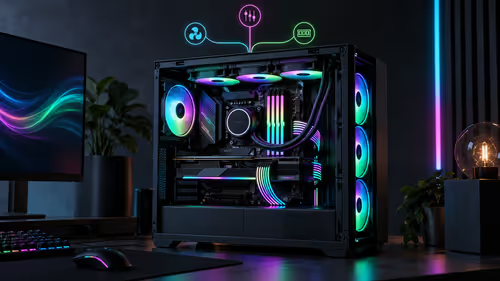
Use the exact BIOS file for the board model, such as MSI B850 Tomahawk WiFi, ASUS TUF Gaming B650-Plus, or Gigabyte B650 Aorus Elite AX where relevant. If EXPO causes BSODs, lower the memory speed one step, keep command rate and voltage within the kit specification, and retest cold boots. A 32GB DDR5-6000 CL30 kit is a common AM5 target; pushing beyond that can add instability for little gaming gain.
When Replacement Makes Sense
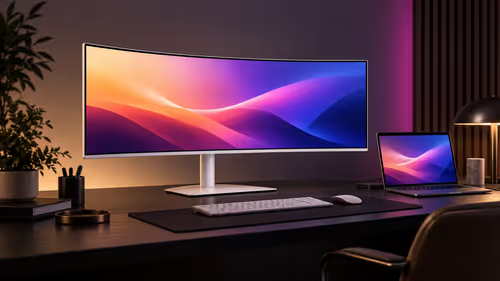
Only suspect hardware after repeatable evidence: no POST at JEDEC, debug LEDs that stop on DRAM or CPU, failure with one known-good DIMM, or crashes after a clean BIOS reset. For display-specific symptoms, test DisplayPort and HDMI, confirm 240Hz in Windows, and try 144Hz as a control. A stable 144Hz result with crashes only after memory tuning points back to RAM settings, not the screen.
FAQ
Can EXPO cause BSODs?
Yes. A memory profile changes speed, timings, and voltage, so a marginal setting can crash Windows even when the PC looked fine at default speed.
Should I update BIOS first?
Update BIOS only after the system can boot reliably at safe defaults. Flashing while unstable adds risk, so establish a clean baseline first.
Is 240Hz affected by motherboard RAM settings?
Indirectly. The monitor needs the GPU and cable, but unstable RAM can crash the PC before the display setting matters.
Stability Check
one written baseline: BIOS version, RAM speed, voltage, GPU cable, and Windows refresh rate. Return to that baseline whenever the next test fails.