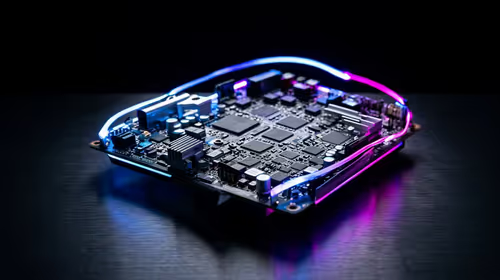
A stack of monthly subscriptions for file storage, password management, media streaming and document scanning quietly adds up to real money every year. A single self-hosting starter stack on a Raspberry Pi 5 can swallow all of those jobs at once, putting your files, passwords, media and paperwork on hardware you own and control rather than someone else's server.
Quick Answer
A Raspberry Pi 5 with 8GB of RAM can run Nextcloud, Vaultwarden, Jellyfin (without transcoding) and Paperless-ngx together, replacing several paid cloud services at once. Add a USB SSD for storage and the whole build comes in affordably, with enough headroom for a household. The catch: Jellyfin must stream without transcoding, and photo apps with AI features are far heavier.
What each service replaces
The point of the stack is that four small, focused apps cover what several subscriptions do separately.
- Nextcloud is your file storage and sync, a self-hosted alternative to mainstream cloud drives, with a full suite of apps on top of plain backup.
- Vaultwarden is a lightweight, resource-friendly password server that is fully compatible with the official Bitwarden browser extensions and mobile apps, giving you the core premium features without the subscription.
- Jellyfin streams your own movies, shows and music, and runs comfortably on the Pi as long as it streams in the format your devices already support rather than re-encoding on the fly.
- Paperless-ngx scans documents, runs OCR, makes everything text-searchable and auto-tags files by rules you define, retiring the document-scanning service.
Building the stack, step by step
- Get the hardware right. A Raspberry Pi 5 with 8GB of RAM is the sensible baseline. Add a USB SSD rather than relying on a microSD card for both speed and reliability, plus a quality power supply and a case with cooling.
- Install a base OS and Docker. Flash Raspberry Pi OS (64-bit) to the SSD, update it, and install Docker and Docker Compose. Running each service in its own container keeps the stack tidy and easy to update.
- Deploy Nextcloud first. Stand up Nextcloud in a container, point its data directory at the SSD, and confirm you can log in and upload a file from your phone and laptop.
- Add Vaultwarden. It is genuinely lightweight, so it slots in with little overhead. Install the Bitwarden apps and extensions on your devices and point them at your Vaultwarden instance.
- Add Jellyfin, configured for direct play. Set your library so content streams without transcoding, since the Pi 5 handles direct streaming well but is not built to re-encode video in real time.
- Add Paperless-ngx last. Give it a watched folder, let it OCR and tag incoming scans, and your paperwork becomes searchable.
Knowing the Pi 5's limits
This is where realistic expectations matter. Jellyfin runs well only when it streams in a format your playback device already supports; ask it to transcode 4K on the fly and the Pi will struggle. Photo platforms like Immich are tempting additions, but their machine-learning features such as face recognition and semantic search are CPU-heavy, and the initial indexing pass takes a long time on Pi-class hardware. Keep those workloads off the box or accept slow first runs. If you find yourself wanting more grunt, a small x86 mini PC steps up nicely, and the mini PC range at Evetech spans Pi-style boards through to more capable little machines. For a sense of what people pick when they outgrow a single board, the best-selling desktops list is worth a look.
Frequently Asked Questions
Can a Raspberry Pi 5 really run all four services at once?
Yes. A Pi 5 with 8GB of RAM concurrently runs Nextcloud, Vaultwarden, Jellyfin (without transcoding) and Paperless-ngx, especially when paired with a USB SSD for storage and headroom.
Why does Jellyfin have to run without transcoding?
The Pi 5 streams existing media formats well but is not designed to re-encode video in real time. Configure your library for direct play so the Pi serves the file as-is rather than converting it on the fly.
Do I need an SSD, or will a microSD card do?
Use a USB SSD. A microSD card is slower and far less durable under the constant read and write of a self-hosted stack, so the SSD is what gives you both performance and reliability.
Is Vaultwarden the same as Bitwarden?
Vaultwarden is a lightweight, independent server that implements the Bitwarden API and works with all the official Bitwarden apps and extensions. You get the core premium features while hosting it yourself.
Can I add a photos app like Immich?
You can, but its AI features (face recognition, semantic search) are CPU-intensive and the first indexing run is slow on a Pi. If photos with smart search matter to you, plan for more powerful hardware.
Is this beginner-friendly?
It is approachable if you are comfortable with the command line and Docker. Deploy one service at a time, confirm each works, then move to the next rather than standing up all four at once.
Take your data back onto hardware you own. Pick up a capable little board or mini PC from the mini PC range at Evetech and build a home stack that replaces those monthly subscriptions for good.