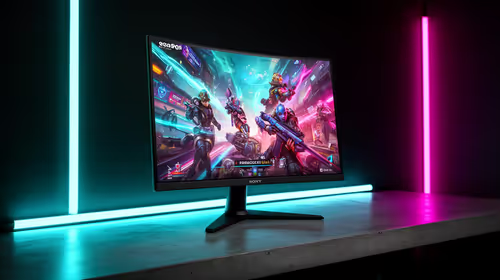
South African gamers often blame the hardware when frame pacing issues appears, but a 240Hz monitor usually behaves once a single setting or driver is corrected.
Quick Answer
Yes, most frame pacing issues on a 240Hz monitor clears once you align display mode, power profile, and a clean driver install. A 1440p 240Hz panel costs around R7,500, while 1080p 240Hz units sit near R4,800. Treat the named hardware as context until your numbers prove otherwise.
Verify Cables, Ports And Connections
Swap to a known-good certified cable and a different port, since a marginal link can cause frame pacing issues that looks like a deeper fault. On a 240Hz monitor this is a two-minute check that rules out a whole class of problems. Reseat the connection, retest the same scene, and record the result before moving on.
Set Realistic Targets For Your Panel
Decide what frame timing you actually need for your panel and game type, then tune toward it rather than chasing a number the 240Hz monitor was never meant to hit. A 1440p 240Hz panel costs around R7,500, while 1080p 240Hz units sit near R4,800. Setting a sensible target stops endless tweaking and makes any remaining frame pacing issues easy to judge against a clear goal.
Fix the cause, then shop smart. When your before-and-after numbers point to a clear limit on your 240Hz monitor, the right Evetech monitor pick becomes obvious.
Clear Background Load And Contention
Close capture tools, browser tabs, launchers, RGB utilities, and update services for one clean pass. Background processes quietly steal cycles and bandwidth, and on a 240Hz monitor they are a common hidden cause of frame pacing issues. Re-run your scene with a quiet system to see how much frame timing recovers without spending anything.
FAQ
Is 1 ms response relevant when fixing frame pacing issues?
It can be. Confirming 1 ms response is configured correctly removes a common hidden cause before you blame other parts. Verify it, retest the same scene, and record the frame timing result.
Does a 240Hz monitor need a specific power profile to perform?
Yes. Set Windows and any vendor utility to high performance, not eco or balanced, so frame timing is not capped to save energy. Then confirm temperatures stay in range during your test scene.
Should I lower resolution or settings first on a 240Hz monitor?
Test the load pattern first. If the GPU is pinned, drop resolution scale or heavy effects; if the CPU is pinned, settings changes help less. Targeting 240 Hz as a reference keeps tuning realistic.
Save Time
Lock the in-game preset and resolution first; only then touch one tuning option so you can attribute any gain correctly.