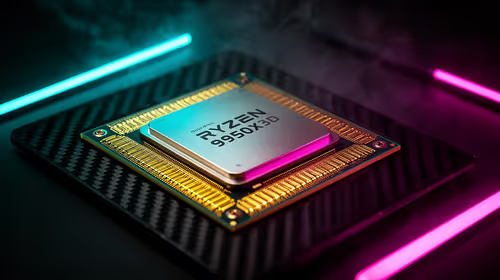
If your Ryzen 9 9950X3D build keeps causing input lag mid-match, the fix almost always comes from one measurable change rather than a fresh parts list. On Windows 11, a couple of OS-level toggles also matter, so we will cover those too.
Quick Answer
Start by locking your Ryzen 9 9950X3D build to one test scene, then confirm refresh rate, frame cap, and the latest stable drivers. A Ryzen 9 9950X3D sits near R22,500, ideal for play-plus-work rigs above R45,000. Measure click-to-photon delay before and after each change so the fix is evidence-based.
Match The Workload To The Hardware
Once your scene is stable, read which subsystem is pinned. High GPU load points to lower resolution scale or softer presets; high CPU load points to engine limits or memory behaviour; storage spikes show up when assets stream. Tying input lag on a Ryzen 9 9950X3D build to a measured load pattern makes the next step obvious.
Confirm Memory And Storage Health
Make sure 16 cores is enabled correctly and that the boot drive has free space and healthy speeds. Misconfigured memory profiles and a near-full drive both surface as input lag under load. A Ryzen 9 9950X3D sits near R22,500, ideal for play-plus-work rigs above R45,000. A quick check here often explains stutters that look like a GPU problem on the Ryzen 9 9950X3D build.
Save Time
Lock the in-game preset and resolution first; only then touch one tuning option so you can attribute any gain correctly.
Check Display Mode And Frame Targets
Confirm the panel is running its rated refresh, that resolution matches your intended target, and that any frame cap is deliberate. Verify VRR is on, choose fullscreen or borderless on purpose, and make sure the Ryzen 9 9950X3D build is not silently falling back to a lower mode. With 5.7 GHz boost sorted at the source, input lag often eases before you touch anything else.
FAQ
How do I measure click-to-photon delay reliably on a Ryzen 9 9950X3D build?
Use an on-screen overlay and the same in-game scene each test. Capture a 60-second run, note the average and the lows, then compare after every change. Consistent scenes make small differences visible.
How much should I budget to properly address this on a Ryzen 9 9950X3D build?
Often nothing, since most fixes are configuration changes. A Ryzen 9 9950X3D sits near R22,500, ideal for play-plus-work rigs above R45,000. If a measured bottleneck remains after tuning, spend on the single part your data points to rather than a full rebuild.
Is input lag on a Ryzen 9 9950X3D build a hardware fault or a settings problem?
Most of the time it is settings, drivers, or background load rather than a broken part. Run one repeatable scene, change a single variable, and watch click-to-photon delay. Only consider a replacement once a clean configuration still shows the issue.
Pin down the limit before you upgrade your Ryzen 9 9950X3D build. Once your notes show whether click-to-photon delay is held back by drivers, display mode, thermals, or load, browse the matching Evetech CPU shortlist with confidence.