Quick Answer
A no-signal screen after this kind of change is almost always the cable, the input, or the GPU's display port, not a dead component. Plug the monitor into the graphics card (never the motherboard) using DisplayPort, select that exact input on the monitor's menu, and re-seat the GPU and its power cables. On AM5 and other DDR5 boards, a black screen for up to a minute after a RAM or BIOS change is normal memory training, so wait it out.
Run the cable and input checks first
Most no-signal cases end here. Confirm the cable runs from the monitor to the graphics card's DisplayPort, not the motherboard's HDMI, then use the monitor's on-screen menu to select that exact input. Swap to a known-good DisplayPort 1.4 or 2.1 cable, since a marginal cable shows a picture at low refresh but blanks at high refresh. it draws up to 575W and uses the 12V-2x6 connector, so a fully seated cable is non-negotiable Try a second monitor or TV to prove whether the screen or the PC is at fault.
Read the motherboard's debug lights and re-seat the basics
Modern AM5 and Intel boards have four Q-LEDs labelled CPU, DRAM, VGA and BOOT. A stuck DRAM light means re-seat the memory and clear CMOS; a stuck VGA light means re-seat the graphics card and its power cables. Clear CMOS with the rear button or by moving the jumper, which resets a bad overclock or memory profile that can blank the screen. Re-seat one part at a time and retest, so you know exactly which step restored the picture.
Confirm the GPU and power delivery are solid
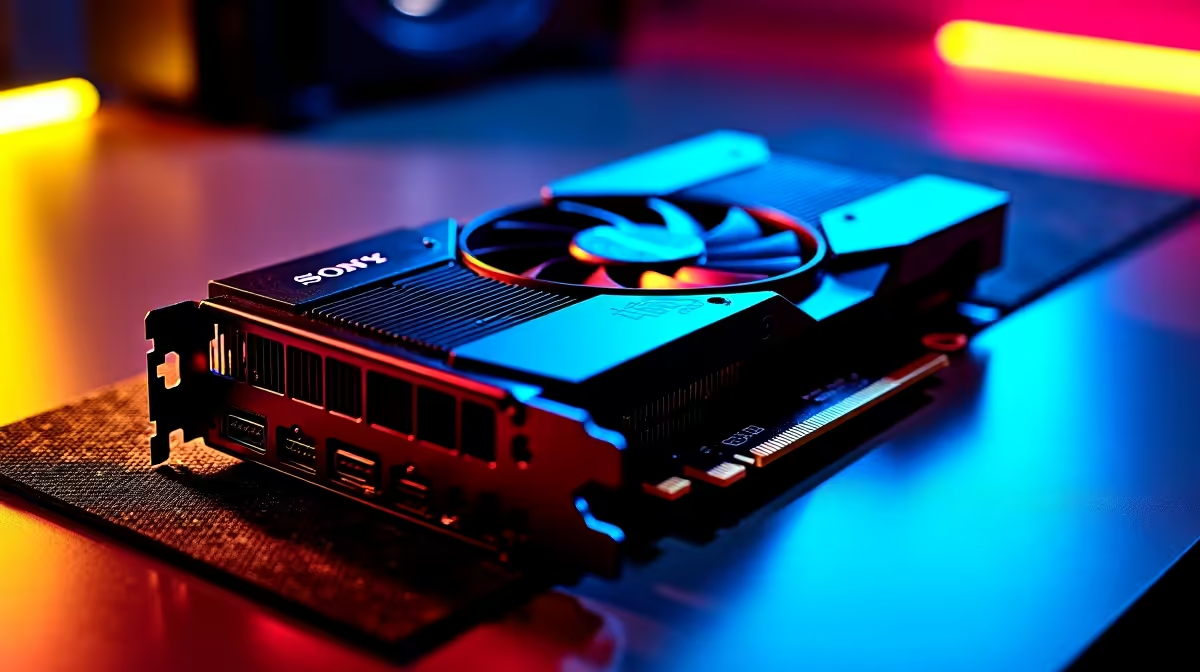
A loose graphics card or an unseated power cable is a classic no-signal cause after any build change. Push the card fully into the x16 slot until the latch clicks, seat every PCIe power cable home, and on current high-end cards make sure the 12V-2x6 connector is pushed all the way in. A 650W to 1000W supply sized to the GPU keeps the card stable; an underpowered or daisy-chained cable can stop the card outputting. Boot with one stick of RAM if a black screen persists to rule out memory.
FAQ
Why is my screen black after this upgrade but the PC turns on?
Power without picture almost always means a cable, input, or display-port problem, not a dead build. Plug into the GPU's DisplayPort, select that input, and re-seat the card before assuming anything failed.
How long should I wait before assuming the build is dead?
Give a DDR5 system up to a minute on the first boot or after a RAM change, because memory training holds the screen black. If nothing appears after that, clear CMOS and re-seat memory and the GPU.
Do I need to buy new parts to fix no signal?
Rarely. The vast majority of no-signal faults are a cable, a wrong input, a loose card, or a BIOS setting. Only after cables, inputs, CMOS reset, and re-seating fail should you suspect a faulty part.
Work the no-signal checklist in order Cable to the GPU, correct monitor input, re-seat card and RAM, clear CMOS, then test a second screen. If a part is confirmed faulty after that, compare your options at Evetech with the symptom noted.