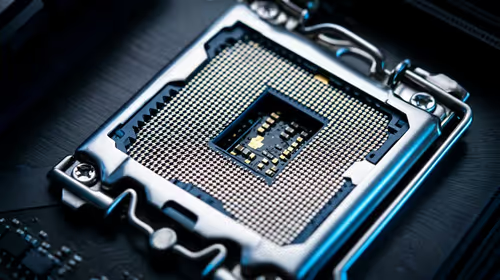
The wave of 2026 agent-first coding tools changed where the heavy lifting happens. Cloud AI-coding agents like Codex CLI Goal Mode, Antigravity 2.0 and Cursor 3 Background Agents run their model inference on remote servers, not on your machine, which means a fast, stable internet line does far more for your day-to-day speed than a top-end graphics card sitting idle in your tower.
Quick Answer
For cloud coding agents, prioritise a fast, low-latency fibre connection over a powerful GPU. The model runs on the provider's servers, so your responsiveness comes from upload and download speed and a stable link, not local VRAM. A solid fibre line matters more than a R30,000 graphics card.
Where the work actually runs in 2026
The defining shift in the current tool generation is autonomy that lives in the cloud. Codex CLI shipped its persistent Goal Mode to general availability in May 2026, where a single directive can survive network drops, a closed laptop and budget resets across hours-long sessions. Antigravity 2.0 leaned into multi-agent work with scheduled background tasks and dynamic subagents. Cursor 3 Background Agents run on a cloud VM that has its own desktop and browser, and can fan out to several parallel agents at once.
In every one of those cases the actual reasoning happens on the provider's hardware. Your machine sends the prompt and context up, the server thinks, and the result comes back down. The GPU in your PC is never asked to do the inference.
Why bandwidth beats VRAM here
When inference is remote, the felt speed of an agent is dominated by the round trip: how quickly your context uploads, how fast tokens stream back, and how stable the connection stays over a long session. A flaky line that drops mid-task is far more disruptive than a slightly slower CPU. This is where a proper fibre setup earns its keep, and where South African developers on good fibre are on equal footing with anyone overseas.
Latency matters as much as raw speed. A line with low, consistent latency keeps the back-and-forth of an agent session snappy, while a high-latency or congested link makes even a fast connection feel sluggish. For background agents that run for hours, stability is the quiet hero: a connection that holds steady lets a Goal Mode or background task finish without you babysitting it.
When you still want local horsepower
Bandwidth-first does not mean the GPU is pointless. If you run models locally, do on-device AI, or render and compile heavy projects, local compute still counts, and the AI-ready PC range is built for exactly that mixed workload. The honest answer for most developers in 2026 is a balanced machine on a great line: enough CPU and RAM to keep your editor and local tooling fluid, paired with fibre that never blinks. If you want a sense of what well-rounded developer machines look like right now, the current PC best sellers give a useful picture of where the sweet spot sits.
Frequently Asked Questions
Do cloud coding agents use my graphics card at all?
For the model inference, no. Tools like Codex CLI Goal Mode and Cursor Background Agents run the model on remote servers. Your GPU only matters if you also run local models, do on-device AI work, or use the machine for rendering and other graphics-heavy tasks.
What internet speed do I need for cloud coding agents?
There is no single magic number, but a stable fibre line with low latency is the priority. The work is text and context moving back and forth, so consistency and a connection that does not drop during long sessions matter more than chasing the highest possible megabit figure.
Is a cheap laptop fine if I lean on cloud agents?
For driving cloud agents, a modest machine with a good connection goes a long way, since the heavy compute is offloaded. You still want enough RAM and a comfortable screen for editing, but you do not need a workstation-grade GPU just to run agents that think in the cloud.
Why does my agent session feel slow even on fast fibre?
Usually latency or congestion rather than raw speed. A high ping, a saturated link, or Wi-Fi interference between you and the router can all make a fast line feel laggy. A wired connection and a clean, uncongested path to your provider often fixes it.
Whether you lean on cloud agents or run models locally, the machine should never be the bottleneck. Explore the AI-ready PC range at Evetech to match your build to how you actually code.