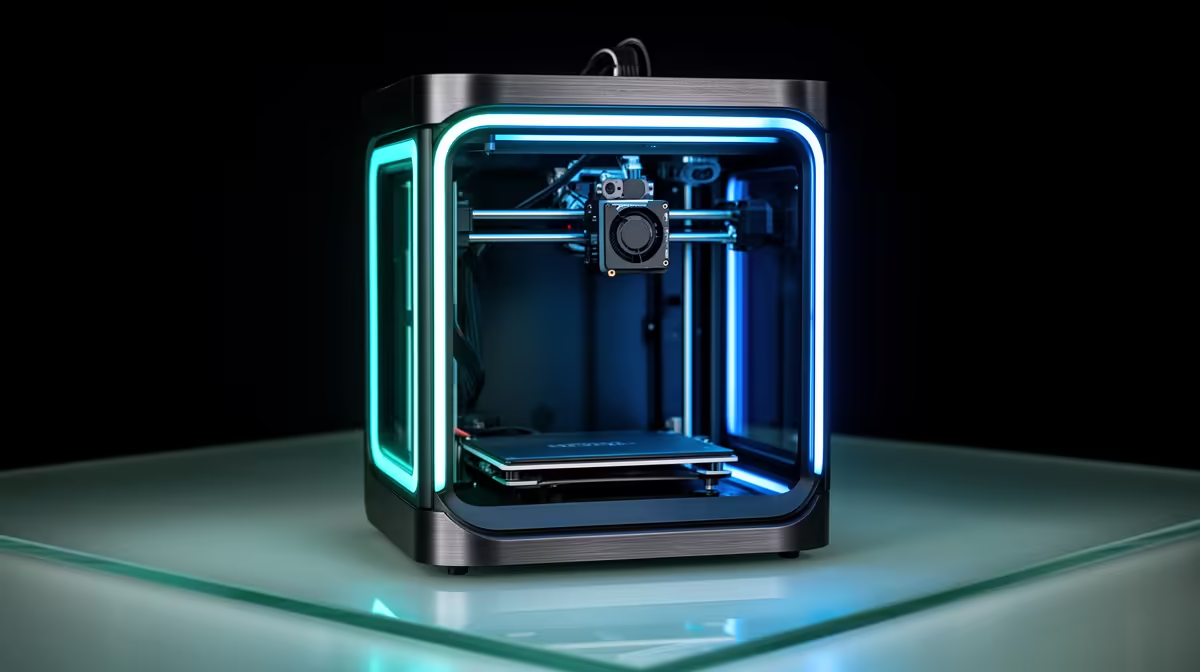
A USD sticker price on a 2026 flagship 3D printer is only the opening number. By the time a unit clears the port and lands on a shelf in Cape Town, import duty, VAT and freight have stacked roughly 35 to 50 percent on top. Knowing how that stack builds is the difference between feeling cheated by local pricing and understanding exactly what you are paying for.
Quick Answer
The 2026 global baselines are about $649 for the Bambu X2D, $1,249 for the H2S and EUR1,699 for the Prusa CORE One L. After SA import duty, the 15 percent VAT and shipping, expect local Rand pricing to run roughly 35 to 50 percent above a straight currency conversion of that sticker.
Where the Money Actually Goes
Start with the currency conversion, then add the layers. Freight from Asia or Europe is not trivial for a boxed printer with a heavy frame and a sealed chamber. On top of that sits any applicable import duty, and then 15 percent VAT is calculated on the landed value, duty included. Each layer compounds the one before it, which is why a naive Rand conversion of the USD price always looks too cheap.
There is also the grey-import question. A unit brought in informally might skip a markup, but it usually skips the local warranty, support and spare-parts pipeline too. When a hotend or board fails, a properly imported machine from local stock means you are not shipping a printer back overseas at your own cost.
What Local Stock Buys You Beyond the Box
The premium over the raw USD figure is not pure margin. It covers the freight, the tax the law requires, and the cost of holding stock locally so you are not waiting weeks on a customs queue. It also funds support: a real person to talk to, replacement nozzles and belts on a shelf, and a warranty you can actually claim in Rand. For a machine you intend to run for years, that backing is worth real money. You can see how that shakes out across the current 3D printer range at Evetech, already priced with all of it included.
Doing the Sums Before You Buy
A quick sanity check: take the USD price, convert at the day's rate, then add roughly 40 percent as a working estimate for duty, VAT and freight before you compare against a local quote. If a local price sits near that figure, it is fair. If a grey import looks dramatically cheaper, ask what happens when it breaks. Budget a little extra for consumables too, since the printer accessories and best sellers you will need, spare nozzles, build plates and filament, also carry the same import stack.
Frequently Asked Questions
Why is the SA price so much higher than the USD sticker?
Because the sticker is pre-tax and pre-shipping. Freight, import duty and 15 percent VAT on the landed value compound on top of the currency conversion, which typically adds 35 to 50 percent before the printer reaches a local shelf.
Is a grey import worth the saving?
Sometimes the upfront price is lower, but you usually lose the local warranty, support and spare-parts access. For a machine with heated parts that wear, that trade often costs more over its life than it saves on day one.
How much should I add to a USD price to estimate local cost?
A practical rule of thumb is to convert at the current rate and add around 40 percent for duty, VAT and shipping. It is an estimate, not an exact figure, but it stops you expecting an unrealistically low local price.
Does VAT apply to the shipping too?
VAT is charged on the landed value, which generally includes the freight and duty, so yes, it effectively applies on top of those costs. That compounding is a big reason the final number climbs.
Are the 2026 flagship prices likely to drop?
Hardware prices ease over time as newer models arrive, but the import stack stays roughly constant as a percentage. So local pricing tends to track global pricing down rather than collapsing independently.
Want a 3D printer priced honestly in Rand with duty, VAT and a local warranty already sorted? Compare the current models at Evetech and skip the customs guesswork entirely.