


PCIe 5.0 vs PCIe 4.0 for Strategy and Sim Games in SA
PCIe 5.0 and PCIe 4.0 differ most in lane support, compatibility, and upgrade value for strategy and sim games. SA buyers should match the choice to their actual hardware and games.
Read moreDisplay Cables: 250Hz panels with 0.5ms Fast-VA pixels deliver competitive smoothness when paired with a tuned overdrive setting. Use it as a buying checklist before clicking add to cart on Evetech. Setup pitfalls and Rand-budget notes are included.

For most desk setups, a 1.8m or 2m display cable is the practical choice. Shorter 0.5m to 1m cables suit compact setups where the PC sits directly beside or below the monitor, but even a few extra centimetres of desk reorganisation can leave you cable-short. A 2m passive cable handles 4K/144Hz and 8K/60Hz without signal loss at standard desktop distances.
The single biggest mistake SA buyers make is ordering a cable without measuring. Trace the actual cable path from the GPU output port on your PC tower, around or behind the desk, and up to the monitor input. A tower on the right side of a deep desk with the monitor centred can easily require 1.5m just to reach neatly. Add routing through a cable management tray or around a monitor arm, and 2m becomes tight. Under-desk cable runs or setups where the tower sits on the floor often need 2m to 3m. At 2m, certified DP 2.1 and HDMI 2.1 cables transmit full 8K bandwidth without active boosting. Only beyond 2m do some passive cables begin showing signal instability at peak bandwidth.
Shorter cables are tidier. A 0.5m cable between a mini-ITX build and a monitor mounted directly above it sits flush and requires almost no management. The tradeoff is zero flexibility: move the monitor, add a monitor arm, or shift the tower and the cable may not reach. A 2m cable introduces some slack that needs to be routed, but allows desk reorganisation without buying a new cable. Velcro ties and cable clips, available at most hardware stores and included with premium cables, keep slack from becoming clutter. For dual-monitor setups or ultrawide configurations, the secondary monitor often requires a longer cable run regardless of tower placement.
For digital display cables, signal quality is determined by cable construction and bandwidth certification, not length alone, up to the passive cable limit. A quality 2m DP 2.1 cable passes 8K/60Hz cleanly. A poor-quality 0.5m cable with inadequate shielding can drop signal at 4K/144Hz. The distinction that matters is certified versus uncertified. Locally stocked 2m cables from reliable brands typically run from around R300 to R650, depending on specification. Spending an extra R100 to R150 on a certified cable over a no-name equivalent eliminates the risk of chasing phantom signal issues later.
When in doubt between a 1.5m and a 2m cable, always buy 2m. Excess cable is manageable with a few velcro ties. A cable that is 20cm too short requires a replacement or an extension adapter, both of which cost more than the price difference.
Passive 3m cables can struggle at full DP 2.1 bandwidth. For runs beyond 2m at 8K, use an active DP 2.1 cable or a fibre-optic DisplayPort cable. These cost more but maintain signal integrity at longer distances.
Loose coils are fine. Tight, kink-forming coils around the connector end can stress the cable and eventually cause intermittent failures. Route excess cable in a gentle loop rather than a tight spiral.
A tower on the floor beside a standard desk typically needs 1.8m to 2.5m depending on routing. Measure from the GPU port to the monitor input along the intended cable path before ordering.
Need the right cable length for your desk layout? Evetech stocks DisplayPort and HDMI cables across multiple lengths so you can match your setup without compromise. Browse the full range at Evetech.
PCIe 5.0 and PCIe 4.0 differ most in lane support, compatibility, and upgrade value for strategy and sim games. SA buyers should match the choice to their actual hardware and games.
Read more
AM5 vs AM4 for video editing in 4K Difference explained is mostly about compatibility, budget, upgrade path, and setup fit. SA buyers should check device support and real needs before expecting a clear win from either option.
Read more
OLED vs QD-OLED for strategy and sim games buyers - what changes is mostly about compatibility, budget, upgrade path, and setup fit. SA buyers should check device support and real needs before expecting a clear win from either option.
Read more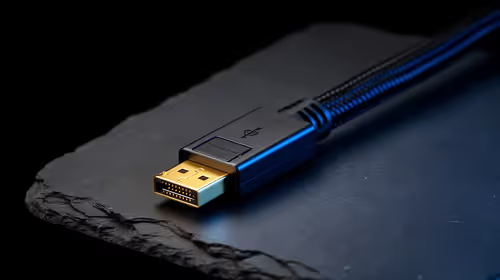
DisplayPort 2.1 and 1.4 differences matter when SA PC builders match GPUs, monitors, and refresh targets. Use this difference between displayport 2 1 and displayport 1 4 explained pc builders guide to avoid mismatched parts.
Read more
Ray tracing vs Path tracing depends on Strategy and sim games needs, platform limits, and budget fit. Compare compatibility, latency, upgrade path, and real setup constraints before choosing for an SA build.
Read more
wireless mouse guide for Gqeberha gamers should be shortlisted around the job it must do. South African buyers should compare sensor, shape, weight, and wireless latency, warranty path, and upgrade room before treating any pick as best.
Read more
From 1 October 2026, WhatsApp Business Platform service replies in South Africa are expected to cost about $0.0076, or 12 cents, per delivered message.
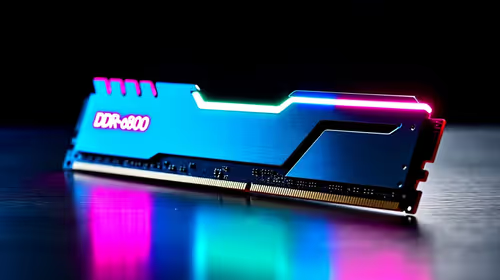
DDR5-8000 RAM Kits pros and cons depend on the build, budget, and workload. Weigh gaming needs, platform fit, power, cooling, warranty support, and South African pricing context before shortlisting it.
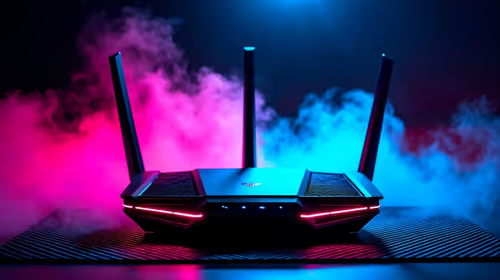
Wi-Fi 6E vs Wi-Fi 6 depends on AAA single-player gaming needs, platform limits, and budget fit. Compare compatibility, latency, upgrade path, and real setup constraints before choosing for an SA build.
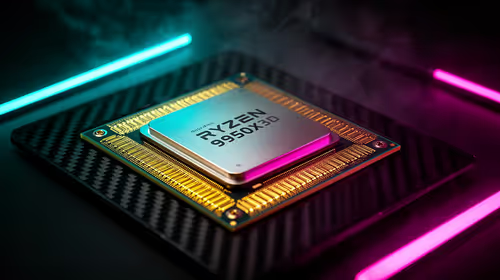
Ryzen 9 9950X3D dead pixel checks should isolate the panel first. Run colour fills, inspect the monitor menu, test another cable or input, and capture proof before linking it to the SA CPU upgrade.

YouTube will count public views from the first frame across video formats from 24 August, while earnings and eligibility remain tied to engaged viewing.
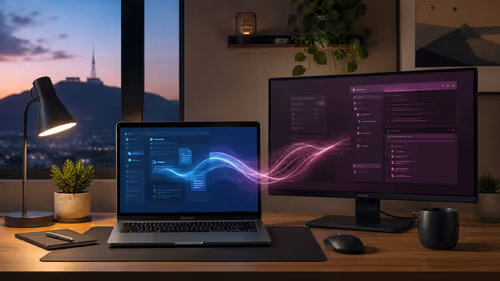
Canonical expects Ubuntu on WSL users to outnumber native Ubuntu desktop users before the end of 2026. The software is open source and runs inside supported Windows PCs.
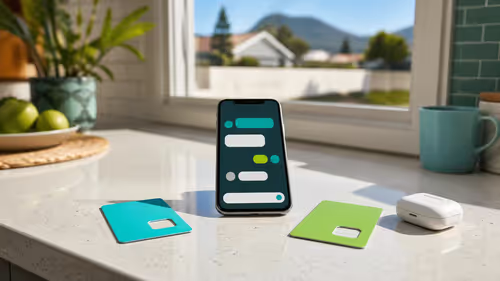
Telkom's daily bundles pair WhatsApp access with 10 all-network voice minutes. The R15 option includes 300MB, while the R17 option uses a fair-use threshold.
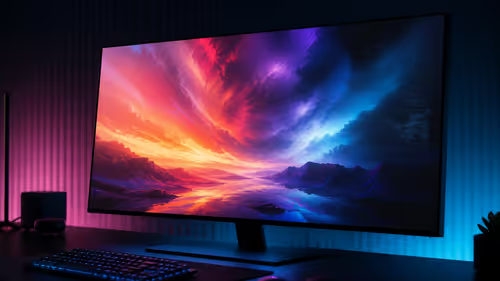
A 10,000-hour test found similar image retention across older and newer OLED TVs, while newer panels were brighter and more efficient. Local OLED monitors started at R9,999.
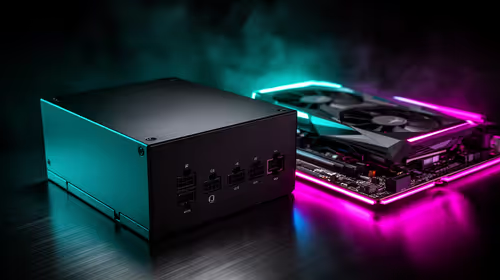
650W for RTX 5090 needs a full-build check, not a simple yes. Review GPU guidance, CPU draw, transient load, connectors, PSU quality, and upgrade plans before deciding.
PCIe 5.0 and PCIe 4.0 differ most in lane support, compatibility, and upgrade value for strategy and sim games. SA buyers should match the choice to their actual hardware and games.

How to fix FPS drops Windows 11 RX 9070 XT starts with GPU drivers, overlays, power plans, and frame pacing checks. For SA gaming PCs, verify chipset updates, HAGS, refresh rate, thermals, and per-game graphics settings.
AM5 vs AM4 for video editing in 4K Difference explained is mostly about compatibility, budget, upgrade path, and setup fit. SA buyers should check device support and real needs before expecting a clear win from either option.