Quick Answer
32GB GDDR7 provides enough VRAM headroom for 4K gaming with maximum texture settings, large 3D scene rendering, and local AI inference simultaneously, while 12GB to 16GB GPUs handle 1080p and 1440p gaming well but show limitations in texture-heavy 4K titles, high-resolution video editing, and AI workloads that cannot fit entirely in VRAM without performance penalties.
What VRAM Actually Does in a GPU 🔧
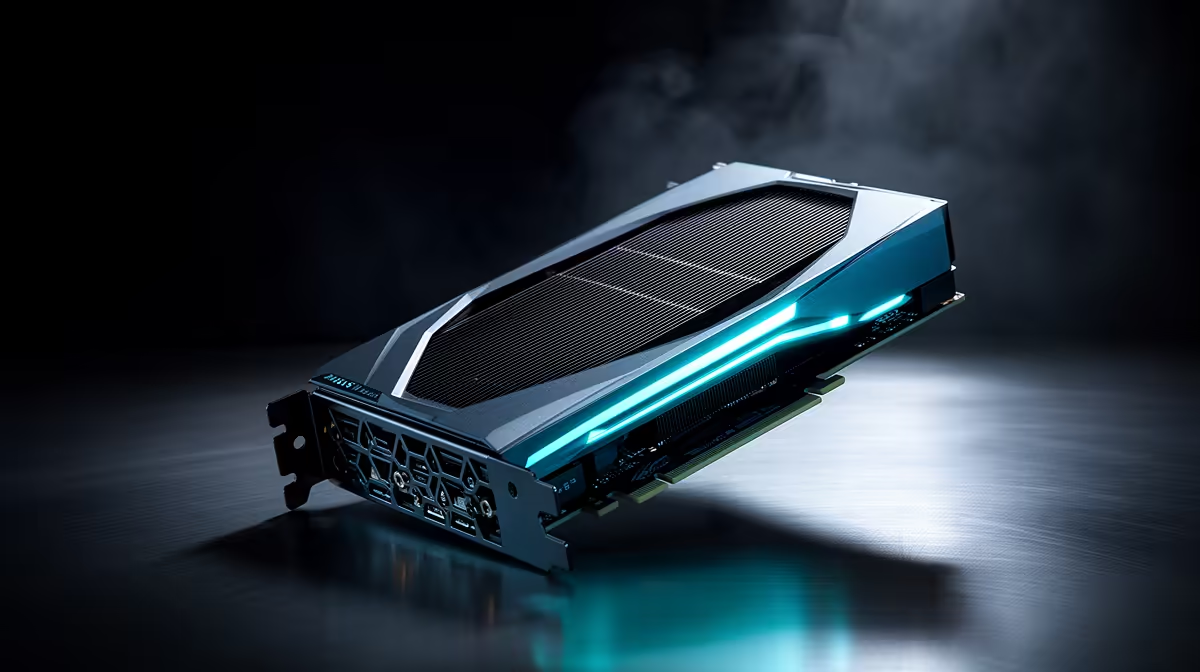
VRAM is the GPU's dedicated fast memory, separate from system RAM. Textures, frame buffers, and AI model weights are stored in VRAM so the GPU can access them at full bandwidth without crossing the PCIe bus. GDDR7 offers significantly higher bandwidth than GDDR6X: the RTX 5090's GDDR7 delivers around 1,792 GB/s compared to roughly 960 GB/s on an RTX 4090 with GDDR6X. When a workload exceeds available VRAM, the GPU spills data into system RAM, reducing effective bandwidth by 90 percent or more and causing stuttering or crash-to-desktop in memory-sensitive applications.
Performance Differences at Each VRAM Tier 🎮
At 12GB VRAM (RTX 5060 Ti tier, around R12,000 to R16,000 locally), 1440p gaming runs well but some 4K ultra-settings texture packs breach this limit. At 16GB VRAM (RTX 5070 and RX 9070 tier, around R15,000 to R20,000), 4K gaming at high-to-ultra settings is comfortable for almost all current titles. At 24GB VRAM (RTX 5080 territory, around R25,000 to R35,000), 4K with ray tracing and simultaneous AI inference become feasible. At 32GB GDDR7, the RTX 5090 at approximately R55,000 to R70,000 removes VRAM as a constraint for virtually all 2026 workloads.
When Lower VRAM Is the Smart Choice 💰
For 1080p competitive gaming in titles like CS2, Valorant, or Apex Legends, 8GB to 12GB VRAM is entirely sufficient and overspending on VRAM provides zero gaming benefit. The GPU compute performance and cache architecture matter far more than raw VRAM for competitive titles at lower resolutions. For a South African student building a first gaming PC with a budget around R18,000 to R25,000 total, allocating R10,000 to R14,000 toward a 12GB to 16GB GPU and the rest toward a quality monitor and peripherals produces a better overall experience than stretching to a 32GB card and accepting a bare-bones peripheral setup.
Monitor VRAM Usage In-Game to Right-Size Your GPU ⚡
Before your next GPU upgrade, install MSI Afterburner or HWiNFO64 and monitor peak VRAM usage in your most-played titles. If you are consistently using 90 percent or more of available VRAM, you are VRAM-constrained and an upgrade to the next tier will be noticeable. If usage stays below 70 percent, moving to a higher VRAM tier is not the priority.
FAQ
Does faster GDDR7 bandwidth matter for gaming more than higher VRAM capacity?
Both matter, but they address different bottlenecks. Bandwidth affects how fast the GPU can read and write data it already has in VRAM. Capacity determines how much data fits without paging to slower system RAM. For gaming, capacity constraints manifest as stuttering; bandwidth constraints manifest as lower sustained fps.
Will 32GB GDDR7 GPUs be necessary for gaming within the next three years?
For gaming at 4K ultra settings in future titles that adopt advanced global illumination and AI-generated assets, 24GB to 32GB will become increasingly relevant from 2027 onward. For 1440p gaming, 16GB will remain adequate for several more years.
Is GDDR7 meaningfully better than GDDR6X for content creation in South Africa?
For video editors and 3D artists working with 8K footage or complex scenes, the bandwidth jump from GDDR6X to GDDR7 reduces render times and allows real-time playback of more complex timelines. For 4K editing workflows, the difference is noticeable but not dramatic.
Trying to decide which GPU VRAM tier suits your build?
Evetech stocks the full range of graphics cards from 8GB to 32GB GDDR7, with local warranty and expert advice. Browse the GPU category at Evetech to compare options at your budget.