Quick Answer
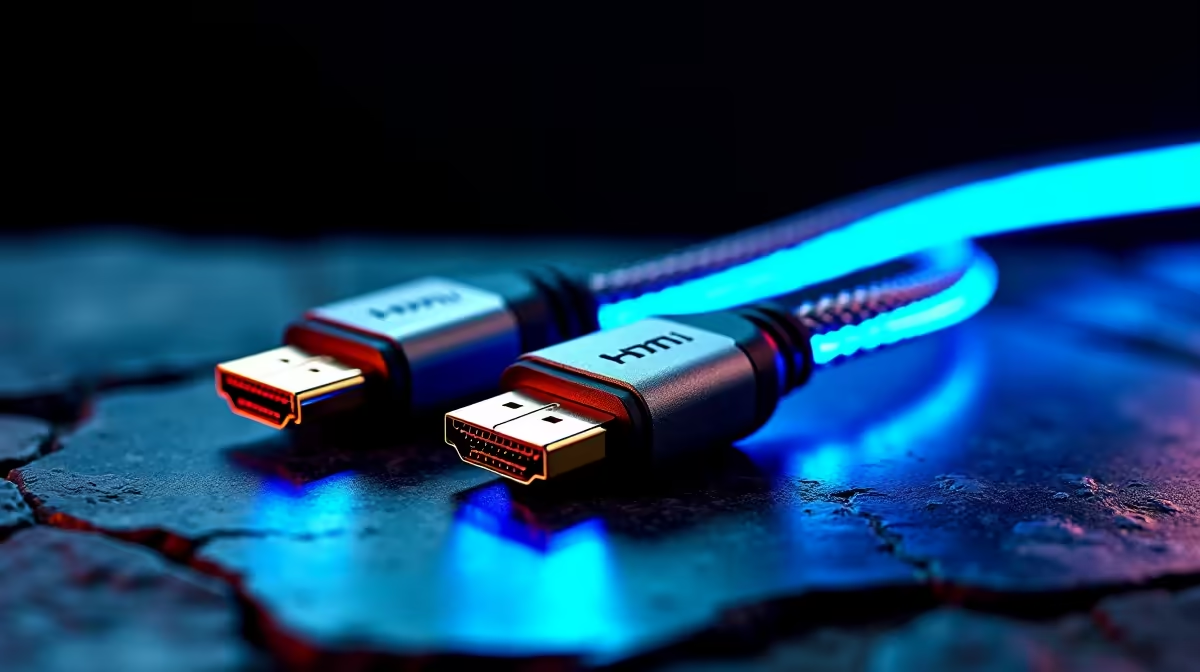
For 1080p HDMI setups, a standard High Speed HDMI cable (10.2 Gbps, HDMI 1.4) is all you need. For 4K/60Hz, you must have Premium High Speed HDMI (18 Gbps, HDMI 2.0). The cable spec is the single feature that determines which resolution and refresh rate combination is possible.
What Changes When You Move From 1080p to 4K/60Hz 🖥️
A 1080p/60Hz signal uses around 3 Gbps of the HDMI bandwidth budget. Even 1080p/144Hz fits within HDMI 1.4's 10.2 Gbps limit. Moving to 4K/60Hz requires 12.54 Gbps for 8-bit SDR video, which exceeds HDMI 1.4's capacity and requires HDMI 2.0's 18 Gbps. Add HDR10 (10-bit colour) to 4K/60Hz and the demand rises to 17.82 Gbps, right at the edge of HDMI 2.0's capacity. This is why 4K/60Hz HDR requires a fully compliant 18 Gbps cable: there is almost no headroom for a cable with marginal construction. South African buyers upgrading from a 1080p monitor or TV to a 4K/60Hz display need to swap the cable at the same time, not just the display.
Features That Matter for 4K HDR South African Setups 🎨
Beyond raw bandwidth, three HDMI features are relevant for SA buyers upgrading to 4K: HDCP 2.2 (required for 4K DRM-protected streaming on Netflix and similar services), eARC support (for lossless audio to a soundbar), and 18 Gbps certification (to guarantee HDR10 alongside 4K/60Hz). HDCP 2.2 is a handshake between source and display, not a cable feature per se, but the cable must carry the 18 Gbps that allows it. eARC uses the ARC conductor in the cable and requires a Premium High Speed cable to carry lossless Dolby Atmos.
Features That Do Not Change Between 1080p and 4K Setups 💡
Several HDMI features are present regardless of resolution: CEC (Consumer Electronics Control, for remote passthrough between devices), ARC for standard compressed audio, and basic Ethernet Channel wiring. For a 1080p gaming setup in South Africa, a R120 to R180 standard High Speed HDMI cable handles everything perfectly. The only scenario where a 1080p setup justifies spending on Premium High Speed HDMI is if you use eARC for Dolby Atmos to a soundbar, since eARC's lossless audio channel benefits from the full 18 Gbps headroom.
Don't Swap Cables When Debugging a New 4K Setup ⚡
If your new 4K display is stuck at 30Hz, first enable Enhanced or HDMI 2.0 mode in the display's input settings before replacing the cable. Many South African buyers replace a perfectly good HDMI cable before discovering the display's port was still set to Standard HDMI mode. Enable the enhanced input setting first, then swap cables only if the problem persists.
FAQ
Can a 1080p setup benefit from an HDMI 2.1 cable?
Not at all for video. HDMI 2.1 provides no visible improvement over HDMI 1.4 for 1080p content. The only benefit is future-proofing if you plan a 4K upgrade: the cable will not need replacing. For 1080p-only use, it is an unnecessary cost.
Does the HDMI cable affect response time or input lag at any resolution?
No. Input lag and response time are determined by the display panel and display processing, not the cable. An HDMI 1.4 and an HDMI 2.0 cable both deliver the signal to the panel in the same timeframe for equivalent resolutions.
What HDMI cable length is practical for a South African lounge 1080p TV setup?
For a console or streaming device on a TV stand directly below a 55 to 65 inch TV, a 1 to 1.5 metre HDMI 1.4 cable at R80 to R150 is the practical choice. This covers virtually every lounge configuration in a South African home without excess cable slack.
Upgrading from a 1080p to a 4K display and need the right cable?
Evetech stocks Premium Certified HDMI 2.0 cables in multiple lengths. Pick the length that matches your setup and unlock full 4K/60Hz HDR performance from day one.