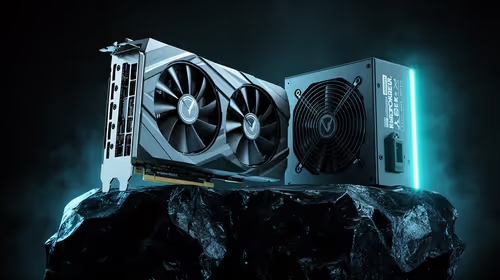
The highest efficiency badge can save a little energy and still be the wrong PSU platform for your PC. Platinum or Titanium PSU value should include load, build quality, acoustics, protections and warranty.
Quick Answer
Platinum or Titanium efficiency can make sense when the exact PSU also delivers the capacity, noise, cables, build quality, and support you want at a sensible current price. Do not expect the badge alone to repay a large premium in a typical gaming PC. Calculate from measured wall power, daily hours, and your electricity rate.
Compare model-level choices in the Corsair power-supply range, then check capacities people are choosing among PSU best sellers. Gold, Platinum, and Titanium describe tested efficiency levels under defined certification conditions; they do not rank every other part of PSU quality.
What the efficiency badge measures
A power supply converts AC electricity from the wall into the DC rails used by the PC. Some input energy becomes heat. Efficiency is the ratio of DC output delivered to AC input drawn at that operating point.
If a system needs 400 watts of DC power, an 80 percent efficient PSU would draw 500 watts from the wall in the simplified calculation. A 90 percent efficient unit would draw about 444 watts. Real systems move through many loads rather than sitting on one number.
80 Plus tiers set minimum efficiencies at specified load points, input conditions, and programme versions. Read the exact model's certification record rather than assuming a family badge applies to every wattage or regional revision.
The badge does not directly certify voltage regulation, transient response, ripple, protection implementation, acoustic quality, component life, cable design, or warranty service. Those need model-level evidence.
Calculate the saving with your PC
Measure or estimate wall power for idle, light use, and gaming. Record hours per day at each state. Find the model-level efficiency at those loads when reputable test data exists.
For each state, estimate the input difference between two PSUs, multiply by hours, then by days. Convert watt-hours to kilowatt-hours and multiply by the current electricity rate that applies to you. Tariffs and usage tiers can change, so use your own bill or authority information.
Do not compare certification minima as though the two exact PSUs sit on those minima throughout use. Their efficiency curves may differ. A strong Gold model can be close to a Platinum model at one load and further away at another.
Include the price difference from named July 2026 models. Divide that premium by the estimated annual saving for a rough payback period. Treat the result as an estimate because gaming hours, component upgrades, and rates can change.
Size matters before the tier
A high-efficiency PSU operated far outside the load range you expected can produce a different result from the calculation. Choose capacity from the exact CPU, graphics card, other components, transient behaviour, and a defined upgrade.
Read the graphics-card power guidance and required connectors. Check CPU power, drives, pumps, fans, and expansion cards. Leave useful headroom without buying a huge unused capacity merely to secure a higher badge.
A modest well-sized Gold unit can be better value than an oversized Platinum model. The reverse can be true when a compact high-load workstation runs for long hours and the premium is small. The workload decides.
Check physical length, fan orientation, and cable space. Higher-tier electronics do not help if the unit blocks a case radiator or forces unsafe cable bends.
Heat and noise may be the stronger benefit
Less conversion loss means less heat inside the PSU at the same output. That can allow a fan to spin more slowly when the thermal design and fan curve support it. It does not make every Platinum unit quieter than every Gold unit.
Compare reputable noise measurements across the load range you use. Fan quality, bearing, grille, temperature, semi-passive control, and case airflow all affect sound.
A zero-rpm mode can keep the fan off at lower loads. Heat still needs a safe path, and the fan may cycle near its threshold. Choose the mode and orientation according to the manual.
In a warm room or compact case, efficient operation can reduce waste heat. Cooling quality, intake clearance, and dust maintenance remain essential.
Build quality and protections lead
Use detailed reviews that examine regulation, ripple, transient behaviour, hold-up, protection response, temperatures, and components for the exact PSU. A certification database entry does not replace those tests.
Check over-voltage, over-current, over-power, over-temperature, short-circuit, and under-voltage safeguards where specified. Names alone do not prove the quality of implementation.
Read the written warranty terms and cable support. Keep proof of purchase. Never open a PSU; dangerous energy can remain after disconnection.
Use only modular cables approved for the exact model. The PSU-side pinout is not standard even when connectors fit. Efficiency tier has no bearing on cable interchangeability.
When the premium makes sense
Consider Platinum or Titanium when the exact unit wins on quality and noise, the system runs sustained loads for many hours, electricity use matters, or the price gap is small. A workstation, server-style home lab, or always-on machine can accumulate more saving than a gaming PC used for short sessions.
For a typical home gaming build, put the same comparison against a sound Gold model. The saving may be too small to recover a large premium, while more storage, a better monitor, or a stronger GPU can have clearer value.
Do not downgrade quality to reach Gold and do not upgrade on the badge alone. Choose the complete model that fits the power, case, cable, acoustic, and support requirements.
Keep the invoice, model code, and original approved cable set together. Recheck the estimate when the graphics card or daily workload changes, because the old payback calculation will no longer describe the same PC.
FAQ
Does Platinum use less electricity than Gold?
At corresponding certified test points, higher tiers meet higher minimum efficiency. The real difference between two exact models depends on load, input conditions, and their measured curves.
Will a Titanium PSU pay for itself?
Calculate the named July 2026 price premium against measured wall-power difference, daily use, and your current tariff. Many home gaming PCs may not run enough hours for a large premium to repay quickly.
Is an 80 Plus badge a quality guarantee?
No. It addresses efficiency under defined conditions. Regulation, ripple, transient response, protection implementation, noise, parts, cables, and support need separate model-level evidence.
Compare two named PSUs at your measured loads and current electricity rate, then pay for the higher tier only when the complete model earns it.