Quick Answer
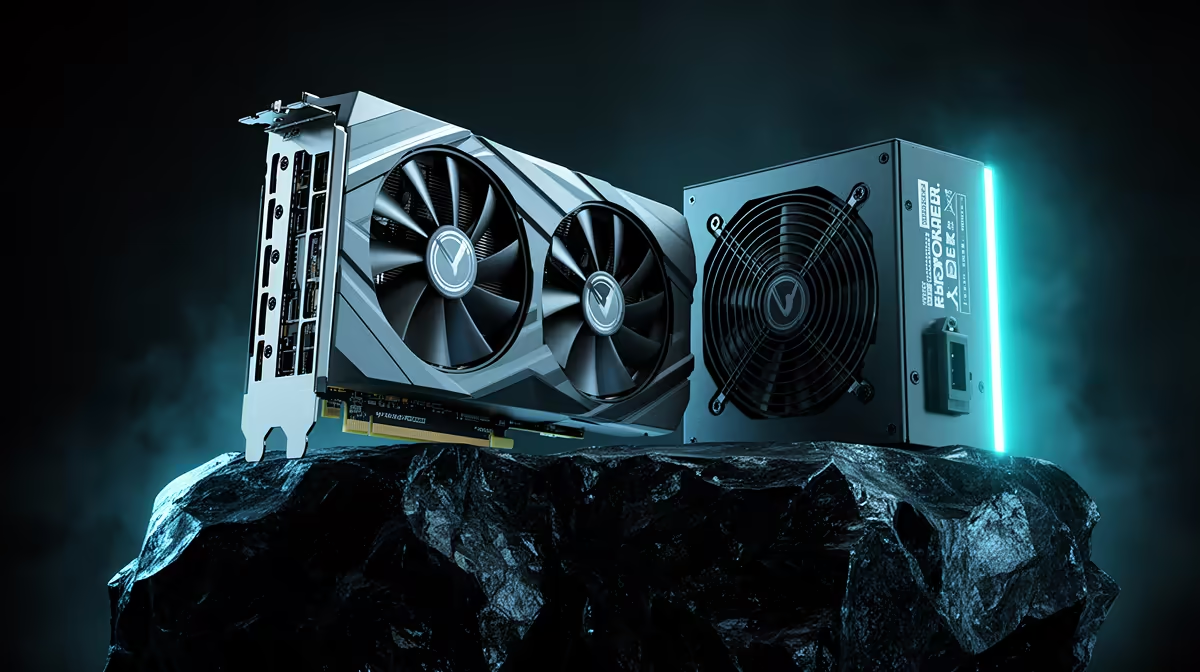
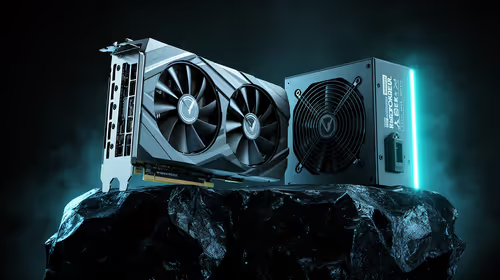
Only with limits - a 850W PSU is usable only for a controlled build, not a tuning-first build. Keep CPU choice sensible, avoid heavy overclocking, and treat 1000W or 1200W as the cleaner target for quiet headroom. Treat the GPU as roughly a 575W-class part for planning, then add the CPU, fans, drives and USB gear before judging the final margin.
Power Math Before The Purchase
Do the simple load check first. Pairing an RTX 5090 with a Ryzen 7 9800X3D can keep gaming draw far lower than a Core i9 class render box, but both still share the same PSU ceiling. Add 80W to 180W for the CPU, 30W to 60W for the board, memory and storage, and extra room for pump, RGB and fan controllers.
For South African shoppers, a cautious category guide is R2,300-R4,800 for quality 850W Gold or ATX 3.x units. Use the band to separate entry units from proper gaming PSUs.
Cable And Connector Checks
The connector path matters as much as the wattage. For this class of GPU, check for flagship transient spikes and a 16-pin/12V-2x6 cable path, avoid tight bends at the graphics card, and use the PSU maker's own modular cables. Do not mix cables from another unit, even if the plug shape looks similar.
Named units to compare include Corsair RM850x Shift, MSI MPG A850G PCIe 5 or ASUS TUF Gaming 850W Gold. A modern ATX 3.x unit is better than an old high-wattage unit with awkward adapters.
Headroom For Gaming And Tuning
A stable 4K gaming target is usually 60-120 fps depending on the game, settings and display, but PSU headroom does not create frames on its own. It prevents shutdowns, heat and harsh fan noise when the GPU boosts. For manual overclocking, heavy rendering or many drives, move one PSU tier up before assembly.
FAQ
Is 850W enough for an RTX 5090 gaming PC?
It is enough only when the full system load fits the margin. For this GPU class, the PSU quality, cable support and CPU pairing matter more than the number printed on the box.
Should I buy more wattage for overclocking?
Yes, if tuning is part of the plan. Extra capacity helps with transient spikes, fan noise and long render sessions, while undervolting is usually the smarter first step for quieter gaming.
What should SA buyers check before ordering?
Check the exact PSU model, warranty, ATX 3.x support, connector layout and case clearance. Then compare the total basket cost against the GPU budget so the power supply is not treated as an afterthought.
Build check
Before installing the GPU, route the native cable and confirm there is no sharp bend at the connector.