Quick Answer
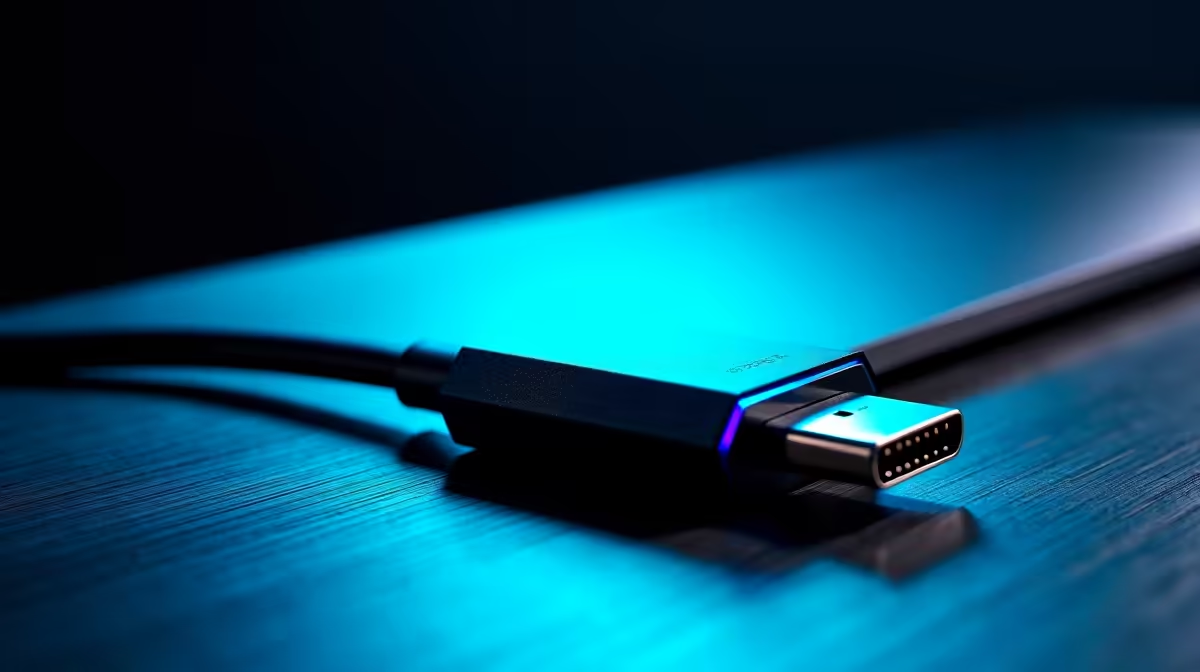
DisplayPort adapters that advertise bi-directional support can carry the signal in either direction: from a DisplayPort source to an HDMI display, or from an HDMI or USB-C source to a DisplayPort monitor. This capability requires an active chipset inside the adapter and does not come from passive cables.
What Bi-Directional Actually Means in Practice 🔧
A passive DisplayPort to HDMI cable is one-way: it takes DisplayPort output from a GPU and converts it to an HDMI-compatible signal for the monitor. True bi-directional adapters contain an active integrated circuit that can operate in two modes, determined by software negotiation or a physical switch. In mode one, a DisplayPort source drives an HDMI display. In mode two, an HDMI or USB-C Alt Mode source drives a DisplayPort monitor. This matters for SA content creators who switch between a Mac laptop and a Windows desktop at the same monitor without changing cables. A bi-directional adapter at the monitor end handles both sources.
How Active Chipsets Enable Direction Switching 📡
Passive adapters work only because DisplayPort pins align mechanically with HDMI signal pairs in one specific electrical configuration. Active chipsets translate between the two protocols electronically, allowing the adapter to detect the source signal type and switch its internal routing accordingly. The chipset introduces a small processing delay, under one millisecond, which is imperceptible in normal use. At 4K at 60Hz, an active adapter using HBR2 (21.6Gbps) performs identically to a direct cable connection on any properly engineered product. Budget adapters with low-quality chipsets can introduce colour banding at 4K.
Picking the Right Adapter for Your Setup 💰
Single-direction active adapters cost roughly R150 to R350 locally and cover the most common use case of DisplayPort GPU to HDMI monitor. Genuine bi-directional active adapters with automatic source detection are less common and typically cost R400 to R800. When evaluating one, confirm it specifies the HDMI version and DisplayPort version relevant to your equipment: for 4K at 60Hz you need HDMI 2.0 on the HDMI side and DisplayPort 1.2 or higher on the DP side. For SA buyers, locally stocked adapters from Evetech avoid the import wait and exchange-rate risk of ordering internationally.
Match Adapter HDMI Version to Monitor ⚡
An adapter labelled HDMI 1.4 will limit you to 4K at 30Hz even if your monitor and GPU both support 4K at 60Hz. Always confirm the adapter's HDMI version matches your target resolution and refresh rate before purchasing. This is the most common cause of unexpected resolution caps when using active adapters.
FAQ
Will a bi-directional adapter work automatically or do I need to configure it?
Most modern bi-directional active adapters detect the source signal automatically and switch direction without user input. Some older models require a physical switch. Check the product description before buying if automatic switching matters for your workflow.
Can a bi-directional adapter pass audio as well as video?
Yes. When used in the HDMI direction, active adapters carry the HDMI audio signal alongside video. In the DisplayPort-only direction, audio over DisplayPort using the AUX channel is also supported on quality adapters.
Is there a resolution difference between the two directions?
The limiting factor is the weaker of the two interface versions. If the HDMI side is only 1.4, you get 4K at 30Hz in the HDMI direction regardless of the DisplayPort side's capability.
Looking for a reliable DisplayPort adapter for your monitor setup?
Evetech stocks a range of active DisplayPort and HDMI adapters to suit single-monitor and multi-source workstation configurations.