Quick Answer
420mm graphics card clearance accommodates every current-generation RTX 50-series and RX 9000-series AIB variant. Real-world compatibility extends beyond length: GPU slot count, PSU shroud height, and riser cable orientation all affect whether a card actually fits in a 420mm-rated case.
What 420mm Clearance Covers in the Current GPU Market 🖥️
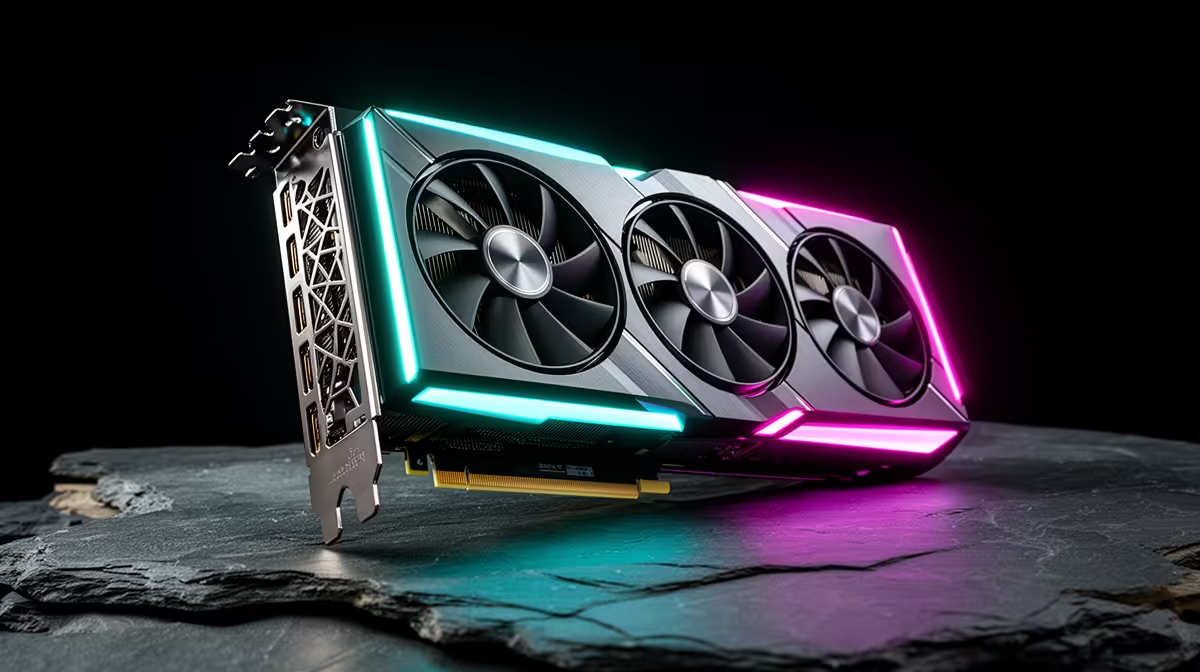
The RTX 5090 in its longest AIB form reaches approximately 400 to 410mm from bracket to cooler shroud tip. RTX 5080 AIB variants from most manufacturers top out at 360 to 380mm. RX 9070 XT AIB lengths cluster between 310 and 340mm. A case with 420mm clearance accommodates every card currently stocked at Evetech without requiring drive cage removal, provided no front radiator is installed in the same chassis.
The critical qualifier is no radiator. With a 360mm front radiator present, effective GPU clearance drops by 90 to 120mm depending on fan thickness. Spec sheets that provide both figures (with and without radiator) give the complete picture; those listing only the maximum require a manual front-depth measurement.
Slot Count and PSU Shroud Compatibility 🔩
Beyond length, a 420mm GPU from a high-end AIB manufacturer typically uses a 3.5-slot cooler design. The card occupies slots 1 and 2 from the top, and partially occupies a third slot. This means a neighbouring PCIe device like a capture card cannot be installed directly adjacent to the GPU.
PSU shroud height matters for the GPU cooler's downward-facing fans. If the shroud sits within 10mm of the GPU fans, airflow is restricted and temperatures rise. Cases with full-depth PSU shrouds extending the motherboard's full length tend to create better GPU underside clearance than partial shrouds stopping halfway.
Case Form Factors That Achieve 420mm Clearance 📐
Full-tower cases are the natural home for 420mm GPU clearance, but several well-designed mid-towers achieve this spec through removable drive cage architectures. Removing the 3.5-inch HDD cage opens the front-to-PCIe-slot run to 420mm or beyond. For builders running purely on M.2 NVMe storage (most modern high-end builds), this is a clean trade-off.
E-ATX mid-towers and standard full towers priced R2,800 to R5,000 in South Africa are where 420mm clearance becomes standard. Below R2,000, clearance specs of 380mm or less are typical. SA builders targeting an RTX 5090 should treat 420mm clearance as a minimum specification, not a premium feature.
GPU Clearance Self-Measurement Tip ⚡
To verify existing case clearance, measure from the inside face of the PCIe slot bracket to the nearest front obstacle with the HDD cage removed. Use a tape measure from directly inside the case; external measurements do not account for internal frame protrusions that reduce usable GPU length.
FAQ
Does 420mm clearance mean any GPU under 420mm will fit?
For length, yes. But also check slot count and height. A 380mm card with a 3.5-slot cooler may not fit without clearance to the PSU shroud depending on the case's internal proportions.
Can I install a 420mm GPU vertically in a case with 420mm clearance?
Not always at full length. Vertical mounting via a PCIe riser bracket reduces effective card length by 10 to 20mm due to bracket geometry. Confirm the vertical GPU clearance spec separately from the horizontal figure.
Are there mid-towers with 420mm GPU clearance under R2,500 in SA?
Some mid-towers reach 420mm after drive cage removal in this price range. The cage-removed clearance figure is the relevant number for high-end builds, and several accessible mid-towers achieve it when the cage is not needed for HDD storage.
Matching a flagship GPU to the right case?
Evetech stocks a range of ATX and full-tower gaming cases with 400mm to 420mm or greater GPU clearance for today's longest graphics cards.